
Sir George to Fort William
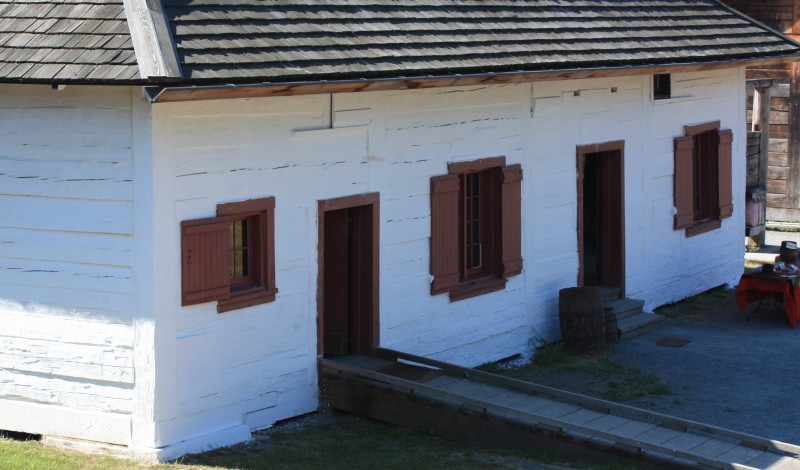
Fur trade warehouse at Fort Langley, the same as found in any fur trade fort
So, in this post Sir George Simpson, Governor of the HBC, tumbles down the French River, and will get as far as Fort William, on Lake Superior. The year is 1841, and he is travelling from Lachine to Rupert’s Land by the old North West Company’s river route. “We had now got fairly into the region of the fur traders,” Simpson wrote, “beyond the ken alike of the farmer and the lumberer; and we here discovered the traces of beaver in the shape of pieces of willow which had been barked by this extraordinary animal.” And where were they when Simpson wrote that? They were on the height of land between the Ottawa River and the French, on their way to Lake Nipissing and beyond. In my last post, found here, I brought you from Chats Falls, on the Ottawa, to Lake Nipissing and the stream that would lead them to the French River. https://nancymargueriteanderson.com/simpsons-travels/
So, the French River. “Making way next morning, we breakfasted on the portage between Lake Nipissing and its outlet, French River. On this stream we saw a few savages who, though poorly clad, appeared to be faring well. Here we ran our first rapids; and in the afternoon we made a portage at the Recollet Falls, which throwing itself from a slanting ledge of rocks, almost in the direction of the river’s breadth, leaves hardly room enough for a canoe to pass between the vortex at its foot and the perpendicular wall of the opposite bank. As we had the current in our favor, and were but little impeded by portages, we made our best march today to the tune of ninety-five miles. Encamping for the night within a short distance of Lake Huron, we heard for the first time our little friend the Whip-poor-will a sure harbinger of warm weather; and a pair of these favorites of the voyageurs serenaded us all night with their cheerful cry which so closely resembles the name that one is often inclined to suspect some persons of imitating it.”
So Simpson has made a short hop on his way from the French River to Fort William. And on this hop, we see Simpson’s use of the word, “voyageur,” although according to many historians that term is well out of general use. Simpson, however, still used the word, and he used it often. He loved the French Canadian culture and over the years many of his paddlers were Canadiens. He travelled in Canadien canoes. He celebrated the Canadien culture. And so he used the words that described the Canadiens in the early days, when they paddled their beautiful birchbark canoes up and down their rivers. He romanticized the Canadiens: that is, perhaps, the best way to put it, although it is hard to think of Simpson as being a romantic. But this he romanticized.
His journey continues:
Next morning we descended to Lake Huron through some remarkable rapids, which in form and breadth bear a close resemblance to canals cut in the solid rock. In one of these we were nearly snagged after a fashion known on the Mississippi. While running down in gallant style, we perceived by the dim twilight a tree bridging the narrow current so as to form a complete barrier. The paddles were immediately backed; and a few blows from an axe quickly cleared our passage. Before sunrise we entered Lake Huron, having now before us, with the single exception of Sault St. Marie [Sault Ste. Marie], seven or eight hundred miles of still water to the head of Lake Superior.
We dined on an island celebrated for a stone, which when struck, emits a musical or metallic sound; and about eight in the evening we reached the company’s establishment, taking the name of La Cloche from the natural bell just mentioned.
In his book, Listening to the Fur Trade, Daniel Robert Laxer writes about La Cloche:
After passing through this Narrows [Point Grondine or Grumbling Point], canoes travelled northwest toward Little La Cloche Island. Here there was another important narrows that yielded a degree of shelter from the winds and waves. This was the location of an important soundmark. Alexander Henry (the elder) in his account from 1 September 1761, confirmed “having reached an island, called La Cloche.” He explained the place name, describing how it is “because there is here a rock, standing on a plain, which, being struck, rings like a bell.”
So this was an interesting and important landmark, and every one of our ancestors who travelled this route (and that’s almost all of them) would have tested the sound of that rock. Simpson’s journal continues:
The northern shore of Lake Huron consists of rocky hills, dotted with stunted trees, chiefly pines; and the adjacent waters are closely studded with islands varying from ten feet in diameter to many miles in length. Though the whole this neighborhood may be deemed an almost hopeless desert, yet the southern side of the lake is more fertile as are also the Manitoulin Islands. These more promising districts are pretty well peopled either by Europeans or by Indians.Next day, being the sixteenth of the month [June 1841], and the thirteenth from Lachine, we reached the Sault St. Marie about five in the afternoon. This celebrated strait empties Lake Superior into Lake Huron, having a British settlement with a post of The Hudson’s Bay Company on the one side, and an American village with an inconsiderable garrison on the other. Having left our baggage to be conveyed across the portage in carts, we visited our establishment under the charge of Mr. Ballenden; and we were here mortified to learn from Mr. I. D. Cameron, one of the company’s principal officers, that the ice of Lake Superior was still as firm and solid as in the depth of winter. This was likely to be a far more serious and obstinate business than that of Lake Nipissing. We, however, pushed forward, encamping at Point aux Pins about nine miles distant, without having seen the enemy. We were accompanied by Mr. Cameron, who was bound for Michipicoton as well as ourselves, and also by Mr. Ballenden, who was to pass the night with us for the transacting of business; and as a curious contrast to the proximity of the ice, the night was so warm, that we accomplished our reading and writing in the open air by moonlight.
And yes, for those of you who are asking, this is John Ballenden, who came to Fort Vancouver to replace Peter Skene Ogden for a few years, but who got sick and had to leave. Simpson’s writing continues:
Next morning after proceeding six or eight miles, we found to our sorrow that Mr. Cameron’s information was too true; and on landing at Gros Cap, we discovered that, as far as the eye could reach, the lake was clad in its wintry garb. As our camp was likely to be a standing one, we arranged our housekeeping with more than ordinary care, cutting plenty of firewood and strewing our tents with a fragrant carpet of the branches of the white pine. We here saw our first tokens of returning spring in the shape of many budding flowers; and as partridges and other birds were plentiful, we contrived to pass this, our first day of detention, very pleasantly.
Next morning, as we had “nae motive” for rising any more than the poet of the Seasons had, we luxuriated in bed till the fashionable hour of seven. To make amends for the delay we had beautiful weather, the air calm, the sky cloudless, and the sun powerful; but to show how little influence all this had on the one thing needful, the thermometer which stood at 73 degrees in the shade, was not far above the freezing point in the water. In the afternoon we managed to advance a mile in order to gain an elevated point, whence we could give our hopes and fears a wider range. We had really become very impatient. The heat of the weather appeared to be good for nothing excepting to broil ourselves, for we found the ice, thus at once our bane and antidote, a highly agreeable addition to our water and wine. Our brightest prospect, in fact, was that of eating our way through the luxury.
Early next morning I received occupation enough for one day at least. A boat from our establishment brought me the journal and other papers of my late lamented relative, Mr. Thomas Simpson, whose successful exertions in arctic discovery and untimely end had excited so much interest in the public mind.
Herein lies a story that I certainly cannot address at this time: it’s an enormous story and still a mystery, as far as I know, as to exactly what happened. Sir George certainly avoided talking about it. But, Simpson’s journal continues:
By the same conveyance, we got a supply of white fish. This fish, which is peculiar to North America, is one of the most delicious of the finny tribe, having the appearance and somewhat the flavor of trout. In the afternoon a trapper, who was proceeding to the Sault St. Marie with some natives in a canoe, informed us that there was open water for a little distance to the westward. This man’s hint enabled us to gain six miles–a great deal by the by, where every little helped.
During the night a slight breeze broke the field [of ice], though the masses still continued to be closely packed. We started at three o’clock and, after a hard day’s work, accomplished about thirty miles. Our progress was much embarrassed by the mirage which assumed various forms, being at one time an island, at another open water, and then again, impenetrable icebergs.
Next morning, starting about seven, we made three or four miles in six hours; and then, as there was no suitable spot for encamping, we were obliged to return to our old quarters, having toiled eight hours in vain to the great hazard of damaging our frail barks [birch bark canoes]. Next day we did nothing, being partly deterred from moving by constant rain, and partly prevented by heavy fog from seeing the state of the ice. Here we lay with a solid lake before us within a month of midsummer, and below the latitude of London. To aggravate the evil we had no provender remaining but biscuits, which such as they were, would not hold out many days longer. Lord Mulgrave however, fortunately knocked down a hare and a partridge for our dinner, while, curiously enough, Lord Caledon, when we were similarly detained in Lake Nipissing, supplied our table with fish.
Remember that the two noblemen, George Augustus Phipps, the earl of Mulgrave, and James du Pre Aexander, the earl of Caledon, were travelling west with Sir George Simpson on their way to Red River to hunt bison. Simpson’s journal continues:
Between three and seven in the morning we advanced two miles, being obliged after this exploit, to make a halt till noon on account of the increase of the fog. After our next move we pitched our camp about eight in the evening, at the mouth of the Montreal River, not more than eighteen miles distant from our last encampment. Our march had been extremely tedious, being effected by forming a lane through the masses of broken ice. But the last few miles were much less obstructed; and we began to hope in right earnest, that the troubles of a week in Lake Superior were drawing to a close. Resuming our course at two in the morning, we found fewer difficulties than yesterday, excepting that soon after starting, we got enclosed in a field of ice which was drifting rapidly out to sea [into the centre of the lake.] This circumstance might have proved to be our worst luck of all, for a heavy gale was blowing from the shore; and before we could get clear of our dangerous neighbours, we were about three miles from the land. The weather was completely characteristic of this inland ocean, a heavy rain for about ten hours in the morning and then a thick fog for the remainder of the day. About four in the afternoon we reached Michipicoton, the good folks of the fort having been prevented by the mist from knowing anything of our approach till the familiar song of the voyageurs struck their ears.
At this place, as I could not pay my usual visit to Moose Factory in July, I was to hold a temporary council for the Southern Department; and accordingly, after taking off our wet cloaks and coats and stowing away a substantial meal, Mr. Cameron and myself proceeded to business along with Mr. George Keith, the gentleman in charge of the establishment and Mr. [John] Cowie, another of the company’s officers.
By 1841, Simpson was in charge of both the Northern and the Southern Departments, and Governor William Williams, who had the charge of the Southern Department after 1822, was sent to England and forcibly retired. This is how that happened: Simpson returned to London after his visit to Fort Vancouver in 1824-25, and discussed with the London Committee the problems he was was having with Williams, who contradicted Simpson on issues related to the schooners that sailed Hudson and James Bay, as well as on the actual boundaries between the Southern and Northern districts. Many of his chief factors were also arguing with Williams, and they wrote letters of complaint to the London Committee. So when Simpson left London in spring 1826, he carried letters from the London Committee addressed to Williams, requesting his return to London. That summer, Simpson was made the Governor of the Southern department as well as of the Northern. The Southern Department was no small Department by the way. It included all the posts on Lake Superior, Huron, and on James Bay as well as in Eastmain (northern Quebec, on the east side of Hudson Bay), and all along the Ottawa and St. Lawrence Rivers as far as the King’s posts, on the lower St. Lawrence east of Montreal. The Northern Department was larger than the Southern, as it included all of Rupert’s Land, the Athabasca and Mackenzie River districts, New Caledonia, and the Columbia district. Note the words “Department,” and “district.” Each district fitted into one or the other Department, and each district had its own headquarters where the Chief Factor resided. This chief factor was the man in charge of all the smaller posts in his district. You can see how Simpson could so easily control every post, big or small, in both the Northern and Southern Departments. Every district was represented by one person who attended the Annual Meeting of the Department his district was a part of.
The rivers that the Southern Department men travelled I found really interesting, as I had spent no time thinking about it before now. From Michipicoton, on the north shore of Lake Superior, Simpson would normally make his way [I think he portaged] north to the waters of the Missinaibi River, which flows north into the Moose River. He would visit New Brunswick House, built in 1788 on Brunswick Lake, on the Missiniaibi River’s upper waters. He then followed the Missinaibi north to Moose River and on to Moose Factory, which stood on the shores of James Bay. The Southern Department gentlemen generally held their meeting there in August, although it could be changed when needed (as in 1841.) When the meeting was done, Simpson ascended the Moose River once again, but followed another tributary, the Abitibi River, to Abitibi Lake, where Abitibi House stood. From Abitibi House he portaged [I think] to another river and followed it down to Timiskaming, on the Ottawa River. A quick paddle down the Ottawa brought him home to Lachine.
The next stop for Simpson in 1841? Fort William, at today’s Thunder Bay (more or less). Simpson and his party began their journey damp. “Feeling the house uncomfortably close after so long an exposure to the open air, we preferred sleeping in our tents; and as the rain fell heavily during the night, we found ourselves next morning in something of a puddle.” His journal continues:
Having completed my work by eleven in the forenoon, I again resumed my journey; and we kept paddling away till eight in the evening in spite of rain, fog and wind. For a great distance to the westward of Michipicoton, the northern shore of Lake Superior consists of rugged mountains of bare rocks with a few scattered trees of stunted growth…. During the next two days we made beautiful progress, calling at the Pic which is prettily situated at the mouth of a small river of the same name. Though we had not the pleasure of seeing the resident missionary, who was absent among the Indians, yet we carried off Mr. McMurray, the gentleman in charge, to our dining hall, a little rocky island in the vicinity of his fort. [Then on the next day, I think….] Having a fair wind for part of the time, we hoisted sail to the great relief of our men; and with the benefit of the full moon, we pressed forward during the second night in the hope of reaching Fort William about sunrise. By four o’clock, however, a breeze became rather too much for us, particularly as we had a long traverse ahead; and we accordingly took shelter at the Thunder Mountain till ten in the morning. The Thunder Mountain is one of the most appalling objects of the kind that I have ever seen, being a bleak rock of about twelve hundred feet above the level of the lake, with a perpendicular face of its full height towards the west; and the Indians have a superstition, which one can hardly repeat without becoming giddy, that any person who may scale the eminence and turn thrice round on the brink of its fearful wall, will live forever. About two in the afternoon we gladly stepped ashore at Fort William, situated near the mouth of the Kaministaquoia [Kaministiquia] River….
Is Thunder Mountain now what local Thunder Bay residents called “the Sleeping Giant?” It probably is.
At Fort William we exchanged our two canoes for three smaller vessels of the same description, inasmuch as he waters would henceforward be shallower and the navigation more intricate.
So they had travelled west from Lachine in the larger canoes called Montreal Canoes, or canots du maitre, for smaller and shallower canoes called North canoes, or canots du nord. Simpson’s story continues: “During the interval occupied in arranging this important matter with a new distribution of crews and baggage, I had an interview with a band of Saulteaux or Chiippeways, who had been waiting my arrival near the fort….” The long interview completed, the HBC men began their new journey north toward Red River. “As the navigation for the first fifty miles was greatly obstructed by rapids and shallows, we were to be accompanied to that distance by a fourth canoe, as a tender; and at six o’clock, after a stay of four hours, our little squadron, in full song, darted merrily up the beautiful river, whose verdant banks formed a striing and agreeable contrast with the sterile and rugged coast of Lake Superior.” And so his journey to Red River begins.
To return to the beginning of this series, go here: https://nancymargueriteanderson.com/sir-georges-travels/
When it continues, the next post will appear here: https://nancymargueriteanderson.com/sir-george-to-red-river/
Copyright, Nancy Marguerite Anderson, 2026. All rights reserved.
I grew up in Georgian Bay and know the French River well. Simpsons descriptions of both are apt.
And earlier post mentioned Petite Falls on the Fraser River below Alexandria. Where above Soda Creek is that exactly and where is that quoted please?
Yes, I think the French River is one of the most beloved historical rivers in Canada–I often hear from people who know the river well. I haven’t found Petite Falls in a quick search, and I have a few posts that cover that part of the Fraser (and some of them were written quite some time ago.) When I find it, I can maybe figure it out. Oh it might have been the Gov Simpson post… I’ll take a look. Not that I will then know what its real name is…