
Fort Simpson Winter
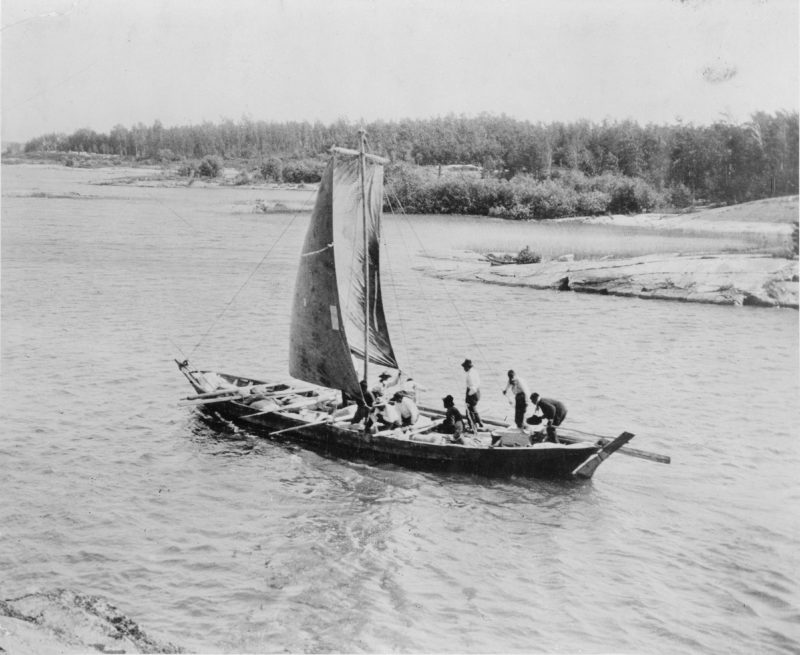
York Boat Sailing, image HBCA-N14645 used with the permission of the Hudson’s Bay Archives
The year is 1843: winter is approaching, and clerk Augustus Richard Peers has just arrived at Fort Simpson, on the Mackenzie River. Fort Simpson was the headquarters for all the posts that stood in what is today the Northwest Territories, and in the Yukon. Here’s all those posts, by the way: https://nancymargueriteanderson.com/historic-posts-in-the-west/
In the last post in this series, Augustus Peers describes Fort Simpson:
Fort Simpson, the head post of Mackenzie’s River District, is prettily situated on an island at the confluence of the Liard and Mackenzie Rivers. The Mackenzie is here a mile broad from shore to shore and as the bank on which the fort sits is very high, a commanding view is obtained of the mighty river and surrounding country.
One of the best things about Augustus Peers’s writing is that he was writing a manuscript to be published in England, and so he described the places he saw. Let us continue:
Above, at a distance of one and three quarter miles stands out a bold point of high land covered with pine trees called the Gross Cap, which forms the bank of either river. Several pretty islands are also seen at the mouth of the Liard. The view below the fort is cut off at a distance of half a mile by a bend in the river. Over the tops of the distant trees a partial and distant view is obtained of the mountains in the lower country.
The fort is situated in about latitude 62 degrees, but notwithstanding its northerly situation, several acres of rich land are under cultivation. Two extensive fields on either side of the establishment were planted with potatoes and barley, the former even at that early date were as large as hens’ eggs, but which by the end of September, when they were dug, had attained in many instances the size of a man’s fist. Behind the fort skirting the forest was a field of waving barley already in a state of ripeness and as plump and full as that grown in more favorable latitudes.
Several head of cattle lay grouped about the park and in an enclosure around the cow-house were two young moose deer, male and female, which Mr. [John Lee] Lewes had himself captured while crossing the river with their dam in the spring. They had become quite reconciled to their confinement and were so tame, that though they had once during the summer got out of their enclosure–the door being incautiously left open–they merely took a turn in the woods, cropping the tender willows, and returned at evening to their house! They were fed on the tender branches of the willow which form their food in a wild state.
Having made the tour of the domains, I was happy to find my future residence in a much more flourishing state that I could have expected. Mackenzie’s River District is very extensive. The posts attached to it are: Fort Simpson (depot); Fort Resolution; Fort de Liard; Fort Halkett; Fort Frances Lake–since abandoned; Fort Norman; Fort Good Hope; Fort Peel’s River; Fort Yukon.
No Fort Selkirk, you might ask? By the time Peers wrote this list, both Fort Selkirk and the Frances Lake Post were completely abandoned and lay in ruins. He continues his story.
These outposts receive their supply of goods from Fort Simpson, so that our time was fully occupied for the next ten days in unpacking and repacking the several outfits and dispatching boats ladened therewith to the posts far and near. The route to the western posts via the Liard River was the most tedious one from the difficulty of the navigation, and even the most hardy of the voyageurs looked upon a trip in that quarter with dread.
Notice the word “voyageurs.” I have argued that this romantic description of the men who worked in the HBC was outdated and, well, romanticized. But it is still used. I have also argued that anywhere Governor Simpson went, the word was in use. However, I find no time when Peers was introduced to Simpson, and so he would not have learned that word from him. So where did it come from? I presume it was still in use–not heavily in use, perhaps, but in use. To continue:
The whole route is a succession of formidable rapids and foaming cataracts up which the boats are dragged by line or launched over the hills, and a voyage was seldom accomplished without some serious accidents transpiring. In the fall I wrote of, one of the boats while crossing Portage le Diable slipped over a precipice and was dashed to splinters among the crags beneath. The repeated hardships of this route have since led to its abandonment, and the goods for the western posts are now sent via the winter’s route from Peel’s River across the Rocky Mountains–of which I shall hereafter speak.
The boats and people being all dispatched to their several wintering grounds, and the roughest of the business over, Mr. Lewes and I found ourselves alone with only a few men to do the requisite work of the fort.
The month of September had commenced, and the trees of the surrounding forest had assumed the livery of autumn, which but too plainly indicated the slow but sure approach of bleak and hoary-headed winter. Vast flocks of wild geese were now seen passing high in air in the form of triangles and lines in a direct southerly course, heedless of our call, and only alighting to feed in the evenings along the shore of the river and amongst the lakes. As the foot of the island on which the fort stands afforded good feeding for the wild fowl, and as I had little to do at the time, I was constantly employed at my favorite amusement–sometimes taking my blankets on my back and passing the night in some favorable spot watching through the night for a shot at the geese, etc, as they came to feed. A few wild pigeons occasionally were added to my game bag, and also a few plover.
My amusements were, however, abruptly brought to termination by a serious accident which befell my friend Mr. Lewes. While shooting grouse one day in the park, his gun accidentally went off, carrying his right hand at the wrist. He was supported to the house where my little skill in surgery was called into service, and although I had never seen a wound of the kind before I fortunately succeeded in securing the arteries with ligatures of silk, and having bound up the wound I put my patient to bed and could not help admiring his coolness as he called for his pipe. But my friend was an old H.B. man and had seen many a rough day in the opposition times of yore, and my readers may recollect in a former part of this narrative his (for it was the same) reluctance to part with his pipe even at the risk of his scalp: it was not therefore to be wondered at that he should still stick to his pipe when the loss he had sustained was only a hand.
I now laid my gun aside as my spare time was fully occupied in attending to Mr. Lewes, who daily got worse. However, by a dressing three times a day of the bark of the Larch reduced to a pulp and applied as a poultice, with the occasional use of blue vitriol, the wound in the course of the winter assumed a healthy appearance. The inner bark of the larch tree is a most valuable application for wounds of this description, as it not only heals but from its resinous properties cleanses the part. It is the only medicine used by the natives for flesh wounds.
Blue vitriol is copper sulphate, better known to some as bluestone, a preservative for fishing nets. The decoction of the bark of the western larch that Peers spoke of was made by gently simmering pieces of the plant in water for an hour or more, reducing it to pulp and extracting its medicinal properties. It was then cooled and applied to the wound. Peers’s story continues:
About the middle of October our little circle was enlivened by the arrival of Mr. [John] McLean, a chief trader in the service, and my former friend and companion Mr. Hamilton, with whom I had passed the preceding winter at York Fort and whose face I little thought of seeing so soon again. He, however, shortly afterwards departed on a snowshoes tramp to Fort de Liard, there to pass the coming winter; Mr. McLean taking up his quarters at the depot. These gentlemen had met with a narrow escape when on Great Slave Lake. They became lost in a dense fog and when the steersman, who was not acquainted with the place, steered a wrong course, and when the weather cleared they found themselves they knew not where. They put ashore to pass the night on an island and during the night the boat slipped her moorings and drifted out, so that by the time they awoke to continue their route not a boat could be seen. Fortunately, however, two of the crew happened to sleep in the boat and after some trouble rowed back to the island and retrieved their companions from, it’s fair to suppose, a lingering death by starvation.
About this time the boats from the Big Island Fishery, in Great Slave Lake, arrived with the winter supply of white fish. From ten to fourteen thousand of these fish are required for the use of the fort for a winter. This seems an almost inexhaustible supply, but it seldom proves too many to feed about a dozen people and as many working dogs for seven months. The usual ratio of fish at the depot, where they average about three pounds each, are four per day per man with potatoes. Eight pounds of fresh or three pounds of dry meat with potatoes is the ration of a man per day, and although this must be considered a fair allowance, some of the men do not find it too much. Indeed, a stranger would be astonished to see what capacious appetites some of these northmen possess–particularly those who are in the habit of voyaging in winter.
As October came to a close the weather took a decided change for the worse. Bleak north winds with frequent heavy showers of snow set in and the once glassy surface of the river became choked by masses of ice. The rivers do not become frozen over in one solid sheet of ice, like a lake. In the first place young ice is formed along the shores, which by the action of the waves is detached and floated out into the current. In this way the numerous tributary streams and bays pour out their portion of the frozen masses, which gather as they are borne down with the stream, till at some part of the river where the channel is either too narrow or too shallow to allow it to pass, it chokes and is firmly cemented together by succeeding frost. Some parts of the Mackenzie are almost impassible from the rough and jagged nature of the ice on its surface, caused at the time of first setting fast in the autumn.
Rousing fires were now kept continually alight, chinks and crevices stopped up, and the doors lined with strips of furs. The cattle were also confined in a well-arranged byre, and only allowed to go out to water at the river. The oxen, however, were used to haul home firewood and appeared to stand the severity of the cold very well, except in the most severe cold when they were covered with a rug or robe…
So Christmas Day arrived, but as Augustus Peers said, “as we had not enough people–male or female– to form a reel, that merry day in other climes was spent by us in a very quiet way.” A fort hunter came in with a report of meat left in a cache in the woods, and “two sleds of dogs were immediately dispatched to bring the prized venison home. Meat hauling is the voyageur’s delight. The Sledges used for this purpose are formed of birch in the same manner as already described for a cariole, but without the body of parchment. Along the edge of the sled are fastened loops of cord for the purpose of attaching the load, which is secured in a leather wrapper to the sled. They are generally drawn by three dogs harnessed tandem-wise and gaudily decorated with red cloth and balls. With this sort of conveyance the voyageur makes his way to the cache through the road made by the hunter in coming to the fort. From the inequalities of the snow and the numerous obstacles such as fallen trees and tangled willows which obstruct the path, voyaging through the thick woods is very laborious, particularly should the snow be deep and the road not well beaten down.” Generally the voyageur spent the night at the cache eating his supper of meat taken from the cache. “These caches, if well and properly made,” Peers said, “are formed of logs of wood in the shape of a box. the bottom is also lined with wood, and after the meat is deposited there the opening is closed by rolling heavy logs on it.” Nevertheless, the wolverine can sometimes get into these caches, and the voyageur might find that nothing is left of the meat when he arrives there.
Sometime after Christmas, the HBC men at Fort Simpson would build their own cache to keep their meat fresh over the summer months. This occurred in every post that had a cold enough winter to support a good growth of ice on its rivers. Here’s what Peers’s had to say of that winter chore.
As we had more fresh provisions on hand than we could consume before the hot weather set in, huge blocks of ice were cut out of the river and brought to the store cellar round which they were piled, one on another, forming a floor and wall three feet thick. In the midst of this, fresh meat was placed in a frozen state between alternate layers of pounded ice. Thus secured, the meat would keep good and fresh for a long time through the summer when fresh meat can not so easily be procured as in winter.
Everything has an end–and in the order of things the long and dreary winter gave way gradually before the steadily increasing heat of an April sun. The days had become sufficiently warm to cause the snow to dislodge on the house tops, and as it came pattering down in crystal drops, covered the ground with pools of water, which, after a long spell of frost and snow were looked upon as a rather curious phenomenon. But as the sun would decline the air received a chill and the thin crust of mud would again be converted into ice.
Spring! That happy and delightful season which gladdens the heart and fills the soul with joy! How rapturously is its approach hailed by the dwellers in any country, but its charms are ten-fold more endearing to us sojourners in a land where for a period of nearly eight months we have lived as it were enshrouded with the gloomy pale of a stern and obdurate winter, which during that long and almost disheartening period has held in its firm grasp rivers and lakes, and has apparently stuck, as with a withering blight, the whole vegetable kingdom. How eagerly is its first approach looked forward to, and with what joy do we announce to one another spring’s first harbingers–the eagle and the lesser owl in the month of March; and later still the little snow birds, and then the appearance of a blue-bottle fly! But greater still, the joy at the welcomed sight of a butterfly as it flutters in its giddy flight, searching in vain for a flower whereon to bask in the noonday sun, and appearing to partake of the one prevailing feeling–Indescribable Joy–at the sure approach of spring!
The appearance of the ice on the river was now watched with interest as it was daily expected to make a move. As the heat increased the snow was converted into water, which flooded the surface of the ice and escaped through its numerous fissures and crevices into the water beneath, causing the river to rise, flooding the shore and making the ice at mid-channel to assume a convex form. Next, the ground ice along the shore by the section of the water [typo???] became displaced, and as each mass was detached from the bottom, rose to the surface, forming vast whirlpools and making the water to foam and boil as though a whole shoal of whales had become suddenly grounded in the shallow. This process being accomplished, the whole field of ice now floated on the surface of the water, and only retained in a stationary position by the angles of the channel. High water was now needed to widen the channel, and allow of this mass of ice to wind its way like some leviathan snake to the ocean. This was not long wanted, for the Liard River, having become swollen by the spring freshet, suddenly burst its bounds and with a noise like distant thunder, or the booming of ordinance, poured out its masses of ice, which meeting with that of the Mackenzie yet stationary, a fearful contest took place. The Liard, once in motion, drove block upon block and floe upon floe, forming with the greatest rapidity huge piles of ice which for a moment hovered in the air and then with a fearful crash came topping down into the muddy water, but only to be as speedily formed [??]. Thus in wave-like form, the ice of the Liard River, driven by a resistless current, actually cut its way through the vast barrier on the Mackenzie, here a mile broad, and its progress was only stayed on reaching the opposite shore where it forms a perishable monument to its victory.
The ice on the Mackenzie having been thus severed, it made a move, at first slow, but as the current increased it passed before the bank with with the speed of a mill race. As some huge floe would strike against the bank, it would swing round, and obstructing the passage, its hard edges would be ground to powder by the overpowering influence of the descended masses. Even the hard frozen clay of the banks would be ploughed up several feet deep. Occasionally amid the ice might be seen vast rafts of timber from the upper waters of the Liard, and ponderous as some of the tres which formed them were, they were jammed and broken like straws.
This as the first grand destruction of the ice I had witnessed, and truly, it was an interesting sight.
A few years ago now, someone who lived at Fort Simpson posted a long video of the ice breaking on the Mackenzie River, and it was truly amazing! And frightening, too. I still remember that film, and can understand how Augustus Peers could describe the ice breaking the way he did. Like I said before, his descriptive manuscript does bring us into the North.
“In a day or two the ice had ceased drifting,” he wrote, “the water fell to its usual level and the noble river flowed tranquilly on in all its majesty. The trees and shrubs once more assumed their summer livery and the air teamed with numerous flocks of water fowl as they. hurried northward, as if anxious to avail themselves of the short season of genial weather to raise their young. The month of May was drawing to a close. Boats were now brought forth from their winter covering, and having undergone all necessary repairs were launched, and as it was necessary to visit the lower posts of the district to bring up their fur packs, Mr. McLean, who was accompanied by Mr. Lefroy, started on this duty.”
I haven’t been able to identify Mr. Hamilton (above), but I did eventually manage to identify this Mr McLean, as you will see below. But Mr. Lefroy is someone who can be identified. His name is Captain John Henry Lefroy (later Sir John Henry Lefroy.) Who is he? He is a soldier and a scientist who arrived in Canada in October 1842 to take up the superintendency of the Toronto observatory which had been in operation for two years already. He found it in bad shape. Nevertheless, he and his team went ahead with the planned expedition to the northwest, in an attempt to locate the magnetic North pole. Lefroy travelled west from Lachine with Chief Trader John McLean, who is, as I just discovered, the author of the book Notes of a Twenty-five years service in the Hudson’s Bay Territories. Lefroy’s travels to the North took him 5,000 miles and lasted 18 months, and returned to Toronto in November 1844.
It is Augustus Peers’s story I am telling you in this post, however, and when it continues, the post will be found here: https://nancymargueriteanderson.com/peers-at-fort-norman/
My book, titled: “No Ordinary Risks: Epic Historic Explorations from Hudson Bay to the Arctic Sea,” will be published in January 2027.
Copyright, Nancy Marguerite Anderson, 2026. All rights reserved.
On the use of the term “voyageur”: I think it can also be taken for its literal meaning, “traveler,” the men whose job was to travel from place to place, conveying passengers and cargo. In this sense, it’s something like the opposite of romantic, connoting drudgery.
My 2xGreat Grandfather was Julian Camsell, who spent over 40 years in the Mackenzie Valley, taking over as Chief Factor in the early 1880s. My grandfather was born in the big house at the Fort; his father, Fred Camsell, worked as Clerk, as did his father, Julian, who started as an HBC Clerk in 1859. Fred retired shortly after Treaty 11 was signed, and the government resumed control of the Mackenzie Valley district. He retired to Fort Resolution and became the post master.
The Camsell range is named for him. I actually know about this, having spoken with David McGuffin, another descendant, when we both on Twitter.