
Simpson at Fort Langley
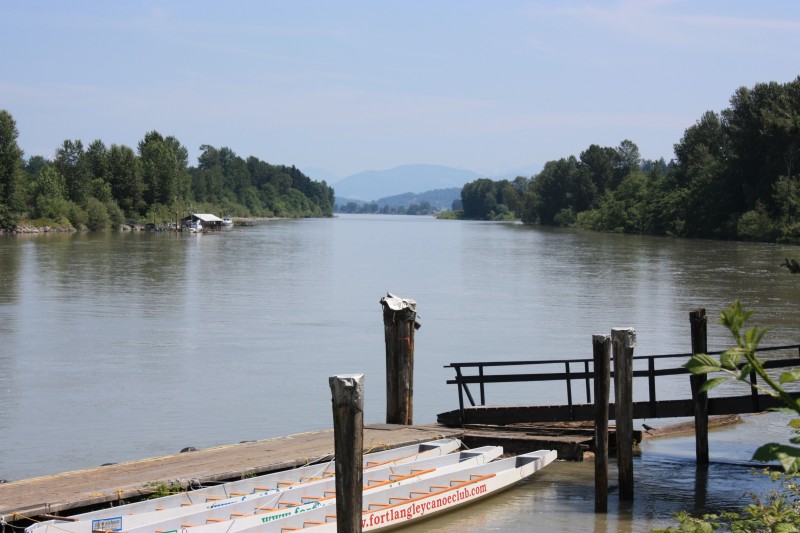
Looking up the Fraser River from Fort Langley, toward the Coquihalla Mountain
Late in the evening of October 10, 1828, Governor George Simpson arrived at Fort Langley, accompanied by Chief Trader Archibald McDonald, who was to take over the charge of this Fraser River post. Simpson and McDonald had come down the Fraser River from Fort St. James, passing through the Fraser River canyons before reaching the peaceful waters of the lower Fraser. To read McDonald’s record of the long journey from York Factory to Peace River to Fort Langley, begin at the beginning of this thread, and follow McDonald’s story, not John Work’s: https://nancymargueriteanderson.com/two-canoes-one/
This is what the man who kept the post journal had to say on the day that Simpson reached Fort Langley; “Friday 10th [October]. The carpenter’s part of the Boat finished, and only requires gumming that Mr. [Donald] Manson & a party of 8 or 10 men may immediately proceed up the river for the purpose of examining the navigation.” The next day’s post tells us of Simpson’s arrival, and the subsequent use of that boat. Obviously, it would not be used on the Upper Fraser River, as Simpson had already done the work of exploring that river and found it unsuitable.
Saturday 11th. About 8 O’clock last night we had a sudden Call from the man on the watch of Canoes & singing down the river and in a few moments had the agreeable Surprise of taking our Governor in Chief by the hand — he is accompanied from York Factory by Mr. Chief Trader Archibald McDonald and Dr. [Richard Julian] Hamlyn and 20 men exclusive of Mr. James M[urray] Yale & 7 men from New Caledonia & Thompson’s River — They left the mouth of that river [Thompson’s River] on the morning of the 9th & to there from Kamloops House took them a day and a half. It would appear the river is worse than any idea we Could have formed of it and renders the practicability of opening a regular Communication this way with the Interior most doubtful.
12th, 13th, 14th, 15th. Since the Governor’s arrival here it has been Settled upon that Mr. [James] McMillan be allowed to avail himself of his rotation of furlough next Season and as a Change of this kind may be attended with danger and inconvenience in the Spring, he now accompanies the Governor to [Fort] Vancouver and Mr. McDonald assumes the Charge of this place, keeping Mr. Yale in the room of Mr. Manson and the Complement of men reduced from 20 to 17 — Mr. [Francis] Annance continues Indian Trader — The furs now procured on account of Outfit /28 are 716 Beaver and 208 Land Otters including 96 Beaver & 39 Otters shipped inApril. — The Journal will now be kept by Mr. McDonald.
Thursday 16th. After a preparation of five days building another Boat — gumming and arranging the one built before our arrival & the one brought down from the Interior [Thompson’s River] the governor, accompanied by Mr. Chief Trader McMillan — Doctor Hamlyn & Mr. Manson with Thirty men left us this afternoon for the Columbia River by way of Puget Sound — The usual honours from the Garrison were of Course bestowed upon him.To remove their Chagrin after parting with some of their old companions and changing Bourgeois, our men were each allowed a pint of Liquor this evening and Certainly had the effects of drowning all the cares of this world…
So Governor Simpson left Fort Langley and made his way down Puget Sound to the Cowlitz and on to the Columbia River and Fort Vancouver, where he would spend the winter. I will tell you of his journey down Puget Sound below, but that is by no means the entirety of this story. It began months before.
In his report to the London Committee, Simpson noted that:
The great population of this part of the country, and the hostile character they bore, rendered it necessary to send a larger force among them [the Klallams of Puget Sound], than the Trade in the first instance could be expected to afford, as we are only respected by those treacherous savages, in proportion to our strength & means of defence. Chief Factor McMillan with 2 clerks and 21 men, accordingly took their ground here, and have maintained it firmly in defiance of the threats of upwards of 5,000 Indians who during the Summer assemble in the neighbourhood of the Establishment for the purpose of Fishing…
The punishment, which it was last Season found necessary to inflict on the Clalem [Klallam] Tribe, for the murder of Mr. [Alexander] McKenzie and his party, has alarmed all the natives in this quarter, and deterred many from visiting the Establishment who were expected to have brought Skins; but this panic will now wear off, while the Salutary measures that gave rise to it are likely to leave a lasting impression, and render our intercourse with them, less dangerous than it has heretofore been.
So what punishment? And for what reason? And who was Alexander McKenzie anyway?
Alexander McKenzie was born in Inverness about 1794, and sailed as a clerk on the NWC ship Isaac Todd in 1814. He was a surgeon at the NWC’s Fort George, and later a Trader for the HBC at Fort George and Fort Vancouver. You will remember him as the clerk who was responsible for staying behind at Fort George after everyone else had moved upriver to the new Fort Vancouver; he was the man responsible for shipping the last boatloads of goods upriver. He would have locked up the fort on departure. In summer 1825, McKenzie was the clerk aboard the William and Ann, an HBC ship that was sent on an expedition up the coast and as far as the mouth of the Fraser River. In Puget Sound, McKenzie told the Klallam and other Indigenous men that the HBC would soon set up a post on the Fraser River. The Klallam tried to discourage this, but building was begun on Fort Langley in summer 1827.
On December 2, 1827, Alexander McKenzie left Fort Vancouver to deliver the Fort Langley correspondence that had arrived at Fort Vancouver with the current York Factory Express. He travelled north up Puget Sound on his way to the Fraser River and Fort Langley. The following comes from the Fort Langley post journals.
Monday 24th [December]. Weather changed. Clear and cold On the morning two Indians from the Musqueam camp near the Quoitle River arrived with a note from Mr. A. McKenzie, the purport of which was that he was disagreeably situated with only four men amongst a formidable Band of Indians, and was doubtful whether he would be able to extricate himself without our assistance. Messrs. Manson and Annance with nine men went off immediately to his relief, but they had not proceeded far, before they met him and his party all uninjured. The Indians have stolen a little property from them, but it will be very easily recovered. Mr. M. is. welcome visitor — he is the bearer of our Home letters and news from [Fort] Vancouver.
Tuesday 25th. Christmas Day.
Wednesday 26th. Mr. Annance with Six men was dispatched to fetch Mr. McKenzie’s Canoe on the Ice to the Fort, and to recover what had been stolen from that Gentleman at the Misquiam [Musqueam] camp. [The Fraser River was frozen across: McKenzie must have walked on the ice to the fort.] In the latter business they succeeded nobly, but the Canoe they found it impracticable to bring up, as the Ice was too weak to bear them, and at the same time too strong for them to break their way through it for any distance with the canoe…
Wednesday [January] 2nd, 1828. The men still enjoyed themselves tho’ the effervescence of Spirits has in a great measure subsided. Mr. McMillan preparing for a trip to Fort Vancouver. We had heavy snow last night and this morning the weather is still very cloudy.
James McMillan is heading off for Fort Vancouver? Yes, he is! And below: Etienne Pepin has just come in with this York Factory Express. He tried to escape from the Express at the Grand Rapids, if I remember correctly. Was he sent to Fort Langley as punishment, perhaps? It would be very difficult to escape from Fort Langley at that time.
Thursday 3rd. Two of the men from [Fort] Vancouver, Louis Ossin and Etienne Pepin are to remain here, and two of our Hands Antoine Perrault and Francois Tarihonga return with Mr. McKenzie in their stead. Early in the forenoon Mr. McMillan with Messrs McKenzie and Annance left us for Fort Vancouver with every prospect of fine weather and a speedy voyage.
Then a week later:
Sunday 13th. Mr. McMillan and Annance arrived with the men from this place who had composed their party. They were detained a week at Point Roberts by uncommonly boisterous weather. Perceiving that after such detention and with such a change in the season he could not accomplish the Voyage except at the expense of a longer absence than he could afford, Mr. McMillan considered it advisable to return, and accordingly left Mr. McKenzie to pursue his route himself, having first seen him provided with Guides, and well supplied with Provisions.
That is not the end of the story. A month later, in February 1828:
Wednesday 13th….In the afternoon Shashia the Cowitchen Chief with two other Indians arrived, bringing a few Beaver Skins with them of which they disposed to Scanawa, in whose tent they took up their quarters for the night. We are told by Shashia that he heard a Report in the Holumma [Lummi] Country that Mr. McKenzie with his party of four men were murdered by the Tlalams [Klallams] somewhere in the vicinity of Whidbey Island. Such a Rumour, vague as we at present take it to be, tends still to inspire us with serious alarm, and if confirmed the event will cause much sorrow, and be attended with very important consequences.
The Fort Langley post journal for 1827-1828 ended at this point, as Donald Manson was heading through Puget Sound, with seven men and the reports that were to go out in the York Factory Express from Fort Vancouver. Manson took out a letter addressed to John McLoughlin, who wrote to Simpson that, “It is with deep sorrow I have to inform you that Mr. Alexr. McKenzie, Antoine Perrault, Chartier, Tarihonga, and Baptiste Boiseau were murdered on January last by the Clallam Tribe inhabiting Hood’s Canal.” Alexander McKenzie’s wife, a Chinook woman, was captured and held prisoner by the Kallams.
McDonald immediately began a new post journal, of course, beginning February 18, 1828. Let’s see what we will find here. On Tuesday, March 11, McDonald reports briefly that Sheinten, a Musqueam chief, told him that “the Chief of the Clallams saved one of Mr. McK’s party, and Sent him off to [Fort] Vancouver.” As far as I know, that did not happen. And of course, I have only just realized that it was the Musqueam who delayed McKenzie on his way to Fort Langley, not the Klallams.
The Fort Langley men remained on alert, running to man the bastions when any large group of First Nations people passed the fort. On the 13th, for example, the men “Saw Indians Skulking about the Fort, but seeing we keep a Strict guard they did not venture too near. They threw a Couple of Stones at the men who were walking on the Gallery, but from the darkness of the night they Could not See to fire at them.” Then a large canoe “slyly” passed the fort, moving on quickly when they were discovered. But this must. have been normal behaviour on this river, as the “punishment” that made the Sound so much more dangerous had not happened yet.
On Thursday, April 15, Donald Manson returned from Fort Vancouver, where he had taken the reports that would be sent out to York Factory for Governor Simpson’s attention. One of those reports had told the story of Alexander McKenzie’s death by murder, so Governor Simpson knew before he had even left York Factory of the dangers of travelling down the Fraser River to Fort Langley. In fact he says in his report that “Previous to my departure from York, I had it in contemplation to pursue my route from New Caledonia direct to Fort Vancouver by the Columbia, being apprehensive from the alarming reports of the disturbed state of the Country between Fort Langley and the Columbia by the coast, that it would have been imprudent to follow that route.” In the same report he said that he had come down the Fraser River (he had made that decision by the time he reached Fort St. James, as William Connolly reported), and he also said that it was “his intention to have returned to the Forks of Thompson River, thence to have crossed the country to Okanagan and down the Columbia to Vancouver: but the state in which we found Frazers River left us no choice, we therefore got two Boats built at Fort Langley, where our party was strengthened to 33 in all, and on the 16th October continued our Voyage.”
So, what was the punishment that occurred sometime over the summer of 1828, that made Governor Simpson’s journey down Puget Sound so much more dangerous than it otherwise would have been? When the New Caledonia brigades came into Fort Vancouver in June, 1828, Chief Factor John McLoughlin dispatched many of the brigade men to the bottom of Puget Sound, via the Cowlitz portage, where they would borrow canoes and make their way to Admiralty Inlet, to meet the ship, Cadboro. This little ship was captained by Simpson’s own cousin, Lieutenant Aemilius Simpson, who had arrived at Fort Vancouver with the 1826 incoming Express. The man in charge of this punitive expedition was Chief Trader Alexander Roderick McLeod, who had already gained a reputation for inappropriate use of authority. Some of the men who were in this expedition were Michel Laframboise, Francis Ermatinger, Thomas Dears, and James Murray Yale, and they led an expedition party of fifty-nine or so voyageurs and the crew of the schooner, Cadboro. Frances Ermatinger kept a journal of this expedition, which showed the strong desire among the men of this enormous party to kill the Klallams and, also, his personal resentment of McLeod’s failure of leadership, his refusal to consult the clerks such as himself, and his dependance on Michel Laframboise’s opinion.
At Fort Vancouver, McLoughlin presumed that McKenzie and his men were killed for their clothing and arms. He also noted that Donald Manson had safely reached the post by the easternmost route through Puget Sound, but that Alexander McKenzie had taken a route down Hood Canal to the west, where it appeared he felt safer among the Klallam people. It was a mistake: he and his four men were murdered by the Klallams as they slept, after having left a Klallam village.
On their way to meet the schooner, some of McLeod’s men shot their guns into a Klallam community and killed several random people. As a result, the Klallams prepared for battle and met the HBC men at New Dungeness, where the HBC attempted to obtain the release of McKenzie’s Chinookian wife who had been captured by the Klallams. When the negotiations failed, the HBC men landed, burned down the village, and destroyed forty-six canoes, all while under the protection of the schooner’s guns. Three days after that, the Klallams released the Chinookian woman they had captured.
The attacks on their communities, which killed twenty-two people, left the Klallams angry and hostile, and they no longer traded at Fort Langley. But the attack also enraged all the other Indigenous people on the Fraser River and in Puget Sound, and all along the Columbia River, which made the region very dangerous for small parties of HBC men. Simpson increased his Fort Langley party to thirty-three men — a number that must have left Fort Langley short of men in a time of some danger. Nevertheless, Simpson could not huddle down at Fort Langley. He must make his way to Fort Vancouver without the help of the Cadboro.
So, Simpson left Fort Langley in two boats, or perhaps three. When he reached Fort Vancouver, he wrote his report to the London Committee, telling them of his boat journey down Puget Sound in October 1828.
Immediately after leaving the River, a telegraphic communication was made all along the coast that an Enemy was abroad, by Smoke during the Day, and large Fires at night on the different projecting head lands; but the Natives did not think proper to interfere with us, and by pushing on late and early, the weather being favorable, we got to a Neck of land between Pugets Sound and a Stream falling into the Columbia, on the 20th, where we Burnt our Boats to prevent their falling into the hands of the Indians; crossed the Cowlitz portage (about 60 miles), got Canoes from the Natives at the head of the Cowlitz River, and reached Fort Vancouver on the Night of the 25th October; having between that Date, and the first of May, performed the longest Voyage ever attempted in North America in one Season, about 7,000 miles. Here I found Chief Factor McLoughlin, the principal superintendent of the Honorable Company’s affairs on this side the Continent, who received us most kindly, and with whom I took up my abode for the Winter.
Of course his estimation of the length of his journey was incorrect: this seems typical of Simpson who exaggerated most of his accomplishments.
When the next post in this series is written, it will appear here: https://nancymargueriteanderson.com/whatever-i-call-it/
Copyright, Nancy Marguerite Anderson, 2026. All rights reserved.