
Fort Norman Stories
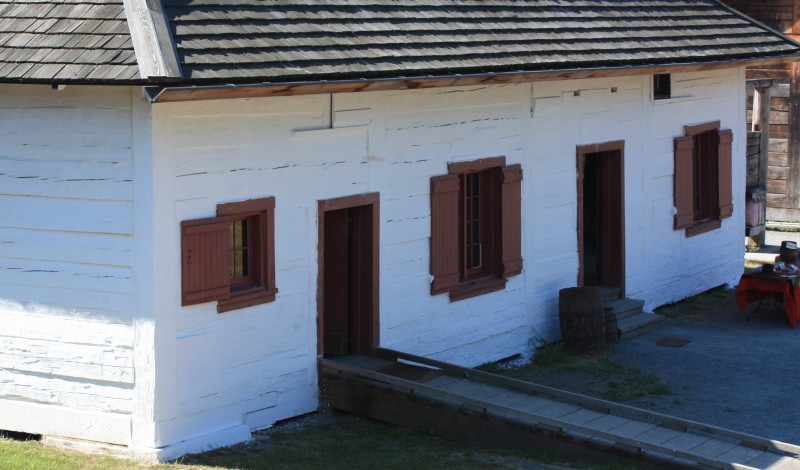
Fur trade warehouse at Fort Langley, the same as found in any fur trade fort
“Fort Norman, though not classed among the head posts of the district, is nevertheless a good fur trading post,” Augustus Peers wrote, “and in good years may vie with many others as it is situated in a country abounding in beaver and martens. The Indians who resort here are the Dogribs [Tlicho] already partly described, and the tribes who inhabit the more mountainous regions of the west who are called Mountain Indians.” These are the Mountain Dene, and some of these First Nations people might actually have traded with the HBC men at Fort Selkirk under Robert Campbell. Peers’s story continues: “A large party of the last named tribe visited the fort soon after my arrival. They had not been to the fort for a year having gone forth into the lower country to visit the gens des roche on a fur trading adventure.” The gens des roche might have been the Northern Tutchone, who lived along the Pelly River and the Yukon, and who traded with Robert Campbell.
“The gens des roche,” Peers continued
are a people who seldom or never visit the trading post, they are consequently ignorant of the established Indian tariff and it may easily be supposed that their visitors practice upon their ignorance to a great extent, purchasing their furs at half the standard price, and as this tribe are destitute of arms, save the bow and arrow of the fore-fathers, their lives are often sacrificed by the upper tribes in an altercation over a bale of furs. On the present occasion they brought with them a youth of this tribe of about fourteen years of age, who had never before seen either a white man or his wonderful house, so that he was much edified by all the wonders of civilized life that met his eyes on that memorable day. The panes of glass in the window filled him with wonder and astonishment.
Peers made a lot of presumptions about the people he is writing about, who are not likely to be so primitive as he thinks they are. If they were the Northern Tutchone, they were sophisticated traders who had long-standing trade relations with the Chilkat First Nations people from the coast. They didn’t need the HBC. Fort Selkirk was built in 1848 and survived until 1852, but few First Nations people traded with them, although it was known by the HBC gentlemen that the Dene of Mackenzie’s River traded at Pelly Banks and Frances Lake. However, Peers is writing this manuscript for English eyes, and so what he says of the First Nations people who lived here is affected by their probable prejudices, and his own. His manuscript continues: winter is coming, and he describes its arrival at this frozen Northern post of Fort Norman.
As the winter advanced, Indians visited me with the produce of their hunts in provisions and furs. Martens were particularly numerous and I collected a great many skins of these little animals.
The weather had set in desperately cold and about Christmas Day my precious crop of potatoes were frozen en masse. We did not, however, give them up, for although not as palatable as they would be if sound, they were nevertheless eatable, and by throwing them at once into boiling water they cooked as they thawed and so retained some of their virtues. Had we allowed them to thaw gradually they would have proved watery and uneatable.
Another Christmas Day dawned but in such an out of the way place it cannot be supposed that it was an occasion of much festivity. I was alone and that is equivalent to saying that the day passed over without anything particular to mark it as Christmas Day.
I found the cold much more severe than at York [Factory] or Fort Simpson. The thermometer was as low as fifty degrees below zero and although this is cold weather, still colder is experienced at the post I now occupy (Peel’s River). [So as we can see, his manuscript was written while he was in charge of the Peel’s River post.] During the greatest cold of that year I had the curiosity to look at a spare thermometer which I had put away in a cupboard in a room adjoining the one I occupied, and to my surprise it registered seven degrees below zero. There was no fire in that room but the chimney which had a fireplace on either side and stood in the division of the two rooms, formed one side of the cupboard. Although I had a roaring fire in my room I was nevertheless obliged to vacate my seat at a table not four yards from the fire, and my ink became converted into ice in my pen.
I experienced for the first time the curious phenomenon of the congelation of the breath. In such severe weather the breath issues from the mouth and nostrils in a cloud, producing a noise in meeting with the cold air similar to the gentle rustling of a piece of silver paper. In very cold weather, the air is so highly rarified that the smoke from the chimneys cannot ascend and hangs over the houses like a shroud, and in this state of the atmosphere I have heard people talking, dogs, bells ringing, or the noise of a person chopping wood as plain as though they were at my side, when in fact I have known them to be even a mile off.
If you take hold of a piece of metal, such as an axe, with the bare hands you instantly experience a sensation similar to that produced by touching a hot iron, and if you still persist in holding it the result will be the same as a burn, and the skin will peel off. Metal for some time exposed to the cold, say, for example, a gun after a day’s shooting, on being brought into the warm house will speedily be covered with a coat of rhyme [rime], caused by the condensation of the warm atmosphere of the room on the cold metal; but after a time, as the gun acquires the heat of the surrounding atmosphere, the frost thaws, and in five minutes you find your fowling piece dripping wet!
Notwithstanding the severity of the cold, parts of the rivers and lakes remain open for some time after the rest has become covered with ice. In such places the warmer vapour of the water meeting with the cold air condenses and enshrouds the country around in a dense fog. While at Fort Norman, I always observed the sky to appear cloudy in the direction of Great Bear Lake — seventy miles off — from this cause. [The Fort Norman he lived in was at its older location on Old Fort Point, not at its present location on Bear River.] From the same cause, hunters are enabled to tell the whereabouts of a band of deer, as in cold weather they are enveloped in a cloud…
The one danger in the region that surrounded Fort Norman was, in his eyes, the grizzly bear, “dreaded by the Natives of these Northern wilds.” He goes on to tell us more of life at Fort Norman, on the Mackenzie River, and its floods. “Fort Norman from its low situation was ever subject to danger by the overflowing of the river at the time of the disruptions of the ice.” He is, of course, referring to the ice breaking on the Mackenzie River, and the floods that occurred when the narrow channel through the Ramparts of the Mackenzie are blocked and the water backs up, as it does every year in springtime.
Knowing the danger, I had the cattle stationed upon a neighbouring hill at the back of the fort, and the safety of my precious stock of furs, which had increased to several packs, were similarly provided for, and as a still further precaution the large boat was brought up to the back of the houses as a means of escape for ourselves. A watch was set to watch the motion of the ice, which in its appointed season began slowly to move from its moorings and soon gave us warning that it would go. It continued to drift down at an even pace, and a pretty strong one, too, and I was about to congratulate myself on my apparent safety. Shortly, however, the speed of the ice gradually decreased till at length it ceased to move. The ice had choked in some part of the river below [the Ramparts], and as the current had received a check, the water was backed and rose rapidly, inch by inch, foot by foot, till at last it reached the edge of the bank, and in a few minutes more the muddy water was pouring in torrents into the valley between the river and the fort. Still the water rose and soon I had the mortification to see the newly put up garden fencing borne down by the restless flood. The “old familiar scene” but an hour ago so dull and monotonous had now received a touch of the romantic, which was not a little heightened by the huge masses of ice as they came toppling over the bank, ploughing the inundated fields and then, losing support, came headlong down, filling the valley with a noise like artillery, engulfing themselves for a moment in the water beneath, and as they rose to the surface with a convulsive heave were whirled onwards with the rest.
Things now wore a threatening aspect; the fort was flooded and water had risen three feet upon the stockades, and as we had every reason to think that it would rise still higher we embarked with our worldly goods, provisions, dogs, and everything of a perishable nature, in the boat. Thus we sat watching the state of affairs, but as the water did not rise higher I embarked in the small canoe and enjoyed the novelty of the scene. The air teemed with geese, ducks, plover, and all that could fly were on the wing, for the waters had covered their favorite feeding spots on the low pockets and bottoms, and they now flew wildly about, alighting ever and anon among the water-encompassed willows, affording me some excellent sport. Once more the ice moved on and the pent up water finding vent ran off the land so rapidly that we were soon left high and dry — no, not exactly dry, for the land before dotted by numerous patches of snow now wore a very grimy appearance, and we had work enough for the next few days in putting things to rights.
Since I left that post its total destruction has been caused by a similar flood, but of a much more serious extent. The water rose so high that it actually over-topped the buildings, which amid the thundering of the ice were lifted from their foundations and dashed to pieces amid the woods. Not a post remained standing, and all the cattle were drowned. The Bourgeois of the depot on his usual visit to the lower posts after the departure of the ice found the water still so high that his boat was enabled to pass over the bank and his dismay was not a little to find the fort gone and its inmates in the boat among the trees.
Now I thought that this might be what Chief Trader James Anderson wrote about in this post, attached, but I find he is arriving at the NEW Fort Norman, built sometime after the flood mentioned by Peers. This bigger flood must have occurred in 1851, because the new Fort Norman was on the junction of the Bear River in 1852. This also means that James Anderson is the bourgeois mentioned above. See this: https://nancymargueriteanderson.com/fort-norman/
So let’s continue with Peers’s story. “The water having subsided, the Indians flocked to the fort with the last of their hunts, and as they intended to await the arrival of the Bourgeois from Fort Simpson, they encamped round the place.” His story continues.
The Slave Indians [Tulit’a?] and Dog-Ribs [Tlicho] were very fond of gambling in their own way. A party of them will set round in a circle on the floor. One of them taking a bullet or other small article endeavours to conceal in in one of other of his hands, at the same time setting up a very sing-song and monotonous chant. Having concealed the ball another Indian endeavours to guess which hand the article is in; if he is wrong he pays the holder of the balls something or other as a forfeit. The game is simple enough but heavy losses are sometimes incurred, and some will even gamble away their clothes, guns, etc., in this way, and although these articles are as precious to them as thousands of pounds to a civilized gambler, they never give way to passion but all on the contrary is done with the greatest good will and friendship.
On the present occasion, a group might be seen sitting in the middle of the hall enjoying their game and the one pipe, which went in turn from one mouth to another round the ring. In a corner behind the chimney might also be seen a group of savages squatting in every position that bone and sinew can assume, and gazing in astonishment on the grim visage of a soothsayer deeply engaged in the mystic art of unravelling the art of futurity. It was the first Medicine Man I had seen and I took my place among the group — putting on a very modest and make-believe expression of countenance, and having ascertained from one of the audience that the day of the arrival of the Bourgeois was the subject at issue, I sat in silent expectation. Presently the Great Medicine Man ceased his cabalistic art, and at the same time the noise of the gamblers and the hum of voices ceased. The great Diviner then stood up and informed the wondering and believing savages that tomorrow, ere the sun had run half his course, the boat of the Behathen-t-cho (big master) would heave [hove] in sight. An approbationary “Ho! Ho! Ho!” resounded round the hall, but scarcely had the echo died away than there rose a cry outside of “The boat! The boat!” The gamblers fled and the hall was speedily deserted by all save the “prophet” who was sadly put out of countenance at the failure of this medicine…
After the breaking up of the ice on the rivers and lakes in the spring, the beaver leaves his winter haunts and takes extensive excursions by water, and in certain localities where they are numerous they may be seen daily swimming in the rivers. Although yet plentiful, these useful animals are not now so numerous as they were in former days. And the numerous lakes where beaver were wont to lurk are now deserted, nothing remaining to mark the favorite haunts save a few “cuttings” blackened by age. The beaver is a very sagacious animal and displays great art in constructing its stronghold, which is so firmly built with mud and sticks that it costs an Indian a hard toil to break through it, and if they construct their habitation on the margin of a stream they are sagacious enough to cut all their timber above the site of their dam, and they therefore find no difficulty in guiding the tree down current. Poplar is the only wood used by the beaver and it is astounding what large trees they will cut down. Nature has however provided them with an excellent set of axes for this important duty. In felling a tree the beaver works steadily at the trunk which he walks round and round cutting the wood as he goes, till at length nothing remains but the heart of the tree, which the superincumbent weight breaks and the tree falls with a crash. I have seen the stumps of trees cut measuring from two to ten inches in diameter…
So scarce are the beaver become along the Mackenzie that all the time I was at Fort Norman, but one was seen swimming down the river. The Indians who saw it gave the alarm, and all the savages present made a rush to their canoes and immediately gave chase. I had no canoe but as I wished to witness the sport I threw my gun into the hollow of my arm and walking down along shore [sic]. The beaver is capable of remaining a great length of time under water and when he again appears after a dive, he is far below the spot. The one we were after avoided the vigilance of his pursuers some time, but at length, after a good deal of paddling and a few random shots, the Indians succeeded in turning him against the current, discharging a ball or arrow at him whenever he showed his nose as he rose to blow. I could not see the beaver from where I stood but as the Indians were gradually nearing my side of the river, I began to have hopes of a shot, even though the odds were against me. Still they came nearer and presently were within twenty yards of the shore in a circle, every eye straining to get a glimpse of the prize. Presently the water was slightly agitated at the very spot I happened to be looking on, and the next moment Mr. Beaver put up his nose. I fired and a very convulsive kick told me I was the owner of the prize. The Indians were rather chagrined to find they had lost the game, and as I bore the body home in triumph they made loud appeals, one wanted the skin and another the meat. I however resolved to keep the carcass, presenting the skin to the senior of the party, well knowing that if it were dressed and dried it would find its way to my store, whereas had I parted with the body I should have lost a most excellent bonne bouche.
I remained three winters at Fort Norman, but as one is the counterpart of another I will not weary the reader with repetitions, and as “variety is pleasing,” I will with this permission introduce him to a still lower and more remote part of the district.
Augustus Richard Peers departed from Fort Norman in summer 1847. He will spend the rest of his life at the Peel’s River post downriver, where he does not appear to have been happy. So, how old was he? In May 1842 he had left London in the London ship for York Factory, when he must have been — we will say, eighteen years old (but he could have been a year or two older.) It’s only five years later. He is only twenty-three or twenty-four years old! He’s a kid! — Funny, but I never looked at his age before.
And so, when we continue Augustus Richard Peers’s journey down the Mackenzie River to the Peel’s River post, I will post the story here: https://nancymargueriteanderson.com/whatever-i-call-it/
If you want to begin at the beginning of his story, then go to this post: https://nancymargueriteanderson.com/augustus-peers-journal/
This book, titled “No Ordinary Risks: Epic Historic Explorations from Hudson Bay to the Arctic Sea,” will be published in January 2027.
Copyright, Nancy Marguerite Anderson, 2026. All rights reserved.