
Peers at Fort Norman
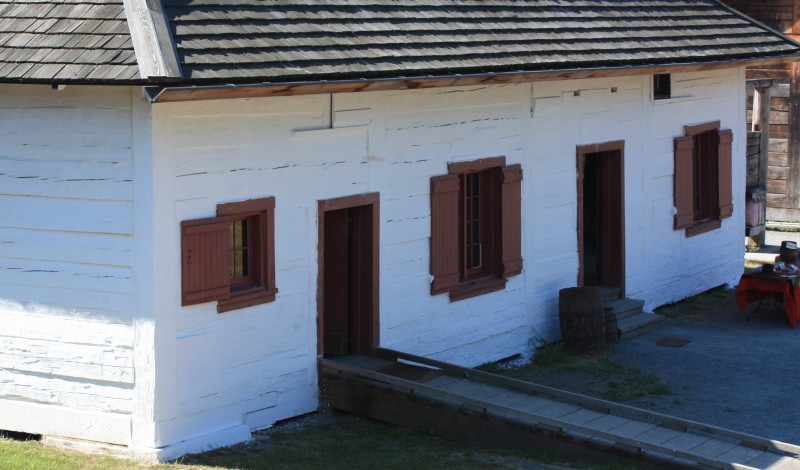
Fur trade warehouse at Fort Langley, the same as found in any fur trade fort
Richard Augustus Peers has spent his winter of 1843-44 at Fort Simpson, on the Mackenzie River, but now it is time for him to leave. “It had been determined that I should pass the next winter at Fort Norman,” Peers wrote, “and as I was to proceed thither during the next month in a small Indian canoe, I dispatched all my baggage by Mr. [John] McLean. My little dog, “Sparrow,” was also sent at this time, as the less the canoe would be encumbered, the better.” His story continues:
Mr. [John Lee] Lewes had now got over his September’s mishap and was enabled to go about again. We busied ourselves in finishing the affairs of the year and in packing up the furs so no time would be lost in starting for Portage La Loche after Mr. McLean’s return from Fort Good Hope.
About this time we witnessed one of the most terrific gales I ever remember to have experienced, and which was very near causing the destruction of our wooden houses by fire. The morning was beautifully fair and it was thought a favorable opportunity to burn a quantity of shavings which had been removed from the boat-house and now lay on the face of the bank. They were accordingly set on fire but scarcely were they half consumed when the sky became overcast in the north-east, and presently the wind rose, and in five minutes it blew a gale. The flag staff which had only the day before been set “trim” was blown 20′ from the perpendicular. The signal halyards flew at nearly right angles with the staff. The shavings, chips of wood, etc., were blown over the fort in flaming masses, threatening every moment to set the place on fire, which would have been no difficult matter as the houses were all covered with sheets of pine-bark now as dry as tinder. To prevent ourselves from being blown down we were literally obliged to lean on the wind, which continued to blow with unabated force for about two hours, when it gradually fell to almost a calm. Such storms are of very rare occurrence in Mackenzie’s River.
Mr. McLean returned after a short passage of eleven days, in which time he accomplished a distance of one thousand miles. He was, however, favored with an unusual share of favorable winds. The usual time taken to perform the trip from the depot to Fort Good Hope and back by rowing and tracking is from seventeen to twenty days.
And now, at last, it was time for Augustus Peers to begin his journey North to Fort Norman in a First Nations canoe. At this time (1844), the HBC’s Fort Norman was not where the town of Fort Norman is today. Instead, it stood thirty miles north of the mouth of the Great Bear River (where it was first built in 1810), a few miles south of the Gravel River (Riviere-du-Gravois). In fact it stood on the site of an old NWC post called Fort Castor, on a point of land called Old Fort Point. There are some interesting stories to tell of this section of the river, but unfortunately (for you, at least) they are not told in Augustus Peers’s manuscript. His story continues:
By the 20th of June the fur packs were all made up and everything ready for a start to Portage La Loche. As for myself, however, my route lay in quite a different route as it had been proposed that I should proceed to Fort Norman, a distance of about two hundred miles, in the small Indian canoe. Messrs. McLean and [Captain John Henry] Lefroy had already started with a part of the brigade two or three days previously, Mr. Lewes remaining to clear up the business, and now that all was ready, [I] determined on starting at 4 o’clock a.m., which we accordingly did.
The morning was beautifully fine and calm and the bosom of the placid river was enshrouded in an exhalation of vapour which indicated a warm day. My crew, two Ham Indians who had come from Fort Good Hope, and were now returning to their grounds again, plied their light paddles urging the frail craft through the water, while I sat in the middle enjoying my otrium cum dig [retirement with dignity] pondering on things past, present, and to come.
In thinking over the past my mind naturally reverted to my native land and many happy scenes and “old familiar spots” amid the noble glades and forests of Hampshire, where but two short winters past I had rambled many a happy day and pleasant hour in pursuit of game, and along the margin of those silvery streams I was wont in the summer time to enjoy the gentle sport of fishing for salmon, pike and trout — but all those happy scenes and times were past, never more, perhaps, to return… Every stroke of the paddle brought me deeper into a country I was totally unacquainted with, and ere long I should have to depend, for the first time in my life, entirely on myself, and as the saying goes, I had, like a young bear, all my troubles before me. While cogitating thuswise [sic] the calls of hunger roused me from my revery, warning me that it was time to put ashore for breakfast, and I accordingly made known my wish to my steersman; but he, unlike me, had only the present to think of, and having kept his eyes continually on the move had descried a wreath of smoke rising from the water’s edge on a distant point — he pointed it out to me and we therefore resolved to make for it and breakfast there. A few minutes paddling brought us there and we found a group of savages bivouacked upon the beach, who observing that my crew were Indians were soon engaged in a lively conversation, the purpose of which was however to me a mystery; but it was evident they had found out I intended to breakfast there, as they busied themselves in replenishing the fire and helping to unload the canoe which had become leaky. Although they appeared destitute of everything in the shape of provisions, they were in possession of a very valuable parcel of furs of beaver and marten skins, etc., I longed to be the possessor of. Hitherto I had looked upon piles of furs with common interest, but now that I was a fur-trader myself, on my own hook, I surveyed this precious bundle with a great desire to trade it, but unfortunately the furs were the rightful property of Fort Simpson, inasmuch as they were in possession of the Indians of that fort, and to trade them and carry them off to Fort Norman would have been an infringement of the laws, for as the Indians are in the habit of receiving goods on credit at their several posts, an indiscriminate trade would tend to unsettle the other Indians and cause them to run from post to post, and thus cause a loss of property to the company. I was therefore obliged to leave the furs in question alone.
By the way, this is one of the rules that Governor Simpson brought into effect immediately on becoming governor — mostly because John Clarke, of the Ile-a-la-Cross post, would trade for furs from First Nations men who actually belonged to the Athabasca District. Well, they didn’t really, because the rule didn’t exist at that time. But shortly after, that became the rule: you did not trade for furs from First Nations people who did not belong to the population that surrounded your own post, and that lived near and traded at another post. Let us continue:
Having breakfasted and the canoe being made again watertight, we pushed out into the current and with its force, united with that of the paddles, we made rapid progress. The river still maintained its great width but as we were constantly meeting with extensive islands, the expanse of the noble stream was often broken. The land on either shore was alternately low and high, but not sufficiently bold to render the scenery particularly picturesque, but as the day declined and our progress [was] rapid the view was considerably heightened by a near view of the Naha y [Nahanni] Mountains, which dipped into the river. As the sun dipped behind the hills we made for the shore and encamped for the night.
In boat travelling on the Mackenzie and other rivers, where there is no danger to be apprehended from rapids, etc., the boats are allowed to drift with the current all night while the crews lie down and sleep till morning dawns, when they again resume the oar. By this means no delay is incurred, for as the current is generally strong a boat will drift a long way in a few hours. In canoe travelling, however, this plan cannot be practiced with safety as the canoe, from its fragile nature, would be broken if driven by the wind on shore, and moreover there is not sufficient room to accommodate all the passengers in a sleeping posture. We were therefore content to roll ourselves in our blankets and find a level spot among the stones, and there snore away the allotted time for sleep. Some of my readers will doubtless think us very free and easy folks in our habits, and so indeed we are. The time was when I would have thought it folly and madness to be out all night, exposed to the damp night air with only a thin blanket to cover me. But now were I to visit my old haunts in my native land, and go out on a day’s fishing, I could, with the greatest contentment, as the night closed in, put off my coat and throw it over my shoulders and with a billet of wood for a pillow pass the night on the river bank, utterly regardless of the thousand and one goblins and legions of fairies which are believed by all old women to roam the country at “the witching hour of still midnight.”
Next morning, after a yawn and a shake, we again embarked. We did not proceed far, however, before the agreeable sight of a flock of wild geese greeted our eyes as they sat feeding along shore. The canoe was soon ashore and we landed, and by crawling through the willows, we approached sufficiently near to rake them with a volley of large shot, which resulted in the death of three or four of the flock.
During the day a slight breeze sprang up from behind us, and we speedily rigged out a mast using a blanket for a sail. As our craft was small, this was rather a dangerous procedure, but as the wind was very light we apprehended no danger, and we advanced much faster than with the paddles. As the day declined, however, the sky towards the north gradually assumed the peculiar leaden hue which presages a coming storm, and as we were still under sail with a gentle south wind, I became somewhat…
At this point the manuscript (as it is a manuscript for a book he has written) breaks off. The Transcriber writes: “It is probable that there is only one foolscap page, written on both sides, lost. In his rather voluminous “Contents” the author outlines this lost portion: Violent Storm of Wind and Rain — Break our Canoe — Le Roche Qui Tremp a L’Eau — Its Singular Formation — Clarke’s Rock and its History — Le Caster Qui Deboule — Arrive at Fort Norman. The manuscript continues with the arrival at Fort Normal and –Description of that Place.” I would love to know what Augustus Peers said about “Le Caster Qui Deboule” because its a good story. Fortunately, I was able to learn it from a different source. And we continue Augustus Peers’s journal:
The place [Fort Norman] had been left in the temporary charge of an Orkneyman who was delighted to see me. The Indians, in spite of his entreaties and threats, would not decamp, being anxious to see the new becatharee (chief or master), and now that they had me among them they examined me most critically, being anxious to find out no doubt from my general appearance if I was likely to prove becatharee naigon (good master) and give them plenty of tobacco, of which article they and all other Indians are particularly fond. They were most uproariously clamorous on the present occasion; nor could I get peace til I have given each six inches to celebrate the day. I set about trading with them at once and sent them off to employ their time more profitably.
I found nothing particularly prepossessing in the appearance of my future residence. Being only an outpost three houses — one for the use of the person in charge; another for the servants, and a store for furs and provisions — comprised the post which pro firma was like any one of its clss, dubbed with the very formidable and terror striking name of “Fort.” It was however sufficiently impregnable as the Indians who resorted thither were of the quietest disposition.
In front of the houses bordering on the river a few acres of land had been reclaimed from the primeval forest, in which were coaxed to grow potatoes and barley, but as the season is too short to allow the former to flourish properly, they seldom exceeded the bulk of a hen’s egg, although one or two might occasionally be found larger. The barley, although it ripened some years, was most generally cut in a green state. It is a thing to be wondered at that vegetables of any sort could grow in such northern latitudes.
Roaming about the premises, cropping the young grass, I found three or four head of cattle which gave to the otherwise desolate looking place a touch of civilization. My domicile consisted of a long, low log building of about forty feet long and with an office and bedroom in one end, a hall in the middle, and several more rooms on the other extremity. The interior of these several apartments was tastefully white-washed, the edges of the doors and window panes having a pleasing look imparted by a paint formed of vermilion in part. Half of the walls were painted with charcoal and glue which combination gave to the rooms an airy cheerfulness so that on the whole I had reason to be contented with my lot. As the store boasted but a very limited supply of dry meat and no fish, we, that is my man and myself, derived our chief support from nets set in the river, where we caught fish of two sorts — herring and poisson inconnu — the former resembling the common herring in size and shape and the later a fish of the above name, varying in size from one to fifty pounds and upwards. With these and a few rabbits supplied by an old Indian we managed to subsist, husbanding with miserly care the slender stock of dried provisions.
Augustus Peers has a lot to say of Fort Norman, and its quite interesting. I will tell you these stories in the next post of the series, because these are stories of living in the far North that can be applied to modern-day. And he’s not that far north, by the way — maybe half the way to the Arctic Ocean?
Now let me tell you about this manuscript. Augustus Peers wrote this while he was at Peel’s River Post. He died in 1852, and the manuscript ended up in California — I don’t know how that happened. An anonymous transcriber took it on and typed out the transcribed copy, and then contacted the Hudson’s Bay Company Archives to figure out which archives he should place this transcription in. They told him (or her) that Augustus Peers was the older brother of Henry Newsham Peers, and Henry’s journal is lodged in the British Columbia Archives. And so, there it is. No one has apparently even looked at it. I only found it because it was listed in the card catalogue as being written by someone named Peers. I’ve had it for years, and never thought I would use it — and then I recognized that it led the reader north and west from Hudson Bay to the Arctic Sea, where it connected with two other HBC men that I was interested in. The other thing of importance is that Augustus Peers’s journal also tells the stories of the Portage La Loche brigades that ran from Red River to Norway House to Portage La Loche and then down to York Factory on Hudson Bay. As far as I know, there is no other book that tells the history of the Portage La Loche brigades!
You can also read this Fort Norman post, which tells the story of an 1851[?] flood at Fort Norman. https://nancymargueriteanderson.com/fort-norman/ which occurred when Peers’s supervisor, James Anderson, visited the post sometime after Peers had moved north to the Peel’s River post. There is even more on this flood in the next Augustus Peers post in this thread, which is here: https://nancymargueriteanderson.com/fort-norman-stories/
If you want to begin at the beginning of Augustus Peer’s journal, go here: https://nancymargueriteanderson.com/augustus-peers-journal/
My book, titled: “No Ordinary Risks: Epic Historic Explorations from Hudson Bay to the Arctic Sea,” will be published in January 2027.
Copyright, Nancy Marguerite Anderson, 2026. All rights resolved.