
Simon McGillivray Jr.
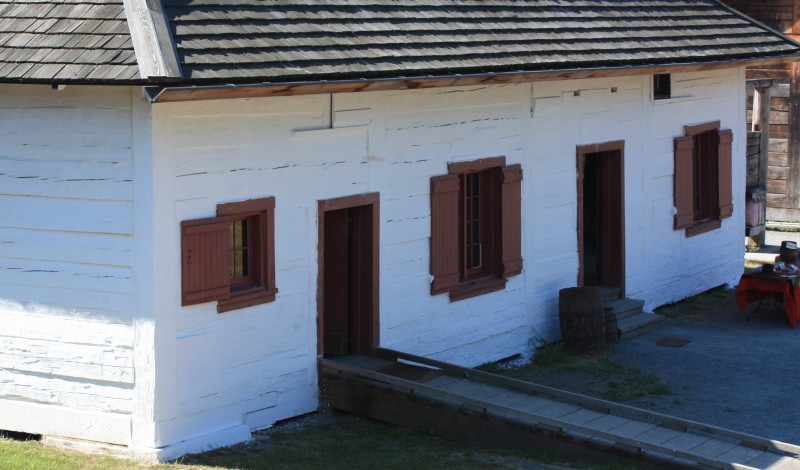
Fur trade warehouse at Fort Langley, the same as found in any fur trade fort
On September 22, 1820, George Simpson noted that “Messrs. [Jonas] Oxley & [George Peter] Andries have arrived” at Fort Wedderburn, “also Messrs. [Aulay] McAulay & [Amable] Grignon; the latter Gentlemen have been unsuccessful in falling in with the Crees belonging to Beren’s House.” Amable Grignon’s presence at Fort Wedderburn is interesting, and he will play a role in the future differences between the two companies at the HBC post. Not only was Grignon a clerk in the HBC (although he was unable to read or write), but he was also a Constable for the District of Montreal, and a man who had been sent North by Governor William Williams with bench warrants to arrest some of the North West Company bullies at Athabasca Lake. Williams had instructed Grignon to touch the man he was arresting, and to read off his name from the warrant (which of course he could not do), before imprisoning him inside Fort Wedderburn. So, on October 23, a Monday, Simpson writes:
About eight o’clock a.m. Mr. [William] Brown came into my room and informed me that the N.W were digging the foundation of a Bastion, at the distance of two feet from our Bastion and immediately in front of it, thereby encroaching about three feet within the line that was acknowledged by Mr. [Simon] McGillivray [Jr.] on the 19th instant [October] to be the boundary of the two establishments. I immediately determined on resisting this encroachment, and being desirous if possible to avoid hostilities, requested Mr. Brown to go out alone to the side of our Stockades, and caution Mr. McGillivray not to attempt building on our ground. He accordingly went but Mr. McGillivray treated his remonstrance with a most ineffable contempt, and intimated his intention of erecting the building on the site lined out, as he now recollected that the boundary line was within the Stockades of our Fort; at this time he was superintending the Workmen employed. Upon Mr. Brown’s informing me the result of the Interview, and after ascertaining that the boundary line acknowledged on the 19th was correct, I resolved that they should not thus invade the Company’s rights with impunity, and forthwith to resist the encroachment by force if necessary. While conversing with the Gentlemen on the subject, Mr. Grignon (a Constable for the District of Montreal who had been absent since the 18th inst.) unexpectedly arrived. On learning the circumstances of the case he informed me that he had a Warrant in his possession against the said Simon McGillivray, and would by virtue of that instrument apprehend him. In reply I told him (through Messrs. [Jacques] Chastellain, Oxley, [Robert] Clouston [the Blacksmith], & Brown as Interpreters & Witnesses to guard against misunderstanding) that I could not interfere or give any sanction or instructions to him in his Official capacity as a Constable, that whatever was done in that way must be on his own responsibility, but that it was my province to protect the Company’s rights and that I was now about to act in conformity. He rejoined that he intended to do his duty, and that he would call upon those around him to assist in the Kings name if necessary. I then said, that if Legally called upon for protection or assistance, we had no alternative. Breakfast being announced the conference broke up. When the cloth was removed, I called the Gentlemen and several of our people together; requested they would support me if necessary, and that all should be furnished with the means of defence. They unanimously agreed to act in strict obedience to my directions: arms and ammunition were brought into the Hall, and I shewed the example by loading my double barrelled gun and pistols with Ball. When in readiness I ordered a few men into the Bastion and directed the others to accompany me, but gave positive orders that no gun should be fired until I gave the signal, which was only to be the case in the event of my being attacked. I then proceeded, attended by Messrs. Brown, Oxley, Clouston & Grignon with about half a dozen men to the ground which the N.W had prepared as the foundation of the Bastion outside the Stockades. Mr. McGillivray and several people armed immediately joined us, he came up to the spot where I stood with his hand on the hilt of his Dagger, and when close to each other I said “Mr. McGillivray, I shall be glad to have some further conversation with you on the subject of this boundary line.” He was about to reply when Mr. Grignon collered [sic] him and said, I arrest you in the Kings name.” He made some resistance and the Officer called out “I demand your assistance in the Kings name,” on which two of our people rushed upon the prisoner, disarmed and conveyed him into Fort Wedderburn. Some of the N.W. people were about to fire, but on seeing us prepared to return the compliment, they made a precipitate retreat; the Officer [Grignon] narrowly escaped being shot by Wilburner, but while his finger was on the trigger, the other presented a Dagger to his breast, which gave him an active pair of heels, and the villain [Joseph] Soucisse took refuge in the woods. On my return into the Fort I found Mr. McGillivray venting his spleen in a torrent of abuse, he inveighed against me with much warmth, declared that the arrest was illegal, and that Warrants would be issued against the whole party forthwith. I replied that the Officer had acted on his own responsibility and could alone be liable for the consequences.
Well, I am sure that was a surprise for the North West Company men, who now suddenly understood that George Simpson was not behaving as meekly as other HBC men had done when confronted with the North West Company’s usual shenanigans. Of course, as soon as the news reached the NWC’s Fort Chipewyan, only a mile or two away, their bourgeois James Keith wrote a letter to Simpson. “Being informed that you and your people of the H.B. Coy have outrageously and violently assaulted the person of Mr. S. McGillivray, Junr., of the N.W.Coy, and having forcibly seized and detained him prisoner in your Fort, I demand to be informed on what grounds and by what authority you have permitted this outrageous act, and whether you are determined to persist in keeping him a prisoner in Fort Wedderburn, against which proceeding I hereby enter a protest on the part of the N.W. Coy, and demand his release without loss of time. I require an answer to this note in an hour from hence, ie. after it’s delivery to your people.” He signed the letter politely, “I am, Sir, Yours &c &c George Keith.” Simpson’s response was simple.
In reply to your note I beg leave to inform you, that neither myself nor any other person acting for or in behalf of the Honble H.B. Coy. did in that capacity arrest the person of Mr. Simon McGillivray. A Constable of the District of Montreal did however apprehend and now detains him by virtue of a Warrant in his possession, and some of the people belonging to this establishment being called upon to assist him in the Kings name, they necessarily complied.
The prisoner was locked into Mr. Oxley’s room inside the fort, “which is the best in the fort, and has got every comfort our Larder and cellar can afford,” Simpson said. “We have also levelled the ground which the N.W. dug up within our boundary line, and for the present their operations are suspended. Being apprehensive of an attack in the course of the night, we have mounted a Guard of three men and an Officer which is to be regularly maintained in future.”
More letters were exchanged between the two head men, Keith and Simpson, and a letter was also sent from Keith to McGillivray himself. To Simpson, McGillivary requested that he be freed on payment of bail, “for his appearance at Montreal in the month of Sept. 1821,” and Simpson replied that he would not be justified “in accepting Bail for his [McGillivray’s] appearance” from “any Gentleman connected with the N.W. Coy. I however told Mr. McGillivray that if he would lodge to the same amount as A.N. McLeod exacted of Mr. Clarke, say 30 Pieces Goods or 30 Pcs Beaver in my hands as an indemnity, I had no objections to offer myself as his security.” A.N. McLeod is the prominent Nor’Wester Archibald Norman McLeod, who in 1816 had forced John Clarke to surrender £3,000 worth of HBC property to the North West Company.
On Saturday November 4, “The weather very boisterous and people employed as yesterday. Mr. McGillivray passed the evening in my room, he is cheerful and the ‘ennui’ occasioned by his confinement now wears off, but appears in bad Health… He also says that a negotiation between the Committee & N.W. Agents was nearly concluded and that a coalition was on the eve of being effected.” The earliest official intimation about a possible amalgamation with the NWC made by the London Committee to its members was written by Governor Williams on February 26, 1821, four months in the future. Both Simon McGillivray’s father, who was William, and his uncle, named Simon, were negotiating the amalgamation between the two companies, so Simon Jr. got that information first hand from his father, William McGillivray. I am sure, however, that Simon Jr. thought that the NWC would come out on top. As we know, that did not happen.
On November 5th there fell occasional showers of snow. It had been very cold during the night and the lake was now a solid sheet of ice. The HBC men were getting their dogs together, and Simpson saw how underfed the dogs were. “By proper attention to the breeding of dogs the Company may make a very profitable trade of them and in spring I intend to issue an Order that none shall keep bitches except the Company.” He also recommended bringing in a small herd of horses, interestingly, and in addition he saw “no reason why Rein Deer should not be employed in this country as in the North of Europe, and intend giving orders that the experiment be tried next season.” He may have expanded that experiment to moose: I know that James Anderson (B) of the HBC was ordered by Simpson to capture moose and tame them, but I don’t know what actually came of that experiment. (James Anderson (B) is the first cousin of James Anderson (A) of Fort Simpson, NWT., and Alexander Caulfield Anderson of New Caledonia.)
On Tuesday, November 7: “The N.W. I understand are equally short of provisions as we are, they made an attempt to go to the Fishery today with Trains [dog-sleds] but the ice was not sufficiently strong. I asked the Prisoner to sit with me in the Evening, but he politely declined leaving his own room in future; he very likely perceives that I court his society more for the purpose of eliciting information from him, than out of respect, and to avoid the risk of committing himself prefers solitude.”
Simpson also wrote a long letter to Governor William Williams, explaining what was happening in the Athabasca District. “I found that [Samuel] Black and some of his desperate associates had taken their departure across the Rocky Mountain,” he said, and “that [James] Keith was in charge of Fort Chipewyan and Simon McGillivray, three Clerks, with Soucisse and their other Bullies were to occupy Black’s quarters at the Watch House. On enquiry into the general State of affairs in the Department I was deeply concerned to learn that from various inexplicable causes the business was left in a most irregular state last season, the Stores empty, the people in a state of mutiny, and a congregation of evils staring in the face those in charge of the Company’s affairs: the Indians were discontented, we had not a pound of ammunition to give them, the Fishery for a length of time was unsuccessful, no provisions on hand, in short both our Indians and people were reduced by starvation to a miserable state.” And so he had a long list of things that were bad and that must be improved next year. You can see Simpson understanding the problems and ready to solve them — something that Williams was nowhere close to accomplishing.
But we are interested in Simon McGillivray Jr. He remains a prisoner at Fort Wedderburn for a while, and it appears he does not come out of his room, as Simpson does not talk about any entertainments he might have offered McGillivray. However, McGillivray did have companionship: not only did he have a confidential servant to wait upon him, but “his Woman and two children live with him and are as comfortable as we have the means of making them.” Simpson admitted that he felt “much satisfaction in having this Gentleman within our Stockades, he would have been a troublesome thorn in our sides during the Winter.” He did also note that “Mr. McGillivray appears, at least pretends by his correspondence, to be in a delicate state of health, otherwise the Officer would have taken him to some post of greater security, but as a Winter Journey might injure his constitution, it may be better to keep him until the Spring, when Mr. Grignon will take him out in a half loaded Canoe.” It is at this point Simpson suggested that McGillivray be taken to York Factory via the Burntwood Portage and the Nelson River, thus confirming that he did know about that portage — and, oh, yes, here it is. Simpson was confused about the loction of the Burntwood Portage (this refers to his 1824 journey to Athabasca Pass, when he gets lost on his way to “Frog Portage.”) Here he writes,
If Mr. Clarke or the Gentlemen in charge of Nelson House can provide a Guide, I think he should be sent by the burnt wood carrying place and Split Lake track from Portage Fort du Trait.
As you all know, Frog Portage is Portage du Trait, and neither of these places are the Burntwood Portage. He was confused in 1824 when he tried to find Frog Portage from the Nelson and Burntwood River , and he was confused while he was in the Athabasca District in 1820-21. If you want to discover what I am talking about, you can begin with this blogpost: https://nancymargueriteanderson.com/nelson-river/ Read this post and the next for the full story.
So, back to Fort Wedderburn and Simon McGillivray Jr. The HBC continued improving their fort. “Since Mr. McGillivray’s confinement the North West have erected a strong Bastion on their own ground which covers ours, protects their communication with the Lake, and from the Upper story commands a view of our Fort. In order that we may have a corresponding strong hold, I have erected a Bastion on the Rock behind our House, which overlooks their square of buildings and renders our Fort impregnable from all quarters if properly watched. This Bastion with the Gentlemen now about me and a few Highlanders would secure Fort Wedderburn against any force the North West could bring against us. I do apprehend they will attempt some ‘ruse de Guerre’ in the course of the Winter and therefore keep a good look out, an Officer and three men with fixed Bayonets and loaded Musquets stand sentry every night.”
There is little more on McGillivray in this journal until December 4th, 1820, when
Last night I retired to Bed at ten O’clock p.m. leaving Mr. Brown in charge of the watch; about that hour we went into Clouston’s Room which adjoins the prisoners and since the watch has been established is used as a Guard Room. Until 1 o’clock this morning everything was quiet about the Fort; but in taking his rounds at that hour he was surprised to see lights in the N.W. Houses, their Fires all lit and a number of people continually passing between their Houses and Bastion; this unusual circumstance excited a suspicion that they were about to attack our Fort, he therefore gave me intimation thereof, when I immediately dressed, started all the Officers and some of our most confidential men, and in a few minutes we assembled under arms in the Hall to the number of about twenty; the morning being extremely cold I gave the people a dram and stationed them in the Bastions and in various parts of the Fort in order to repel any assault our Opponents might attempt to make. I directed [Waccan] Bouche, the Interpreter, to get as near the North West Houses as possible for the purpose of reconnoitering; on his return he informed me that while listening close to their Bastion he observed a number of people bustling about the Houses under arms; one man came to the Bastion and said to those within “The English are up.” A voice replied, “yes and one of them is now listening close to the Port Hole of the Bastion.” Bouche finding himself discovered thought it judicious to retreat. [You will notice that both Waccan Bouche and Paul Bouche (Lamallice) are at Fort Wedderburn this year.]
From the Upper Bastion I distinctly saw them at various times in groups of five or six people watching our proceedings. About three o’clock every man in the Fort was under arms and little doubt remained that an attack was contemplated, but that finding us on the alert the plan was abandoned. The people were in high spirits and every man seemed anxious to have an opportunity of showing his zeal and courage. The morning being bitterly cold I gave the people a second dram and they danced a few Reels in the Hall for the sake of Exercise as it was impossible to remain inactive on account of the severity of the weather. The noise about the Fort I conceived had roused the prisoner as there was a fire in his room and his Woman and Children were heard walking about. We continued on the Watch until 7 o’clock when the people went to their usual occupations, and myself and some of the Gentlemen lay down for an hour, Mr. Oxley being left in charge of the morning Watch. A few minutes after we had gone to our Rooms, two of the servants went to the Lake for a Bucket of Water, on their return a N.W. man asked if Mr. McGillivray had joined in the dance, he was answered in the affirmative, the N.W. man rejoined “well, then he danced with us too and we have taken care of him.” On the return of our people with the Water, they mentioned the circumstances to Mr. Oxley who immediately went into the Prisoners Room and discovered that he had made his escape!!! His woman was interrogated on the subject and at first stated that he got out through the Chimney, it was examined and found too small to admit his body. The Stockades were then inspected particularly, but no tracks discovered and had he scaled them the impression of his Feet and hands must have appeared: suspicion at length fell on [Johann Frederick] Knipe, the man who attended him, and he was secured while I examined the Woman. She with much hesitation confessed that McGillivray had bribed the man and that he was conducted out by him between the hours of 8 & 9 o’clock last night; that the plan had been concerted several Days but they had no opportunity of carrying it into effect until last Night when Knipe opened the Door and said to Mr. McGillivray “if you promise faithfully to meet me in Montreal and keep your word I shall now permit you to escape, as the Night is dark and there are no people moving about the Fort.” Mr. McGillivray gave his hand and assured him on his honor that he might depend on his promise; he then took leave of the Woman and desired her to remain quiet until Morning as he was now liberated, he then accompanied Knipe who locked the door upon her.
I have examined Knipe very particularly on the subject but he denies all knowledge thereof, his countenance and manner however betray evident proofs of his guilt, he has been interrogated in English, French, Italian, and Spanish, languages in which he is tolerably conversant (having been a soldier in the late De Meuron’s Regiment) but pretends that he does not understand the questions and regrets that we cannot put them to him in German; I however feel perfectly satisfied that the Woman’s statement is correct and that he got out by the side Gate from the Wood yard as there is a track from thence round the Stockades to the North West Houses. I was rather surprised that Knipe did not escape with McGillivray but on looking at his account it appears that there is a Balance of nearly 2000 Livres due to him and it is probable that he intends serving his time out in hopes of getting his Balance paid up and afterwards going to Canada. I must however compare notes with the Governor on this subject as such a mercenary wretch might by perjury endanger our Lives in a Canadian Court of Law.
About ten o’clock a.m. two N.W. men called for McGillivray’s clothes, which were delivered; one of the men, St. Pique, says that McGillivray arrived at the Watch House between the hours of 8 & 9 last night without his Coat, that he told them he had made his escape by personating his woman in her Gown, and that he had got over the Stockades behind the Smith’s shop; that however cannot be the case as the snow is not disturbed and the story is no doubt fabricated for the purpose of removing suspicion from Knipe. The prisoner has been watched with so much vigilance ever since he came into the Fort that I am satisfied he could not have got away except through treachery. He was certainly allowed the range of the Fort on his parole of honor, but that was scarcely looked upon as a collateral security with Locks & Keys.
So, there we have it. Simon McGillivray was captured by the HBC men and imprisoned, but he got away. McGillivray did not trust the HBC men enough to remain at the Watch House, and he went to Fort Chipewyan and was replaced at the Watch House by another NWC man. Things returned to normal at the HBC post, for a while at least. The next interruption would be caused by the return of Samuel Black, and it is he whose story might be told next. When the next post in this series is published, it will appear here: https://nancymargueriteanderson.com/the-canadians/
To return to the first post in this series, go here: https://nancymargueriteanderson.com/simpson-at-rock-depot-1820/
Copyright, Nancy Marguerite Anderson, 2026. All rights reserved.
Loving this account and the way you are framing it. Bravo!
Another Great story!
Thank you. 😊