
Peter Fidler’s Journal
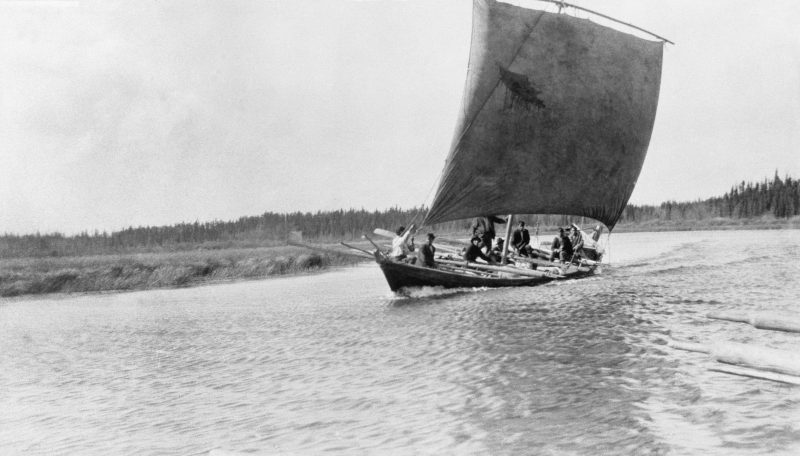
This powerful image of a York Boat under sail is used with the permission of the Glenbow Archives. Its number is na-1847-5. The HBC men sailed these boats anytime the wind was blowing in right direction, both going downriver, and coming upriver.
Although this post is a continuation of Peter Skene Ogden’s story at Ile-a-la-Crosse, we are following Peter Fidler’s Journal of 1810-1811 to see what happened at the HBC post at Lac Ile-a-la-Crosse. I think I said in the last post in the series that the HBC post was called Fort Superior — no, it was not. It would be called that name when Governor Simpson passed through Ile-a-la-Crosse in 1820, but in 1811 it did not bear that name.
At Ile-a-la-Crosse, Peter Fidler opened his journal with the words, “at 8 a.m. sent 12 men in 2 Batteaux [York Boats] to go to Churchill Factory with the few furs Mr. [Robert] Sutherland & self have traded here & at the Methy Lake where he wintered… Mr. Sutherland, self & 5 men at present remain at Isle a La Crosse House.” So the HBC post is called Ile-a-la-Crosse House!! To continue: On June 10, he wrote that early that morning the Nor’Westers “all embarked for the grand Portage, now dignified with the name of Fort William. Mr. John McDonnel, my opponent here this Winter accompanied them.” On June 21 in the evening: “11 loaded canoes of Canadians with two Clerks, Messrs. [Samuel] Black & Faris [Hugh Faries].” Now that they were the only traders in the Athabasca District, the NWC men were doing well, collecting furs not only at Athabasca Lake but also on the Peace River, on Great Slave Lake, and in Northern New Caledonia on the West side of the Rocky Mountains. As the NWC men West of the Rockies came out by the Peace River, many of those men paused their journey at the NWC post at Lac Ile-a-la-Crosse.
The HBC men knew that the Chipewyans wanted to trade with them, but were too frightened to do so. On June 23, 1810, Peter Fidler’s Journal described how “The Indians who went to the Canadian House yesterday all went away — at Dusk in the evening one of them came sly-ly here walking Thro’ a wide swamp arm pit deep — being afraid to come here openly for fear of The Canadians, he comes for a little credit for 4 men, he says that the Canadians locked them all up last night to prevent Their coming over to our House which they all very much wished, gave him but a very little Credit. He went away in the same sly way as he came, being greatly terrified for fear of seeing a Canadian.”
In addition to frightening away the Indigenous traders who wanted to trade with the HBC, the NWC men constantly harassed the men who worked at the HBC post. They followed the HBC men whenever they left their post, and ensured that they had no contact with First Nation traders. Then on July 2, summer-master Robert Henry, Samuel Black, and two other men “marked out a place for a house only 10 feet Distant from our Stockades to the North of our House.” That is exactly what the NWC men had done at Nottingham House; by the time the HBC men left their Athabasca Lake post for good, two watch-houses loomed over the two small buildings of the unpalisaded HBC post on Athabasca Lake. Now, at Lac Ile-a-la-Crosse, it appears the same plan was being put into effect. In his journal, Peter Fidler described what the four NWC men were doing.
Their House before is not above 150 yards distant from ours & on the South side of us and now they are building on the [North?] side so very near us for the express purpose to prevent a single Native from entering our Doors. They stand at nothing to get everything the Indians kill, nor do I now expect a single native will be able to give us anything privately as none will be suffered to enter our Doors. What a most unpleasant Thing to prevent the Natives from coming to Trade with us openly — as they all in General wish to do — as they always received from us a better treatment & more Goods considerably for their Peltries than the Canadians will give them.
The Canadians hauled logs to build their watch house. As he had done at Athabasca Lake some six years earlier, Black “would not rest in the night, but kept nightly a constant watch to keep all Indians from coming to our House & alarmed & Disturbed every one within.” On July 5, Fidler described how “Mr. Black goes about our house at almost all hours in the night hallowing Loud on purpose to disturb us exactly as he did at the Athapescow Lake.” Peter Fidler’s Journal described Black as the “best calculated I ever knew to do any unjustifiable action.” The noise and threats continued and increased, and the NWC men also began to destroy the HBC fishing nets and to take pot-shots at the HBC flag when it was flown above the fort.
On July 16, 1810, Fidler had his men dig a trench for a palisade-style fence (a tall fence of logs) that would run from the corner of the fort stockades down to the waterside. Fidler’s fence was to prevent the NWC men from “passing close to our East & front Gates.” In response, the Nor’Westers “cut a Track from their Watch house here toward their big House within 10 feet of our Stockades, a thing never known before to cut so near one another & right over our Dunghill.” Then Black rounded the palisade-fence that was intended to keep him out, and “came up to our front Gates & hallowed loud & began cutting wood close at our Gates and alarmed & disturbed everybody.” At mid-night July 21, Black “hallowed several times loud & cut wood on purpose to disturb us at the West Gates.” Black even admitted that it was his job to harass the HBC men. As Fidler said, he “challenged all & said he would disturb us whenever he thought proper by hallowing, firing Guns & by & by we should hear him Dance & sing & everything that he knew could disturb us.”
On August 13, the watch house was finished and Black moved his bedding into it. At the end of August he was walking around the HBC post every night, hollering at the gates to prevent the HBC men from sleeping and sometimes firing his gun. The HBC fishing nets began to go missing and many were located badly damaged. Then on September 1, the NWC canoes returned to Lac Ile-a-la-Crosse from Lac la Pluie, and three Iroquois who arrived with the NWC brigades came into the HBC post to trade. Black ordered them away. At last, on September 16 the HBC York boats returned from Churchill House — two boats and eleven men. “They have brought very little Goods with them, principally Necessaries,” Fidler said. What might have been good news to the HBC men, on September 17, Fidler noted that “Yesterday Mr. Black’s things were carried away from the Watch House here to their own house, he is very badly.” On September 21, Robert Henry, who had acted as master of the NWC post all summer, left for Athabasca Lake where he would winter. In his own Journal, Peter Fidler listed the men who remained at the NWC post for the winter: John Duncan Campbell, the Master; with clerks “Mr. Ogden,” and Samuel Black; Cartier, the guide; and twenty-two common men, making twenty-six NWC men against the HBC’s eight.
Sick as Black might have been, he also recovered quickly. On October 12, Peter Fidler noted in his Journal that
Mr. Black & Ogden went over there [to the new HBC fence of logs] & the Latter came into our Garden & walked through it & over the stockades near their Watch house — previous to this Mr. Campbell was in the Watch house & when he thought we had near finished them he sent a man from the Watch house to fetch Mr. Black & Ogden They remained at our Front Gates near 10 minutes armed with Pistles [sic] & Daggers — when Ogden was in our Garden Campbell called out “have you got your Hanger.”
I now know that a Hanger is a long, curved saber, and it was part of the harassment, of course. The attempts to intimidate continued, and clearly the log fence made little difference to the HBC post’s security. The NWC men cut away at their fence and stole their firewood. On October 19, Fidler wrote that “Mr. Black and Ogden come close to our Launch where we take our fish ashore at night, which is very insulting as they say nothing but come in a very Bravado manner.” Black and Ogden began to regularly watch the fisherman unload his fish and the two men also hung out outside the gates of the HBC post “upwards of ten minutes waiting our Fisherman coming ashore. They had their Daggers on — I don’t know why they come over every night when our fisherman returns from our Nets. In the Day they were both over & remained about our front Gates with a gun each” On October 12, “Mr. Black & Ogden walked across Our Yard in at the West & out at the East Gate armed, the latter carrying a chair, the other opened our oven door & looked in.” On October 25,
Mr. Black & Ogden came to our Gates this morning & in the evening they both came into our Yard at the East Gates to pass thro it — Mr Black with a loaded Gun & 2 pistols & Ogden with his Dagger which they seldom carry but when They mean to insult us. I met them in the Yard & asked Mr. Black the reason why they passed thro our Yard, a thing never done before till lately — he said he would make a common practice on account of our putting down the Stockades [the fence]. I told them to return the same way they came & that they should not pass thro our yard in the Insulting Manner they intended. I told one of our men to shut the West Gates — which was at last done — they perservered [sic] in passing when I struck Mr. Black with a stick two or 3 times. Ogden immediately drew his Dagger & cut 2 large holes in the side & back of my Coat & pricked my body but no further. Mr. Black then took up part of the stick I had broken over him & struck me twice with a stick — all our men looking on the whole time without giving me any assistance — Mr Black & Ogden then followed me into my room with their Guns & Dagger & abused me very much whilst my Thumb was dressing — They then went & opened the West Gate & went away saying that we all should lead a very miserable & unhappy winter.
The threats continued, with Black and Ogden watching the HBC men while their Canadien employees hacked at their stockades with axes and threw the downed logs into the lake. Peter Fidler’s workers, who were mostly peaceful Orkney-men, were thoroughly intimidated by the bullies, NWC Canadiens and clerks alike. When the HBC men left the fort by sleigh the NWC men pursued them and, ordering them to disembark from the sleigh, disarmed them and tied them up before returning them on their own sleigh to the HBC house. “All our men are very much frightened, that they are even afraid to stir about — the Canadians being near 4 to one of us.”
In the days that followed, Black and Ogden walked into the HBC post “armed with their Daggers & Pistols but said nothing about the Indians as they saw everybody home,” the men clearly too frightened to leave the House.. In the afternoon of November 21, Black and Ogden “came into our Mens house armed with Daggers & Pistols, then came into my room & told me to take up our Nets, they being too near theirs, or else they would cut them to pieces.”
Nevertheless, they had a quiet Christmas at the HBC post, it appears, and on January 3, 1811, “Mr. Black & Ogden came over here quite unexpectedly (in a civil manner) with a verbal message from Mr. Campbell, says if we would send one man to the Saskatchewan River with Letters he would send another in Company & also furnish a Guide.” For some reason, Peter Fidler accepted the offer, and the letter he sent to the Saskatchewan River post of Carlton House, via Green Lake, provides us with the information that correspondence he had received only a week or so earlier indicated that he was “directed to relinquish this place in the spring as nothing can be done.” Perhaps the NWC men had received the same message and could now be more polite than they had been in the past. The war might be considered over.
Well, no. Sam Black was not to be trusted. On January 16, Black “followed James Isbister hunting & asked him if any more were with him.” On January 18, “Mr. Black & Ogden met James Isbister who was out hunting Partridges and asked him what he was seeking.” Black told Isbister that no one was allowed to stir from the HBC post. “Things re come to a fine pass when we cannot be allowed to stir about anything outdoors,” Fidler complained, “& calls aloud for a compleat [sic] stop being put to such conduct of the Canadians.” On January 19, Black and Ogden lay in wait until Isbister passed their hiding place, when they jumped out
& Mr. Black went to our Man & knocked him Down by striking him in the face — he then jumped & trampled on his Gun down into the snow either to break it or to get it wet to prevent it from going off, & Mr. Black told him if he ever caught him again from the House he would break his arm — the Man came Home crying & told us as above — sent a note over to Campbell about it but as usual got no satisfactory answer — only promising fine things as usual — without either meaning or performing them.
On January 20 Black came to the HBC post and demanded that Fidler tell him why he had sent a note to Campbell. “He said he would do as he chose,” Fidler said, “and that we should not be allowed to send any man from the House but what should be greatly beat & maimed, that death should be preferable to the lingering existence they should have.” Later the same day, Ogden told Fidler that the HBC men should “be allowed safely to send our Men about our hunting, etc., provided I would consent that they should not interfere with any Indians they might meet with.” Fidler refused to consent to this demand, and Ogden then told him that the HBC men would be beaten and maimed if they had any dealings with Indians or even if they went hunting for partridges. As all of Fidler’s men were present when Ogden gave Fidler these orders, they became even more afraid than they ever had been.
That night, after all the HBC men had gone to bed, Ogden and Black fired shots outside the windows of Fidler’s room. They sang loudly and yelled, and then moved off to the West gate where they drove daggers deep into the wood of the gate. Additional shots at the west gate dislodged some plaster in the men’s house, frightening them even more. Black and Ogden did the same on the following night and on the night after that they took up some of the HBC nets and cut them to pieces. On January 23, the two NWC bullies came into the yard of the HBC fort and “looked at the thermometer and went away again without saying anything — quite in a hasty manner.” Fidler called on his men to remove the Nor’Westers, but all refused. “They are all so much afraid after the great threatening & the bad actions we have experienced,” Peter Fidler wrote in his Journal.
Things appeared to quiet down for a while, and it seems that at this time, Black and Ogden were meeting with their Indigenous traders at their communities, returning home with enormous packs of furs. In February Black and Ogden again stalked into the HBC post and stared at the thermometer. In February and March the “Jepowyans” [Chipewyans] traded for liquor and goods at the NWC post, but none visited the HBC post. The HBC’s firewood disappeared, clearly stolen by the NWC men in spite of Campbell’s promise to not allow his men to do such a thing. On March 25, Mr. Black ran from the Canadian House to prevent our Man from speaking to the Indian which he did as the Native durst not speak to our Man.” On March 27, 1811, “at 8 a.m. Mr. Ogden & 7 Canadiens came home with 9 Sledges of 3 Dogs each loaded with Skins & Meat,” obtained from the First Nations men that lived on the rivers that led toward Methy Portage [Portage La Loche]. In his journal, Peter Fidler commented in sorrow: “How very mortifying it is to us to see such loads of Furs and Provisions brot [sic] home by the Canadians and our men durst not stir from the House after any Indians for fear of having their legs & arms broken by the Canadiens.”
Then their best dog disappeared, and Fidler presumed that the NWC men had stolen it. Because of the new threat, the HBC men were forced to confine all their dogs inside the fort yard. On March 30, Black enticed two of the HBC puppies away, but Fidler called them back and Black walked away without looking back. Finally the best dog returned to the HBC post, starved and thin after having been locked away in an outhouse without food for three weeks.
At the end of April, Fidler’s men began to plant a garden in the hopes that they could deceive the NWC men into believing the HBC would remain active at Lac Ile-a-la-Crosse. In early May, the Beaver River showed signs of opening, though First Nations people still crossed the frozen surface of the lake on foot. On May 22, Fidler reported that the ice on the lake was weak, and near the fort he saw open water. On May 30, Fidler packed some items in preparation for leaving for Churchill House. The NWC men were not fooled, however. On the evening of June 4, 1811, a few of them stayed in their watch house where they beat a drum loudly and sang songs to keep the HBC men awake all night. “During the night they threw sticks, Chips & stones against the sides and roofs of our House so that not a single person in it could get the least sleep,” Peter Fidler wrote in his journal.
At eight o’clock the next morning, the exhausted HBC men swept the fort clean and closed and locked the gates, before setting off for Churchill House. They were accompanied “by Mr. Ogden with two canoes of Canadiens… [who] go ahead of us to get everything from the Indians that may be on the road as they can go much faster than we who are heavy loaded with Trading Goods taking down towards Nelson House.” A few hours after they left the post, the HBC men looked back to see
a large smoke ascending exactly in the Direction of our House & we suppose that it is the Canadians who set it on Fire as the Canadian said Yesterday — One of the Canadians women who now accompany us told us privately that they Intended to immediately to burn it as they had done to our other Houses at the Green Lake when Mr. Sutherland & people left in the Spring — Took all our dogs with us — put up at 6 p.m. nearly thro Isle a la Crosse Lake being very early but it is necessary as none of us had the least sleep last night at the House by the dreadful & loud noises of the Canadians on purpose to disturb us.
On June 5, Fidler and his men put up for the night at the lower end of Primeau Lake. “One Canoe of Canadians constantly keeps a distance ahead of us” Fidler said, “& the other behind us that we can have no chance of getting anything from any that we might find in the road. At night they sleep close to us.” On June 10 the HBC men reached “the mouth of Deers [Reindeer] River, where we found Messrs. [John] Charles, [John Lee] Lewes, & 5 men…We must remain here until Mr. [John Pocock] Holmes comes from his House [Egg Lake], built last January towards Cumberland House.” Egg Lake House (also called Bedford House) had been built in 1809 by Holmes, and was located near the confluence of Reindeer Lake and the Churchill River.
Holmes joined them on the afternoon of June 14, and on June 19 they made Nelson House, a post that stood on Burntwood Lake at this time. The fort was built by David Thompson and it stood on the south end of the Kississing Portage, an easy portage that brought men and goods from the Churchill River to the Burntwood River, or vice versa. On June 24, he set off down the Churchill River and on July 3 he and his men reached Churchill Factory.
But this is Peter Skene Ogden’s story. Where was he? He left the Churchill River at Frog Portage and made his way down the Sturgeon-Weir River to Lake Winnipeg, on his way to Lac la Pluie. Once loaded up again, he returned by the same route to Ile-a-la-Crosse. Presumably he spent two more years at that post, until in 1814, he was placed in charge of the Nor’Wester’s Green Lake post on the Beaver River.
So, when I continue Peter Skene Ogden’s story of his time at Green Lake, I will post it here: https://nancymargueriteanderson.com/whatever-i-call-it/ The times continue to be violent, and Ogden is definitely directly involved in said violence. In fact, it is his time at Green Lake that forced him to escape to the West side of the Rocky Mountains to avoid being arrested and charged with murder. Yes, murder. But we all know that.
Copyright, Nancy Marguerite Anderson, 2026. All rights reserved.