
To Peel’s River Post
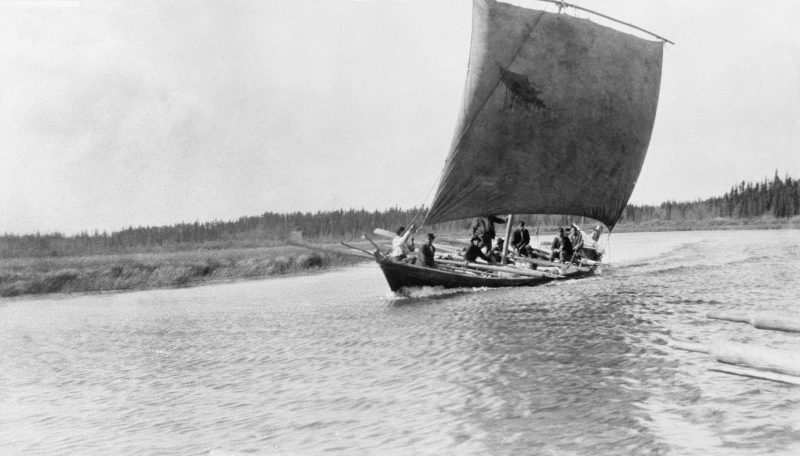
This powerful image of a York Boat under sail is used with the permission of the Glenbow Archives. Its number is na-1847-5. The HBC men sailed these boats anytime the wind was blowing in right direction, both going downriver, and coming upriver.
“I remained three winters at Fort Norman,” Augustus Richard Peers told us in September 1847. “I one day sat in my arm chair over the remains of a plate of herring, cogitating on the ways and means of another winter,” when a tawny head was thrust in through the half-opened door and an Indian informed me that Peel’s River boat was in sight, on its return from the depot.” In 1847, the man in charge at the depot of Fort Simpson, Mackenzie River, was not John Lee Lewes, but Murdock McPherson. Peers’s story continues:
By it I received “notice to quit” as my services were forthwith required at the post on Peel’s River, which was at that moment minus a manager. I rather anticipated this change from a previous hint, and although I was snug enough where I was, I was nevertheless too fond of variety to regret the order to go rule the roost within the Arctic Circle. I was in a rough and tumble country where things are done in a very offhand sort of way, so laying down the letter I straightway hauled forth from the recesses of a timber room my dust covered trunk, placed it beneath my wardrobe and then, introducing an arm at either end of the shelves, raked my changes into it in true bachelor fashion, and by dint of a few pressings the horrid task of packing was accomplished. Giving a few orders to my successor pro tem, I jumped on board the craft and in five minutes I was once more on my travels.
It was in that particular season of the year between the breaking up of summer and the setting in of winter, known as the “fall” of the year, that I set out once more upon my travels. The trees and shrubs were fast shedding their orange tinted leaves and the last of the wild fowl were wending their way south. The crew of my boat was composed of white men and three or four Indians, and the craft heavily laden as we had on board the outfits of Peel’s River Fort and that of the new establishment on the Yukon River [Fort Yukon] west of the Rocky Mountains.
He would have been travelling North in one of the massive 40-foot York Boats that travelled on this river. And, Fort Yukon is NOT Robert Campbell’s Fort Selkirk, but a post that was built a year before Campbell established Fort Selkirk on the Yukon River — see here: https://nancymargueriteanderson.com/fort-yukon/
Peers’s story continues: “The current was strong, so that with the aid of the oars, which my mottled crew plied vigorously, I was soon hurried out of sight of my old “beats” where I had many a day and night hunted the inhabitants of the woods and marshes.”
The Mackenzie for some miles below Fort Norman continues narrow and tortuous with numerous pine and willow clad islands in mid-channel. Soon, however, the scene changed. On rounding a projecting point of land we came in full view of what is termed “the Long Reach” on which is seen the pine-capped hill termed “Bear’sRock,” which stands at the entrance of Bear River, which flows from the famous lake of that name. The noble river here stretches out to a wide expanse and the distance from shore to shore cannot be much under two and a half miles at the widest part, and as the view is straight the river has more the appearance of a lake. The view is certainly grand, but it cannot be said to be picturesque, as the tameness of its shores, which are low and clothed with gnarled pine and willow, spoil a scene which with lofty banks would be rendered bold and romantic.
As we descend, a portion of the right bank is discovered, of a brick red color, which on a sunny day contrasts pleasingly with the bright green foliage of the birch and aspen trees which clothe its top. This spot is the one known as the “Smokes.” The ground is intersected by a strata of coal which is continually in a state of combustion, impregnating the air with that peculiar smell which recalls the nose of a visitor to the manufacturing towns of England. Some of the fires are near the water’s edge and others higher up the bank. Once in passing here I had the curiosity to act as stoker to what appeared to be at first sight a mere smoke, but on breaking the outer crust of clay I was surprised to see a cavern-shaped recess in a perfect glow of white heat; just below the fire I found several pieces of what once were veritable pieces of living green wood but which now were converted into a metallic substance much resembling iron in color, appearance, and weight. Whether this change had been affected by the fire I am not mineralogist enough to say. Here also I found an unctuous clay of very pure white color which makes n admirable substitute for lime and is used for white washing our wooden shanties, both externally and internally, and as soap is an article very scarce in these parts it is sometimes used by the men in washing clothes, particularly leather, and it does [it] admirably.
If you are wondering about the American spelling in this manuscript, I will tell you how it came to be stored in the BC Archives. It was found in California: how it got there I have no idea! The man who had the document transcribed it — with American spellings — and after consulting with the Hudson’s Bay Company Archives, had the transcription sent to the BC Archives to join his brother’s journal. His brother was Henry Newsham Peers, and he is an important character in my book, The HBC Brigades. Of course, because of Henry, I found Augustus’s manuscript by accident, because I “checked out” who this “other” Peers character was. I’ve had the document for years, and only found a way to use it when I realized that his story tied in perfectly with the other two major stories in this book — Robert Campbell’s, and James Anderson’s. The three men all knew each other.
Let’s continue with Augustus Peers’ story. “In the face of the bank in the neighborhood of these Smokes a passer-by in the month of August may spend a very pleasant and profitable half-hour amid a luxuriant growth of raspberry and gooseberry bushes, which in good season produce large quantities of delicious fruit, but it behooves him to be wide awake as this garden is much frequented by bruin, whose devastation among the bushes may be seen. Should the visitor after his repast feel desirous of partaking of a drink of the purest water he ever drank, a quarter of an hour will bring him to the mouth of Bear River, which pours out its waters: which for purity might vie with crystal — Such water that your Londoner would give a year of his life for.” His writings continue:
Should this river [Bear. River] be high its current extends far out into the Mackenzie, with whose muddy waters it contrasts strongly. The two currents do not mix but flow down side by side, so that for some distance the traveler may have one on one side of the boat and the other on the other. Even in the “dog-days,” this pure water is as cold as ice and it is no uncommon thing to hear the voyageur sweltering under a broiling sun as he toils up the warm and muddy water of the Mackenzie exclaim, “Oh, for a pot of Bear River water today!”
In the next section of his manuscript he tells us that the Bear River itself is not clear of ice until mid-summer. He describes how the Mackenzie River narrows and sweeps around a corner, and the boat passes a rapid which is avoided by “passing down on the left side where the current is deep but quiet.” Then, he says, below this rapid
there is nothing to rivet the eye of he traveller till we come in sight of the Ramparts of Fort Good Hope. When viewed from above [upriver] these natural ramparts are visible from a distance of three or four miles, and if the day be cloudless and the sun shining on the rocks, which are of a whitish grey stone, a very pleasing picture is presented. The river is more than a mile wide, but so suddenly do the shores collapse that a bay is formed, so that a stranger viewing this part from a distance looks right and left for the outlet. On a nearer approach, however, a passage is discovered between the defiles of rocks.
Should the passage be low, a rapid extends from shore to shore and is rather dangerous at a very low water. We descended along the right shore and ran the rapid without accident, although the boat was heavy, and in a quarter of an hour we were in the Ramparts, where the channel, but five minutes before more than a mile in width, was now pouring its waters through a passage of scarcely a hundred and fifty yards. The rocks on either side, which are high, are of a tabular form with perpendicular sides and clothed with a stunted growth of pine. In some parts the rock is turreted and looks romantic, and if the day is calm the even plashing [sic] of the oars awake the echoes.
The base of this defile of rock is smoothed by the action of the ice of successive ages as it forces its passage. What a commotion must here be caused every spring at the breaking up of the ice as it comes driving on before an impetuous current; what crushing, heaving, and convulsion must there be at this spot. Last spring the water rose to such a height that vast blocks of ice were heaved on the top of the rocks. This defile is more than a mile in length. Finally emerging at the lower end (something like leaving a railway tunnel), the rocky valley assumes its usual width and a distance view of Fort Good Hope is obtained. Having a head wind to pull against, we were a long time in reaching the landing. The fort itself is in architectural point of view a shadow of the rest of the posts: high wooden stockades surround the building and over the gate is a lookout from which rises a flagstaff.
The site of this establishment is, with the exception of the depot [Fort Simpson], the prettiest and most picturesque of any on the river, and as the bank is high, a commanding view is obtained of the surrounding country. The Mackenzie is here more than a mile in width. In front of the fort, near the opposite shore, lies a long low pine island on which the fort stood some sixteen years ago, till it was destroyed by the ice. Above on the left is obtained a distant view of the ramparts, while below the right bank [descending] takes a considerable sweep to the left, forming a deep bay. The back view is checked by the primeval forest. As the soil on which the fort is built is of a sandy nature, moisture is quickly absorbed, and the place always wears a neat and lively appearance.
It cannot be expected that Fort Good Hope boasts of a farm, its situation being too far North, but still, as if for the sake of “auld lang syne,” Mr. [Adam] McBeath, the manager, had under his fostering and coaxing care an experimental garden in which struggled for existence a small crop of Swedish turnips, of which my friend was particularly proud. “For,” said he, with the greatest joy and exultation, “they are as big as my thumb!” and in case I felt inclined to doubt his assertion he topped the fence and gathered about twenty or thirty, and in half an hour the “deal” [wooden table] was graced by a snowy white table cloth, on which reposed a platter of dried deer’s meat and salt tongues, flanked on either side by dishes of the afore mentioned bulbs, and also their tops, converted by the magic fingers of Mrs. McB — What cannot a woman do! — into a very excellent and really palatable dish of greens a la chose!
Potatoes and barley will not — I should say, cannot — grow here as the summer season is so short and fleeting. Therefore, with the exception of an occasional dish of blueberries, etc., the inhabitants of this remote post are wholly carnivorous.
The Natives who resort to this fort are the Hare, Dog-Rib, and Mountain Tribes. [Today the Hare, the Tlicho, and the Mountain Dene.] The traveler northward is soon struck with the rapid change in the appearance of the face of nature which is here decked in her most un-picturesque attire. Below Fort Good Hope the trees and shrubs assume a more stunted and distorted growth and the banks of the river look low and cheerless, so that with the exception of long vistas of the river there is nothing to please the eye.
Something made Augustus Peers hate the region around the Peel’s River Post: he seemed to loathe everything about the place. Here, perhaps, is the beginning of his disappointment in being placed at this post. But we will find out. In the meantime, his manuscript continues:
Having passed the “beat” of the Hare Indians, our fourth day brought us to a camp of Loucheux [Gwich’in, or Dinjii Zhuh] who were fishing in the river. I was impressed with the great difference in features and general appearance between this and the upper tribes. It was this tribe, and as near as I can judge, about the same locality that Sir Alexander Mackenzie sixty three years ago visited, and though now quiet as mice, it would appear that in that distant day they were looked upon with suspicion, for on Tuesday, 21 July 1789, Sir Alexander remarks, “All my people went to rest, but I thought it prudent to sit up, in order to watch the movements of the Indians. This circumstance was a subject of much enquiry, and their curiosity was still farther excited when they saw me employed in writing, etc.” But how different were they now; how fearlessly they approached me, and how familiarly they addressed me as their future Kah-Khi (Chief).
This tribe of people, although partially described by Sir A Mackenzie in the first instance, and by [Sir John] Franklin and [Peter Warren] Dease in later days, have never yet, so far as I am aware, been fully described. Those travelers from the nature of their duty were only enabled to treat them with a passing glance; but as I have had an opportunity of a more intimate acquaintance with them, I have noticed their manners, peculiarities, and customs, and shall endeavor to describe them as fully as possible.
For the present, however, I must continue my voyage. After trading a few fish and some baskets of cranberries from these people, I continued on my descent and we soon arrived at Red River, which is a considerable stream flowing in from the left bank. Here the banks are composed of a friable grey stone and being lofty present a bold view, but it is the “last cheering sight.” Below this the river widens out till it loses all semblance to a river, appearing more like a vast lake studded with islands, and the current becomes sluggish. In the distance a low point is seen on the left bank, known as Point Separation, as the route here diverges, the sea-bound traveler keeping away to the right, while the left leads to Peel’s River, and as my route lying the latter direction we hugged the left shore. We sniffed the air in hopes of catching the well-known odour of the sea, but in vain.
This “Red River” is now called the Arctic Red River. Just so you know, he is sniffing for the salt air of the Arctic Sea — they are in the estuary of the Mackenzie River, and if they continue straight on they will row into the Arctic Ocean (which all good Englishmen called a Sea.) Peers’s manuscript continues:
Soon the channel becomes dotted with numerous low but very unpicturesque islands, covered merely by a gnarled growth of dwarf willow, and as the main land is also very low and the trees mere apologies, the scene is anything but grand. Seeing it under its most favorable aspect, it is cheerless; but as I saw it on the present occasion, through a thick drizzling fog, it looked positively wretched and seemed only a fit locality for Esquimaux to live in. The only enlivening sight is a partial view of the distant snow-capped mountains [the Richardson Range] trending seaward.
Having descended sufficiently far, a sudden turn to the left brought us abruptly into a branch of Peel’s River only a short stone’s throw wide, and I thought my steersman must have mistaken the road, but remembering that he knew the road better than I did I restrained my tongue. The course of the river is so serpentine that to avoid the bays we were obliged to cross from point to point continually; the mud along shore bore testimony of the recent presence of moose deer, as their tracks were frequently seen. The banks being composed of moss and decayed vegetable matter were worn and honeycombed by the action of the water as they were continually falling down, and so obstructed with prostrate trees tracking was out of the question. We therefore ascended with oars till we arrived at the main channel of the Peel, named, I presume, in honor of the late Sir Robert, but the Canadians and half-breeds ludicrously mistaking the sense have dubbed it with the appellation of La Riviere Plumée [feathers?], which name it is known in the French language.
It is often less, and in no place exceeds, I should think, half a mile in width, and it is something strange that not a stone, large or small, can be found for many miles upward from its mouth. The banks and shores are only composed of moss and mud, and as the water was very low, as it ever is in the autumn, it proved a very difficult river to navigate, as the boat was constantly grounding in the soft tenacious mud, causing the crew too be ever out and in, so that by the time we arrived at the encampment, the boat and covering were covered with a coating of dirt, and truly I could not help regretting the day I left the clear stream and noble vistas of the Mackenzie for the muddy waters of La Riviere Plumée. We pitched out last encampment on its muddy banks under the shade of a few stunted pine trees.
So, Augustus Richard Peers is very unhappy with the Peel River, and his unhappiness will not disappear when he reaches the post the next morning. So let me bring you to the Peel’s River Post, where Peers will spend the remainder of his life. His story continues:
A few hours tracking the next day brought us within hearing distance of the fort. As soon as the Indians found out the boat was approaching, two or three Rat Indians came along shore to meet us. This was the first specimen of the tribe I had seen, and I regarded them with a scrutinizing eye. They immediately hitched themselves onto the tracking line and helped the barge up stream. Turning a sudden point I came abruptly in sight of my future home. The Indians from all quarters — Loucheux, Rat, and Mackenzie River Indians — to the number of seventy men with their wives and children, had assembled to await the arrival of the boat, and now that it was on the point of landing, what shouting, running, laughing, and commotion there was among them. They each had a weapon in hand and at the command of their chief, Grand Blanc — so called, I imagine, in contradistinction to his dark and grim visage — who like the general commanding his troops was seen running hither and thither, arrayed in a brand-new bright frock-coat with bright tinsel facings; his legs encased by a pair of white trousers and his head surmounted by a flaming high peaked scarlet worsted cap! Instantly “falling in,” they stood in a line along the front stockade with arms presented, dancing and singing to slow time, and just as the boat struck her prow in the soft mud they discharged a very irregular volley of blank cartridge, and then came rushing pell-mell down the bank to gaze at me and also to assist in unloading the boat and storing the goods.
And so, Augustus Richard Peers has arrived at the Peel’s River post. He was not a happy man. Still, he tells a good story, even if he hates the people he works with — and he does. It’s just the way he is. When I continue with his story it will appear here: https://nancymargueriteanderson.com/whatever-i-call-it/
If you want to return to the beginning of his story, go here: https://nancymargueriteanderson.com/augustus-peers-journal/
Copyright, Nancy Marguerite Anderson, 2026. All rights reserved.