
The Pas and Cumberland House
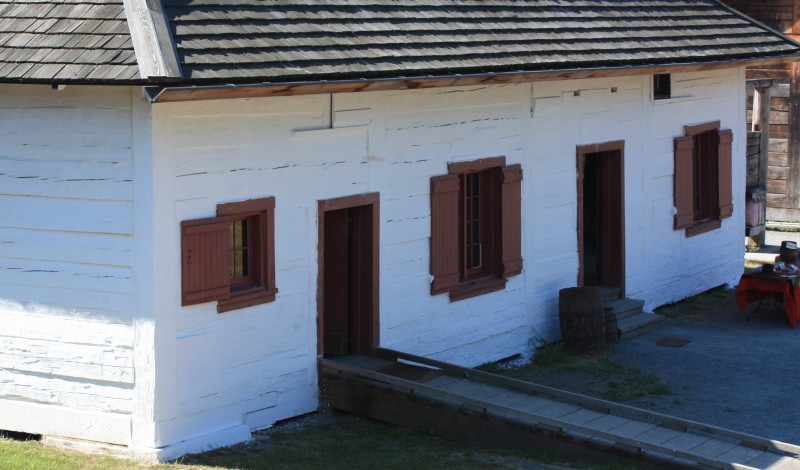
Fur trade warehouse at Fort Langley, the same as found in any fur trade fort
HBC clerk Augustus Peers continues his journey west and north, from Cedar Lake on the Saskatchewan River, to the Pas and Cumberland House, the latter of which stands on Cumberland Lake. Why do I write this *the Pas* instead of *The Pas?* Because the Pas is what the HBC men called the place where the mission was later built. So here is an introduction to this part of Augustus Peers’s long journey west and north.
On our second day after leaving the Grand Rapid we entered Cedar Lake–so called from the cedar trees which grow on its banks. It is a very large and picturesque lake. While crossing it we met Mr. Roderick McKenzie from his establishment on Lac à la Crosse….After a short conversation, and on the twenty-sixth of June, after crossing numerous lakes and threading our way up the rapid rivers we arrived at the Pas. Here there was a small village inhabited by a number of Cree Indians. The beach was soon crowded by the motley crew, chiefly young women, and as nearly all had babes on their backs I presumed they were the mothers thereof, though I thought they appeared too young for such an office. A school-master resided among them, who “taught the young idea how to shoot [sic].” Since my visit a church has been built and a clergyman now resides there, so that the natives are making rapid strides toward civilization.
The cedars that grew along the shores of Cedar Lake were Eastern White Cedars, and these cedars grow nowhere else on the Saskatchewan River. I told you about Roderick McKenzie in the post just before this one, so if you want to learn more about him, go to https://nancymargueriteanderson.com/rapid-river-cedar-lake/
So, we have arrived at the Pas. The Pas was at the narrowest part of the Saskatchewan River, where a high ridge that served as a lookout loomed over the river. This had been a place where the First Nations and French traders always traded, and a place where the Cree people built their canoes for their journeys downriver to the HBC’s York Factory. It was the only firm ground on this part of the river, and many early posts were built here over the years. But in the 1840s only the Cree, and mixed-blood free-traders [men retired from the fur trade], lived here, at least until the missionaries came.
Augustus Peers is visiting the Pas in 1843. In 1847, Thomas Lowe mentions in his York Factory Express journal that they “reached the Pas in the evening, where we remained all night. A sufficient number of Indians were engaged at this place to make up the boats crews to 3 men each, a few had 4, besides the steersman.” He doesn’t mention the missionary Reverend James Hunter, who had set up his mission at the Pas in 1844. Nor does he mention the missionary on his return in late summer, when he said, “Reached the Pas about 2 pm and spent the rest of the day there settling with the Indians who have been working in the boat from Norway House.” In 1848, however, Lowe tells us that “the Reverend Mr. Hunter & Miss Jessie Campbell embarked here to take a passage to Norway House,” where there was another missionary. On their return journey Lowe’s party reached the Pas at 2 pm., “and as some of the Boats did not arrive until the evening had to remain there for the night.” In 1849, John Charles’s Express stopped at the Pas and “took tea with Mr. and Mrs. Hunter, who live in a fine and elegantly furnished house.”
So, continuing Augustus Peers’s narrative: “As the climate is favorable for raising crops, potatoes and barley and several sorts of kitchen herbs are grown. Cattle are also kept which tend to further the comfort of the inhabitants of this remote village.” Peers’s story continues:
Having passed an hour or two among the good folks of this village we crossed to the opposite shore and encamped for the night. As supper was preparing, an old Indian with his wife and children arrived at the camp. They brought with them a birch-bark basket half full of eggs of every colour and size, from the smallest plover to the largest duck. As I was always particularly fond of eggs I bought as many of the latter as I could eat and handed them over to my cook to boil, flattering myself on the chances of an excellent supper; but alas! on breaking the shell of the first out popped the head of a little duck–not alive, of course, but boiled dead. Lamenting poor duckey’s fate I put it on one side and cracked another, which I found in a similar state, and thus vanished my anticipated feast. But although I was myself too fastidious to eat eggs in such a state there were those there who were by no means so nice, and I was not a little surprised and much disgusted to see the halfbreeds enjoying themselves as they drew forth from its shell a little duck or plover and gobbled it up, head, body, skin, feathers and all! After that I began to wonder what a halfbreed would stick at.
Peers had a lot to learn about growing up and surviving in the bush. Would he ever learn it? [No, he wouldn’t.] But now it is time to depart from the Pas and travel to Cumberland House, the next stop along the Saskatchewan River.
Next morning, long before the inhabitants of the peaceful little village were astir, we were winding our way up the river under full sail and made more rapid progress than by the tedious process of tracking. We encamped at our usual hour on the bank of the river….
The night being overcast and sultry, the mosquitoes proved most vexatiously troublesome and appeared determined to prevent me from sleeping. In spite of all my endeavours to prevent them, a whole legion got into my tent, and although I rose several times in the night and banged away right and left with a towel for ten minutes, believing that I had surely killed them all, still no sooner had I fallen into a delightful slumber than one would steal forth from his hiding place, and lighting on my nose cause me to jump up and give myself a sound slap in my impatience to kill the torturer. Whether I succeeded in killing all I do not know, however, towards morning sleep sealed my eyelids fast and I should have no doubt slept till the sun was high in heaven, had not the ever watchful [Alexis] L’Esperance with his “Leve! Leve! Leve!” [get up! get up! get up!] in about as much esteem as I did the half past five o’clock bell at school which warned me that it was time to pursue my daily studies; but by sleeping in the stern of the boat I enjoyed my rest until breakfast time, unless the weather was wet or a rapid and portage were met with. [There may be a few words missing in the sentence before the last?]
Shortly after leaving our encampment next day, we met the Athabasca brigade of boats under Mr. [Colin] Campbell, a chief trader in the service, who was likewise on his way to the common rendezvous, York Factory, and as it was the usual hour of breakfast we put ashore for that purpose. Mr. C. had come from the distant interior in the Athabasca District, and as he had to go all the way to York Factory and return again to winter quarters, the greater part of the short summer was spent on the voyage. Had I not known that my entertainer came from the north where good things are a rarity, the nature of our morning’s repast, pemmican, would have revealed the fact.
I checked very carefully to see whether or not this was Robert Campbell, of the Yukon. It was not. At this time, Robert Campbell was exploring the Yukon River for the first time, and he would spend his winter at the Liard River post of Frances Lake. Peers’s narrative continues:
Breakfast over, as time would not permit of a further acquaintance, we parted and pursued our respective routes. During the day we fell in with a party of Indians encamped on the bank of the river, but as Mr. C’s people had probably relieved them of all their superfluous provisions we obtained little else than fish, which however I was glad to get. I was much amused at the unceremonious manner in which the halfcastes turned over the goods and chattels of the old women in their search for a piece of fat or a bladder of grease, the owners looking on evidently ill-pleased but fearing to complain, as they knew their customers from old experience.
Don’t be offended at Peers’s words–this is who he was, and in spite of his attitude toward anyone who was not white and English, he tells a good story that we all want to hear. For the most part I leave his offensive words out of the book, except when I am talking about his attitude toward others.
On the last day of June we entered Cumberland Lake. In a bay at its western extremity stands Cumberland House. Our course lay along the eastern shore but as it was necessary to call at the Fort for a further supply of provisions, we landed on a small, willow-clad island where one of the boats was unloaded, and presently started for the Fort; being anxious to visit it also I accompanied the guide, and after a pleasant sail we came to the landing. As the proper manager of the fort was on his way to York Factory with his returns of furs, we found the place in the temporary charge of an Orkneyman. The approach to the houses lay by a dry and well-beaten road through a shady grove of trees which must afford to the inhabitants a delightful retreat on a summer’s evening. A treat, by the way, which many of the inhabitants of the forts in the country are strangers.
Fort Cumberland, which is constructed entirely of wood, is prettily situated on a long low bank surrounded by trees. The Lake on which it stands is very extensive and well-stocked with excellent white fish and sturgeon, some of the latter with new milk formed my breakfast which proved a great treat. The flesh of the sturgeon is very rich, and though a great delicacy is not a fish on which one could live without getting tired of. They are sometimes kept alive for a considerable time tethered by a rope passed through the gills and mouth to a post sunk in the water.
Now, isn’t that interesting? Augustus Peers actually has a wonderful description of Cumberland House, which is a place that not much is written of, or not described well. This is the fort that Governor William Williams lived at when he was governor of the HBC, 1818 to 1821 or so. When we get back to Simpson’s Athabasca journal, we will learn more about Cumberland House as it was in 1820. Peers’s narrative continues:
There is a large garden attached to the establishment in which are grown potatoes, etc., and as the hop plant grows in the neighbourhood, beer is also added to the other creature comforts of this place. The swampy and sedgy borders of the lake afford shelter and feeding to the numerous flocks of wild fowl in the spring and autumn, and many choose to bring forth their young progeny here.
Several bags of pemmican were conveyed to the boat in a cart built in the rough-rustic style and drawn by oxen. We embarked, and leaving this peaceful retreat of the fur trader, we returned to the island, and as the wind was both fresh and favourable, we were soon bounding over the waves on our course.
Their course led them north, up the Sturgeon-Weir River to Portage-de-Traite, once known as Frog Portage. The Sturgeon-Weir was also called the Maligne, or the Wicked River–as Alexander Mackenzie said, it was “an almost continual rapid.” Simpson, as he heads up the Sturgeon-Weir in 1820 says much the same thing. “Proceeded up the River Maligne,” he wrote, “very appropriately named as it is a continual rapid for abou thirty miles, the poles in use nearly the whole way.”
As I have already written Augustus Peers’s story of the journey up the Maligne River, I will include it here: https://nancymargueriteanderson.com/wicked-river/
This book, titled: “No Ordinary Risks: Epic Historic Explorations from Hudson Bay to the Arctic Sea,” will be published in January 2027.
Copyright, Nancy Marguerite Anderson, 2026. All rights reserved.