
Rapid River to Cedar Lake
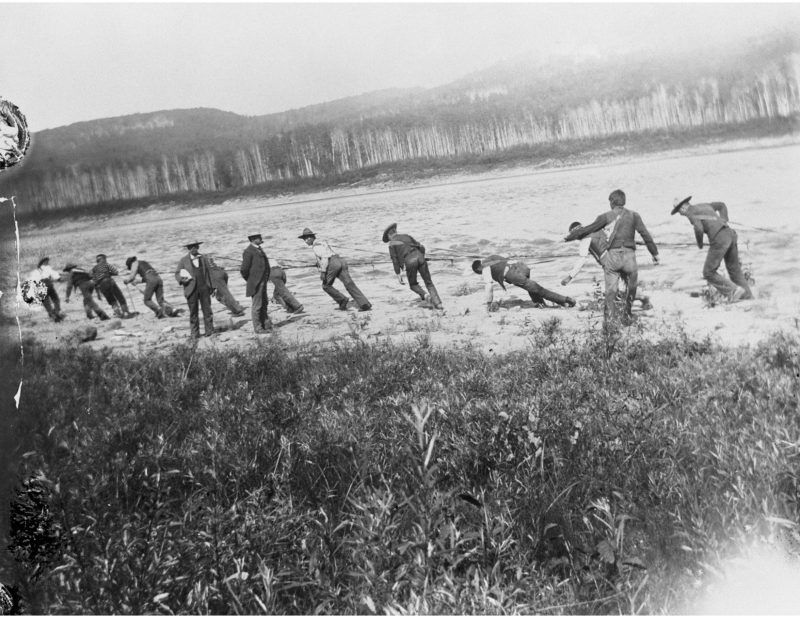
This tracking image is used with the permission of the Glenbow Archives, image na-949-115. The guide yells “Haul, Haul,” while the voyageurs pull the boats upriver and the gentlemen stand by, watching.
Rapid River was the name of the short piece of the Saskatchewan River, that extends westward from the horseshoe bay at the mouth of the river, on Lake Winnipeg, to the base of the Grand Rapid. In 1843, clerk Augustus Peers arrived at the mouth of the river with the Portage la Loche boats, where he tells the story of the Portage la Loche brigades making their way up this three-mile-long rapid-filled river, and the Grand Rapid beyond.
Peers’s writing is really good, and as a result, its really enjoyable. But as you will see, as we follow him into the Mackenzie River district, he is not a very nice man. But that makes no difference to the story he tells so well.
Towards sunset we entered a beautifully picturesque bay which formed the outlet of the Rapid River. We were now in the vicinity of the Grand Rapid and as we presently felt the strength of the current we put ashore on the left bank to prepare to surmount the rapid. Here there commenced the toils and difficulties of river travelling through which, for the most part, to the distant regions of the Mackenzie River, my course lay.
Although the sturdy voyageurs had passed this route several times before and were consequently fully aware of the many trials and hardships awaiting them, their spirits were as buoyant as ever and they set manfully to work to unload the boats.
They were unloading the boats, not at the rapid-filled Rapid River–that is, the short section of the Saskatchewan River that runs from Lake Winnipeg to Grand Rapid–but at the base of the Grand Rapid itself, three miles upriver from its mouth on Lake Winnipeg. The Rapid River was a challenge, to be sure, but ascending the Grand Rapid was a major chore, and took much hard work. It was not necessarily a dangerous rapid, although men certainly died here. But it was a long, hard job. Peers’s description of the work the men did continues:
The sun being yet up, the guide determined on getting over a portion of the work forthwith, but as this rapid is several miles in extent and the water too turbulent to allow of the boats passing up under full cargo, half of the goods of each boat were landed and covered up, and a person left to guard them, while the several crews prepared to mount their respective boats with the other half of the cargoes to the carrying ground.
The mode of procedure was now changed. The oars, being of no service here, were placed fore and aft within board, and a tracking line fastened to the bow–the other end of which was furnished with leather straps to which the men attached themselves to drag the craft upstream, after the manner of canal boat handling. On ordinary occasions it is customary to employ only half the crews at a time in tracking while the other half remain in the boats, ready to take their turn on the line at the end of what in voyageur parlance is termed a “pipe”–generally an hour and a half. On the present occasion, however, the strength of the rapid required all the force available to surmount it; therefore with the exception of the steersman and bowsman, who remained on board, the whole of the crews were sent on shore to track. Those who remained in the boats divested themselves of their trousers and shoes, ready to jump overboard to fend the boat off from stones, or in case of the line breaking to prevent it from being turned down with the water.
All being ready the work commenced, the guide of course taking the lead with his boat, the others following at equal distances.
The guide is Alexis L’Esperance, as you know. His description is in one of the previous blogposts.
Such was the strength of the current, the trackers were often obliged to bend themselves till their hands touched the ground, giving them the appearance of walking on their hands and feet, as in fact they were, for the former served them at times as much as the latter. The water foamed and boiled as it shot past the boats in its course, and it required the utmost skill of the bowsman and steersman to keep the craft from sheering out and so coming broadside on to the rapids. The bowsman with a long iron-shod pole watched every movement, changing his pole from side to side as occasion required, while the steersman plied his long sweep-oar in concert, and every now and then cried out at the top of his voice to those on shore to “Haul! Haul! Haul!”, when in fact they were hauling to their utmost and straining on the line which was brought to an alarming state of tension as the boat creaked and quivered between the contending force of the water and the trackers. It not infrequently happens that while mounting rapids of this sort the line will suddenly snap, pitching the disconsolate trackers on their heads and hurrying the boat to the foot of the rapids, thereby causing a great loss of time and labour. Such was the power of the current, notwithstanding the united force of six men to each line, the boats were at a dead stand, the boiling surges nearly foaming over their bows. This was altogether a novel sight to me and I watched the slow progress of the boats with interest, expecting at every moment to see one or another swept down and dashed among the rocks which projected out of the water. Becoming at length tired of watching them, I shouldered my gun and ascended the steep bank where I found a well beaten footpath by which I pursued my way through a luxurious growth of stately pine and maple, and after a half an hour’s walk came to the carrying ground where the boats would land their cargoes.
In spring or early summer, 1821, Governor George Simpson came down the Grand Rapids on his way to Norway House. He said of them that although “it was considered dangerous to run the Rapid with the full complement” of men and packs, that the Grand Rapid was “considered the finest run in North America, and altho’ the swell is heavy it is by no means a dangerous rapid.” We return to what Augustus Peers’ has to say of this rapid.
Here I obtained a very magnificent view of the river and rapid as it foamed and boiled its onward way. the opposite bank of the river curved inwards, forming a beautiful bay whose waters being out of the influence of the current, were as tranquil as a mirror, and on whose bosom several wild swans were sailing to and fro in all their stateliness, while on some rocks close by a group of pelicans sat sith outstretched beaks watching their prey in the water beneath. The expiring sun threw its its golden rays on the emerald foliage and added splendour to a scene that would have graced a more southerly clime.
This next is why I don’t like Augustus Peers very much. “Having feasted my eyes on this delightful scene, I again entered the forest to wile away the time in quest of game but, with the exception of a large hawk which I mercilessly shot, while sitting on her nest on the topmost branch of a lofty pine–also a few small plover in a neighboring swamp–I found myself little to shoot.” Now, why shoot a hawk sitting on her nest? Even he admits his actions were merciless. The only reason why I tolerate the man is that his writing is good, and he describes the north as we modern-day visitors will never see it.
His story continues. Do not be offended by the use of the words “half-caste.” These were the words that were in use at this time, by some men at least. To hear his story, you have to listen to it in his own words.
The boats shortly arrived and after discharging their cargoes at once put out into the current and were soon hurried to the foot of the rapid where they were to pass the night with the rest of the goods which would be brought up next morning. My cook, however, remained with me, and having chosen a convenient spot, I had my tent fixed up, as it was probable we should spend two days here in transporting the boats and cargoes.
Next morning, the boats again arrived about breakfast time, and after the hungry crews had demolished half a dozen capacious kettles of robbibo, the work of transportation commenced.
Robbibo (spelled various ways) is a thick soup made of pemican in chunks boiled and thickened with handfuls of flour, much like a pea soup. It was very nutritious and a high-energy food, and easily eaten with a spoon and a bowl–something that every man carried with him.
Each piece [pack] weighs eighty-four pounds, and two such pieces are carried at a time by each of the men who are provided with a portage strap of leather. The porter attaches both ends of his strap round one piece, which he slings on his back, placing the loop of this strap over his forehead. Then, with his hands, which are entirely free, he takes up the second piece and lifting it over his head, drops it on the first. Thus loaded, off he sets at a shuffling trot to the other end of the portage, where he deposits his load and returns for another. I have elsewhere spoken of the loads these half-castes will carry. They take a delight in showing of their prowess and contend, one with another, in carrying the heavy loads. Some will not only carry but actually load themselves with five or six such pieces, to do which requires no small amount of physical force. The Scotch and Orkney men, although they ultimately become good porters, find this sort of duty at first irksome and harassing and are generally glad to avail themselves of the friendly support of a tree to rest their loads against, while two or three brules [“burnt”], as the half-breeds are scornfully termed by the Canadiens, will come sweeping past in a headlong race, jeering them with “Hello, Boy! Come Along!” It not infrequently happens that one will trip his foot in some branch or stump and fall prostrate with the full weight of his load, one hundred and sixty-eight pounds, on his body, hurting him severely.
If you want to learn more about the Grand Rapid, go here: https://nancymargueriteanderson.com/grand-rapids/
Augustus Peers had something to say of the First Nations who camped at this rapid, which was, by the way, an enormous sturgeon fishery for them. “During the day a family of Cree Indians who were encamped in the neighbourhood paid us a visit. Their children were running about in a perfect state of nudity and appeared to mind the want of clothes but little, and were utterly regardless of the scorching heat of the sun or the merciless attacks of mosquitoes…” It’s actually quite difficult to copy out a full sentence of his, without having him descend into demeaning descriptions, especially when he is talking about people who he calls “tawny.” But he did enjoy their maple sugar. “The old people had a few cakes of maple sugar which I traded from them.” I wonder what he used as an item of trade? Tobacco? Ammunition? Liquor? “This sugar, which is excellent, is made from the sap of the tree. In the spring, when when the trees are full of sap, notches are cut in the bark into which pieces of wood are inserted to act as a conductor for the saccharine matter which as it exudes from the tree falls drop by drop into bark dishes placed beneath. In this way several trees are tapped at once, and the juice being collected in a kettle, is boiled down to the consistency required–either in syrup or sugar. Where maple does not grow, as in the more northerly district, the birch tree is an excellent substitute and by the same method a very excellent syrup is obtained, a small quantity of which added to cold spring water forms a wholesome and refreshing drink at a hot day.” MMMM! Sounds delicious! His journal continues, as the men of the Portage la Loche brigades begin their journey up the Saskatchewan River west of the Grand Rapid.
The goods and boats all being carried across, and everything made ready, we once more embarked above the rapid. The mosquitoes had now gained strength and commenced their attacks on us with unrelenting perseverance. I had however prepared myself in some measure to resist their persecutions. By pulling down a green silk veil which I had reefed round the rim of my cap, and fastening it securely round my neck with a draw-string, and by encasing my hands in gloves and pulling down the cuffs of my sleeves, I set the enemy at defiance! Nevertheless, one would occasionally in spite of all my care, squeeze his way under the veil and apprise me of his presence by sticking his proboscis into my ear or some other tender part. I noticed that they preferred some people to others: those of a fat and sanguinic [sic] habit being in most cases the victimized wretches. Many of the men’s faces and necks were completely cut up by repeated scratching, while the scraggy fellows were allowed to go scot free.
Insects were a problem in many places in the wilderness, but here, in mid-summer, and on the muddy banks of the Saskatchewan River, they would be numerous! Overwhelming, in fact. His story continues:
But the mosquito is not, in my opinion, as bad as the sand fly. The former (the mosquito), albeit he makes you smart at first puncture with him proboscis, quietly sucks your blood and when full flies off with a sharp buz-z-z scarcely able to bear away his bloated carcass; but unless you really provoke irritation by scratching the part no annoyance is felt. Not so the sand-fly which is so small that you can scarcely see it on your skin; its bite is very poisonous and the part attacked is marked by a blood-red spot under the skin; the wound swells and exactly resembles in appearance and sensation the sting from a common nettle, which as everyone nows is anything but pleasant. A single bite is nothing to complain of, but when it comes to dozens at once, it is another affair.
On the second day after leaving the Grand Rapid, we entered Cedar Lake–so called from the cedar trees which grow on its banks.
In fact, the cedar trees were Eastern White Cedars, that grow nowhere else on the river.
It is a very large and picturesque lake. While crossing it we met Mr. [Roderick] McKenzie from his establishment on Lac-a-la-Crosse. He was now on his way to the marine depot [York Factory] with his winter stock of furs. After a short conversation, and on the twenty-sixth of June, after crossing numerous lakes and threading our way up the rapid rivers, we arrived at the Pas….
Roderick McKenzie is James Anderson’s father-in-law. James Anderson is, of course, the man who made his way north along the Great Fish River in 1855, in search of remnants of Sir John Franklin’s lost and now-long-dead men. James Anderson is also Alexander Caulfield Anderson’s older brother. And A.C. Anderson is my great-grandfather (as you all know.) So, Roderick McKenzie is in my family tree. In his “Character Book,” Governor George Simpson wrote this about Roderick McKenzie Sr:
About 60 years of Age. A very honest well-meaning warm-hearted correct man altho’ irritable and short-tempered to such a degree that it is unpleasant to do business with him. His Health and constitution broken down and worn out so that his useful Days are over, and it is full time that he should retire from the Service altho’ he has not held his present situation exceeding two years; indeed, he never was possessed of abilities which could qualify him to fill such a situation with advantage, and he owed his late promotion entirely to the circumstance of his being senior to two Gentlemen who were in Nomination with him and being less objectionable in many points of view, the Company having had the choice of three very indifferent and in some respects unfit men from among whom it was necessary to fill the vacancy to which he succeeded.
Simpson says he is 60 years of age, which is true. He would be 73 when Augustus Peers met him. The footnotes are interesting: “Usually known as Roderick McKenzie (Senior) to distinguish him from Roderick McKenzie Jr., who died in 1830. McKenzie was born about 1772, joined the North West Company in his twenties, and at the coalition of 1821 became a Chief Trader in the HBC. In 1830 he was appointed Chief Factor and sent to Ile à la Crosse in charge of the English River district, where he remained until 1850. After two years’ furlough he retired from the Company’s service in 1852, and died at Red River on 2 January 1859, aged 87.” Somewhere, Simpson says that he was too honest to cheat an Indian, which says more about Simpson himself, than it does about McKenzie. “McKenzie’s letters show this indomitable old man firmly in charge of affairs at Ile à la Crosse, despite a crippled leg; as he wrote to James Hargrave in 1839 when explaining why he would not be going to the Council at Red River, ‘I can be of more use at my Post, in Trading a Skin than at the Council…'” In 1846, Simpson actually attempted to discourage McKenzie from retiring because his returns were so good. McKenzie did regret eventually retiring, and said to Simpson that he would return to the trade if his eyesight was not so poor. “Isle a la Crosse is the only place where I have been happy during my long residence of 56 years in the Indian Country.”
To return to the beginning of this thread, go here: https://nancymargueriteanderson.com/augustus-peers-journal/
When the next post is written, it will show up here: https://nancymargueriteanderson.com/the-pas-and-cumberland-house/
This book, titled: “No Ordinary Risks: Epic Historic Explorations from Hudson Bay to the Arctic Sea,” will be published in January 2027.
Copyright, Nancy Marguerite Anderson, 2026. All rights reserved.