
Simpson to Cumberland House
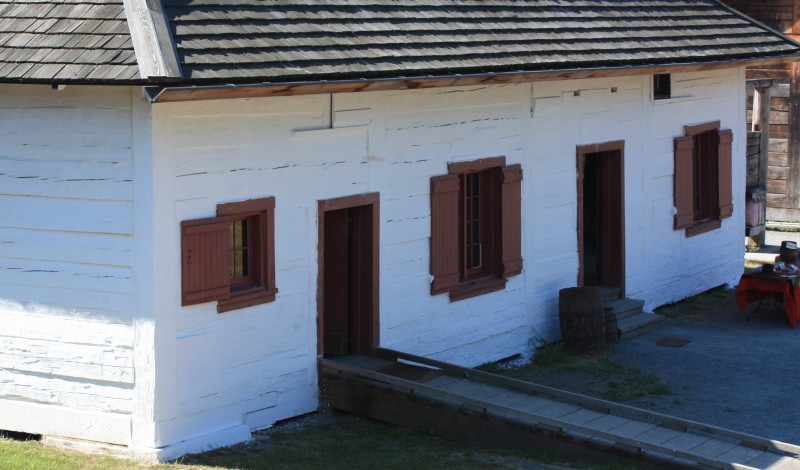
Fur trade warehouse at Fort Langley, the same as found in any fur trade fort
In August 1820, Governor locum tenans George Simpson had come upriver in canoes, from Rock Depot to Norway House, where the men of the Athabasca Brigades would load the remainder of the goods that had been shipped upriver from York Factory. By the end of this post they will be at Cumberland House, but they have some distance to travel before they get there. So, let’s see how they manage to get along.
From Norway House, on August 15, 1820, “The Brigades started from the Point this morning with a fair wind. Mr. [Robert Seaborn] Miles closing the Athabasca accounts.” The “point” is Mossy Point, the long tongue of land that separates Playgreen Lake from Lake Winnipeg; and the current Norway House stands on the east shore of this point of land. However, Simpson and Miles were still at Norway House preparing the account books for presentation to the London Committee. On August 16 Simpson wrote letters, first to Governor-in-Chief William Williams, telling him of the disruptions suffered at Norway House and letting him know what changes should be made to make things run more smoothly. He also told him that because of the shortage of goods for the Athabasca, little of what he was instructed to do there could be accomplished that year. Interestingly, I discovered a letter that told me what he expected he would be doing over the winter of 1820-1821.
On Sunday afternoon [February 1820] I leave town [London] for Liverpool, embark in the packet for New York on Tuesday, from thence proceed direct for Montreal and afterward take an inland Route by the St. Lawrence, Lakes Ontario, Huron, Superior, and Winnipeg to Hudson Bay and afterward to Athapascow to Slave Lake and Copper Mine River. The Journey is rather a serious undertaking and the mission is important…
Coppermine River, he says? Well, that was before he left London, and some things changed. However, he did reach Rock Depot and Norway House, and he was assigned to the Athabasca district, although it appeared he was supposed to return to London from York Factory. This is a question I have to answer, I guess. But, let’s continue with the story of the journey west from Norway House: he said this:
All our Canoes for the interior are in a wretched state, there was not a sufficient quantity of Bark, gum and roots for their Repairs, and I fear the goods will in consequence get damaged; to avoid this evil next year, I beg the favor of your giving directions that fourteen Canoes may be furnished from the Saskatchewan; Mr. [John] Clarke will provide six, and a sufficient quantity of Bark, Gum & Roots required for ten or twelve more from Swan River, Lac La Pluie &c., in order that some of the Guides may be employed here in making and repairing, while the different Brigades are at the [Rock] Depot for their Cargoes; and if a canoe shed could be erected during the Winter, it would be very important not only for the preservation of the canoes but that the building & repairs may not be delayed by unfavourable Weather.
He also asked for storage boxes or cassettes, and a good supply of oil clothes to protect the goods in transit. “We have experienced some inconvenience from the scarcity of provisions, the Canoes have no more than one and a half bag of Pemican each to Cumberland.” Very important! If you do not feed the men who do all the work, you will have problems with them further down the line. Simpson also advised that there be goods for the working men to spend at Norway House, as “our men should expend as much as possible of their enormous wages when in this part of the country.” Enormous wages, he said. I think you can see the future coming.
To continued with Simpson’s comments: “Mr. [George Peter] Andries arrived here on the 6th Instant [August] from Cumberland, and took his departure for Athabasca with Mr. [Jonas] Oxley a few days ago. He has explored the Rein Deer Lake Route, but finds there is not sufficient water for boats or Canoes.” The Reindeer River is on the north side of the Churchill River, about where Lac la Ronge is to the south of the Churchill: it leads northwest from the Churchill River, and via Reindeer, Wollaston, and Black Lakes, reaches the east end of Athabasca Lake. It would have been a good route, perhaps, if the water had been deep enough.
On August 17, Simpson’s canoes were on the water and making their way across Lake Winnipeg, heading for the Grand Rapids, where Simpson thought it likely that the North West Company men were waiting for them. “We have therefore provided our people with a musket and bayonet each, and ten rounds of ball cartridge, and armed ourselves for the purpose of Self defence; thus equipped I started from Norway House at 5 a.m. with Mr. Miles in a canoe manned by nine stout Canadians, accompanied by Messrs. [John] Clarke, [Archibald] McDonald & [Louis Leon] Pensonnant in another with the same compliment of men. Put ashore to breakfast at nine, re-embarked at ten after gumming the Canoe, and at twelve were compelled to land by strong head wind; Mr. Clarke’s canoe being quite light was enabled to proceed, whereas mine was deeply laden and had nearly swamped before we got ashore. The gale continuing, we encamped for the night.”
They probably paddled across the lake and stopped on islands, but if they did not then they followed the shoreline around the northern edges of Lake Winnipeg, where it also wasn’t easy to find a good landing place. If they seem to be travelling fast, remember they are in canoes and not York Boats. On the day that followed, Simpson’s canoes set off again, and late in the evening reached the bottom of the Grand Rapid, about three miles up the Saskatchewan River.
Blowing hard all night. Embarked at four a.m., and came up with Mr. Clarke at eleven. Breakfasted and got to the foot of the Grande Rapid at ten p.m., when we landed and sent two men across the Portage to reconnoitre; gave the people a dram (the Canadians require an auxiliary of this kind in time of danger), arranged our arms, and sat up all night, as we suspected the N.W. Half-breeds were laying in ambush for us.
They weren’t, as it happened. The next day: “The men who were sent across the Portage last night returned at 3 a.m., and informed us that the coast was clear. Embarked and landed opposite Martin, the Freeman’s lodge; this fellow is a N.W. Co. [North West Co.] spy, he addressed us very politely and attempted to play the Sycophant, but Mr. Clarke gave him what is vulgarly called ‘a good blowing up.’…Crossed the lower Portage, about three miles; at the upper end Ploueff, the Freeman, has a lodge, a decent fellow attached to our cause. From him we learned that Messrs. [James] Leith, [James] Keith, Simon McGillivray [Jr.] and an Army of Clerks, Interpreters, Half-breeds and Canoe men, loaded with arms and threatening destruction to the Hudson’s Bay Company, had passed a few days ago. He also informed us that our Brigade had passed the Portage on the same day in Company with the N.W.C….” and that the remainder of the NWC canoes were expected to arrive in a day or so. Simpson’s journal continues:
Breakfasted and by twelve the canoes and baggage were transported to the upper end of the Portage: Gummed & Embarked. Broke our canoe in the Red Rock Rapid, lost an hour in repairing the damage. Sailed through Cross Lake [Lac Traverse]. Got to the head of the Saskatchewan Rapids at 7 p.m. Passed through the narrows of this Lake (where a Freeman resides) and encamped on an Island at eleven p.m. This is considered a good days march. The Weather more sultry than I have yet experienced it.
20th–Sunday. Embarked at three o’clock, got through Lac Bourbon [Cedar Lake], and at nine came up with the Ile a la Crosse boats, Mr. [William St. George] O’Doherty and [Patrick] Cochrane [Corcoran] passengers for Athabasca…Breakfasted & re-embarked at ten; the heat very oppressive and after a hard days march encamped at nine o’clock. The Waters are very high, and the banks of the River inundated, so that we actually floated in our blankets and were tormented by Myriads of Moscheto’s.
21st, Monday: The Mosheto’s drove us from our Encampment before day break this morning; Breakfasted at ten; Passed the Carlton Boats at twelve, and Mr. Clarke’s Brigade at four p.m., also eight of the NW Canoes, and at nine o’clock landed at a similar encampment to last night.
22nd, Tuesday: Embarked at half past three a.m.; passed fourteen N.W. Canoes. I could not help remarking with much concern the striking contrast between our Brigade and that of our Opponents; all their Canoes are new and well built of good materials, ably manned, a water proof arms chest and cassette [box] for fineries in each, and the baggage covered with new oil cloths: in short, well equipped in every respect. On the other hand our Canoes are old, crazy, and patched up, built originally of bad materials without symmetry and neither adopted [adapted] for stowage nor expedition; manned chiefly by old infirm creatures, or Pork-eaters [greenhorns] unfit for the arduous duty they have to perform; the Arms wrapped up in Leather so that the first shower of rain must damage them; and not more than half a dozed tattered Oil cloths in the whole Brigade: there is much room for improvement in this branch of the business.
You can see the wheels churning!
Our guides have wrought night and day to keep the lead. At four o’clock observed a half loaded Canoe pushing across the River towards us. It turned out to be Simon McGillivray, who merely came alongside to make his observations. This Gentleman I understand has been most active in every nefarious transaction that has taken place in the Athabasca, he is notorious for his low cunning; has made Mr. Clarke a prisoner twice; and threatens to have him soon again. He seems to have mistaken his trade, as he possesses sufficient artifice to have ranked high as a tip staff in the civilized world.
A tip staff, to Simpson, was a court official or a bailiff. His comments continue:
Next to [Samuel] Black, he [McGillivray] is more to be dreaded than any member of the N.W. Coy. He was the principal leader of the lawless assemblage of Half breeds and Indian Assassins at the Grand Rapid this season: a day of retribution I trust is at hand for this worthy. Continued our route until twelve p.m., as we could find no place of encampment, the banks being overflown with water, and came up with the whole of our Brigade. Passed some encomiums on the Guides and men for their activity, which arose from two causes: the spirit of emulation, and fear of starvation as their provisions are quite exhausted…I gave a dram to the people and supper to the Officers & Guides.
23rd–Wednesday: All our Canoes were in the water this morning at two o’clock, and I arrived here [Cumberland House] at six a.m. The Brigades encamped on Athabasca Island, where they took in provisions for the remainder of the voyage. Here there is also a scarcity of Pemican, from Norway House to this place the Canoes had one and a half bags each, and from hence to Athabasca they take six bags. Their regular allowance in nine bags for the whole voyage, ie. from Norway House to Athabasca, and I understand it is little enough, but if under that quantity the Flour generally suffers. This, however, I hope will not be the case on the present Voyage, as our quota of that useful article is very scanty.
I presume the flour suffers when the men must be allowed to extend their supply of pemmican by making a thick soup called rubaboo, made from pounded meat (pemmican) boiled in water and thickened with flour.
From Cumberland House, Simpson wrote some letters: the first to Governor-in-chief William Williams. In this letter he reported that “The North West Co. I am happy to learn are not quite so formidable as we had reason to expect; their Lesser Slave Lake and Athabasca Fall Expeditions amounting only to Twenty two canoes. They passed the Grand Rapid the same day that ours did, and the Guides seem inclined to display their marching talents.” His letter continues:
Messrs. Leith, Keith, Black, and McGillivray are, I understand, to be my opponents at the Lake, [John George?] McTavish at Peace River, and Thompson [John Thomson], [John?] McDonald (White-Head?), and Livingstone (the Montreal Sheriff’s Officer), at Ile-a-la-Crosse:–we must be on our guard, and I hope they will have nothing to boast of in my department. Mr. Clarke is preparing to meet them on any terms, and from his superior means and force he cannot fail of giving a good account of them. But in the event of their committing any serious outrage, which we may be unable to resent [resist?], we trust much to your powerful assistance in Spring.
You might wonder about “Livingstone,” mentioned above, who was apparently the Montreal Sheriff’s Officer. This is Duncan Livingstone, who joined the North West Company in 1819 and was sent into the Athabasca as a constable to annoy the servants of the HBC. Well, although you have not yet run across him, the HBC also hired a Montreal Constable, and he will appear in about November 1820, if I remember correctly. His name was Amable Grignon, and it is he who captured Simon McGillivray Jr. But I am getting ahead of the story, am I not?
In his journal, Simpson described Cumberland House, and you can see why Governor-in-chief William Williams chose this post as his headquarters and residence for much of the year.
Mr. [Francis] Heron is at present in charge here, pays us every mark of attention, and appears an interested valuable Officer. This is by far the best place of residence I have seen in the Country and capable of being made an excellent Farm as the soil is fertile; Mr. Williams has made great improvements already, the Garden produces a variety of Vegetables, and the crops of Wheat, Barley & Oats look remarkably well: the Lake abounds with Wild Fowl & delicious fish, so that there is no danger of starvation here. It is usual to supply the Gentlemen of the Athabasca Department with a few [smoked buffalo] Tongues and dried meat for the Voyage at this place, but this season no other provision is made for them than Pemican. In this respect I think there should be some little distinction made between the Officers and Canoe-men.
25th, Friday: It has blown hard all day, which unfortunately detains us here, but we must made an early start in the morning, if possible.
I think he had sent the rest of the brigade ahead of them, not, of course, expecting to be delayed by the wind. Imagine his surprise when he arrives at the brigade’s encampment, on the Maligne [Sturgeon-Weir] River, to find that, on August 26:
Mr. Clarke converted one of the Canoes of his Brigade into a Light Canoe with eight men for the better accommodation of his Woman [Sapphira Spence], and her Servant; taking the Ladies into his own, and turning Messrs McDonald & Pensonnant into the other, the Cargo left at Cumberland; this measure is somewhat extraordinary, as I have repeatedly intreated him to bring on some pieces for the use of the Athabasca Department, which he knows is very inadequately supplied with goods, but he uniformly replied: that he requires all his supplies and accommodation for the use of his own District. The Committee may well be displeased when they learn that one of their Officers deliberately puts them to an expense of about £500, exclusive of the injury their business may sustain by the want of the goods merely for the accommodation of an Indian Mistress. Mr. Clarke daily loses ground in my estimation, yet he has some good qualities….
In these days, the men who were in charge of the various posts had no one who was in charge of them–they reported only to the London Committee, and not to anyone else. You can once again see the wheels churning in Governor Simpson’s head–this would definitely be one of the things he would change. In fact, when he did have the power to do so, a Nor’Wester named Williard Ferdinand Wentzel, now converted into an HBC employee, complained that “the northwest is beginning to be ruled with a rod of iron,” and quit the HBC. [Interestingly, Wentzel was Swedish: the only Swede in the fur trade as far as I know.] I will have to admit, Simpson may have carried things too far, but change was required, and he was the man to make those changes!
So, when I do the next blogpost, we will travel up the Sturgeon-Weir River (sometimes called the Maligne, because of its constant chain of rapids), to the Churchill River. I don’t know how far we will get, but we’ll find out.
When the next post is written, it will appear here: https://nancymargueriteanderson.com/sturgeon-weir-river/
If you want to return to the beginning of this Athabasca journey, go here: https://nancymargueriteanderson.com/simpson-at-rock-depot-1820/
Copyright, Nancy Marguerite Anderson, 2026. All rights reserved.