
Portage La Loche
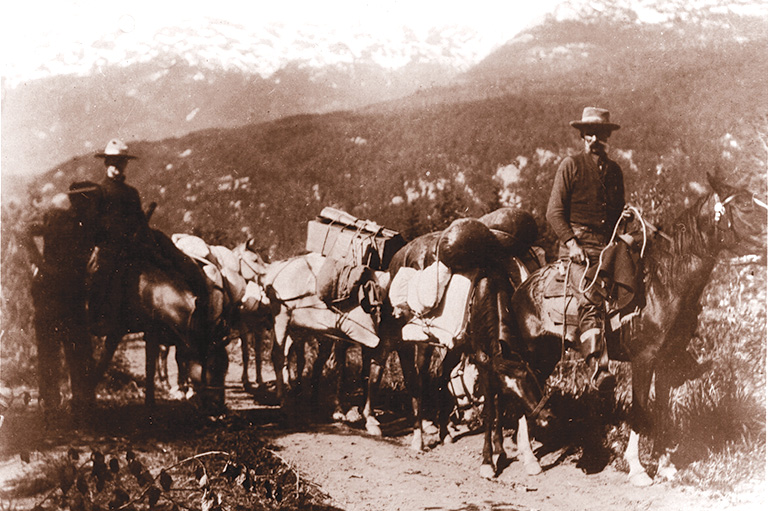
Men on horseback leading packhorses on a rocky path with high snow covered hills in the background.
In 1843, Augustus Richard Peers made his way north by the Sturgeon-Weir River and the Churchill, to the Ile-a-la-Crosse post on Lac Ile-a-la-Crosse. There he met Roderick McKenzie’s wife and children, and Peers wrote that
I spent an agreeable half hour at this pretty establishment in the society of Mrs. and Miss McKenzie. The society of the fair sex is a blessing at any time, but more particularly in a country where so few ladies reside. After half an hour spent in chatting about our mutual acquaintances south, we embarked again having strengthened our victualling department with several bags of pemican. There is nothing striking in an architectural point of view about this establishment, but as it is prettily situated on the shelving slope of the bank and surrounded by trees and shrubs, which at the time of my visit were in full leaf, it formed a very pleasing picture, heightened by the rays of an evening sun. The lake is small, studded with many islands and affording excellent white fish.
We were now rapidly approaching the celebrated Portage la Loche and after four days progress through river and lake, having crossed several portages, we arrived at Methye, or Loche Rver, which from its shallowness we experienced great difficulty in passing. The men were constantly in the water, some fishing for the deepest water while others followed with the boats. Such is the tortuous course of this insignificant river that the boats appeared to be ascending and descending the current at the same time, giving rise to the great deal of mirth among the men when those who appeared too be going south would be saluted by the others with “Adieu! Adieu! Pour la riviere Rouge!”
We next entered Methye Lake and having crossed it arrived at Portage La Loche on the evening of the twenty-seventh of June [1843]. We had now reached the height of land which divided the waters which flowed north and south.
That is true. Portage La Loche is a ridge of land that lies between the Athabasca River, which flows north into the Arctic Sea, and the headwaters of the Churchill River which flow east into Hudson Bay, which is considered a part of the Atlantic Ocean, not the Arctic. Also, Methye is the Cree name for the burbot, a freshwater fish found in the lake. In later years the French word for the same fish, “la Loche,” supplanted the Cree name. Augustus Peers’s journal continues:
This being the termination of L’Esperance’s outward passage the boats were unloaded and the cargoes piled up and covered over with oil-cloths etc.
Alexis L’Esperance’s brigade of York Boats was bringing in the trade goods for the Mackenzie River district, I believe, and a later brigade of boats would bring in goods for the Athabasca District. L’Esperance’s brigade would return south all the way to York Factory, bringing out the furs for the district. The other brigade would not be able to make York Factory before the London ship sailed, so it probably brought out passengers for Norway House and Red River. I believe it would have ended its journey at Norway House and Red River rather than following the Hayes river down to York Factory and return. The second or later brigade of boats was managed by a Métis guide named Jean-Baptiste Bruce. Peers’s journal continues:
Here we found a group of free men with their horses! They had come purposely to assist in transporting the goods across the portage. A courier shortly arrived from the north end of the portage and reported the arrival of the Mackenzie’s River brigades in charge of Chief Factor [John Lee] Lewes. I immediately dispatched a message with the packet box with a note intimating my intention to join my future bourgeois in the morning. Mr. Lewes had come from his wintering grounds with the year’s return of furs. An interchange of cargoes would here take place and it was the duty of each brigade to render their respective cargoes at the middle of the portage, which was about twelve miles across. The cargo of each boat is divided equally among crews so that each individual has about eleven or twelve pieces to carry to the middle and also his share of the packs to bring back.
About a week being allowed to perform this duty, the men might either carry the loads themselves or hire, at their own expense, horses from the free men who came there in the hope of gain. Within the past few years, however, this system has been changed, and the goods are all transported by horses at the expense of the company–a great relief to the men who under the old plan were obliged to carry their loads themselves or pay dearly for the use of horses, and as such payments were generally made in goods, an unfortunate individual who was unable to carry such a distance was at the end of the job minus a good part of his kit.
So, as you can see, sometime after 1843, and likely before 1850, the horses carried the goods up the portage trail and the voyageurs (the men who rowed the boats) no longer had to do this difficult job, nor pay the men who owned the horses. It seems fair.
Next morning, I was up early and having breakfasted, my tent was struck and, pitching all my goods and chattels in a pile, I bargained with a half-breed to transport them the whole twelve miles for a fine cotton shirt and a silk handkerchief–two articles held in great demand by these people who are particularly fond of anything gaudy.
The words, “half-breed” and “these people,” refer to the Métis men who were the free-traders found here.
Shouldering my inseparable companion–my gun–I set off in high spirits at the prospects of a walk through the wild forest. As the road was imbedded in trees and shrubs, I had but a very limited view till about the eight mile where I came suddenly upon a very picturesque lake of about a mile or so in circumference.
This was Rendezvous Lake, where the two parties met and exchanged goods and correspondence.
As the morning was very beautiful and calm, the bosom of this lake, which resembled a diamond set in emeralds, was placidly tranquil, disturbed only by the gentle rippling caused by an anxious duck as she hurried to the shelter of the long grass with her progeny. As I sat on the moss-clad bank of this lake, which seemed so appropriately placed wherein the weary voyageur might bathe his heated brow, and as I contemplated the scene my gaze fell upon a grave o’er-hung by willows which tended to add solemnity to a scene which from its peacefulness appeared a fitting resting place for the dead.
While wondering to whose memory that moss-covered mound was raised, a person passed by whom I made enquiry. He told me it was the grave of a half-breed who, many years past fell a prey to his ambition! The poor fellow had undertaken a race with another man light while he himself bore a load; the margin of this lake was the appointed goal and alas it proved a goal indeed, for the ambitious spirit, having mortally inured himself internally, fell down and expired on that spot which now marks his resting place.
Arriving at the other end of the portage the most magnificent view of wild forest scenery burst upon my view. I stood upon the brow of an eminence several hundred feet high. To my left for a distance of many miles lay a country diversified by dense masses of somber pine and prairie ground, through which meandered with snake-like form, Clear Water River, like a stream of molten silver. Immediately in front of me a hill similar to that on which I stood, profusedly [sic] decked from base to crown with a luxurious growth of wood, the lighter foliage of the willow and poplar contrasting pleasingly with the deeper shade of the pine, while in the valley immediately beneath my feet glided a tranquil river on whose banks were encamped the Mackenzie River brigade, the smoke from their morning fires floating upwards in spiral wreathes in the calm air and the tents boats, men, and horses appearing like tiny atoms when viewed from the dizzy height.
Chief Trader James Anderson, who also crossed this portage, later described this same scene: “The view from the Crête [crest] is magnificent–this crête is a steep Ridge like the roof of some titanic house–along the top a path 3 or 4 feet wide passes–on either side is a profound dell–well clothed with superb pines whose plume-like tops are seen far below–the sides of the ridge are covered with dwarf willows, bear berries etc., one sheet of scarlet and yellow and different hues of green–the trees now being tinted with the Dyes of Autumn–opposite and beyond the River is an amphitheater of conical sand hills of different sizes one blending to another–they resembled the cones of volcanoes–from their distance the individual forms of the trees are lost–and the hills appear as if painted, with scarlet, crimson, Gold and different hues of Green–while here and there a dark line of pines crosses them–below at my feet was a beautiful little prairie, while the “Clearwater” pursues its silvery and devious course through the Valley–it was a lovely scene, and I saw it on a lovely day.” Augustus Peers’s journal continues:
Having enjoyed this scene, I commenced the descent by a series of declivities alternating with flats. The horses in descending and ascending this hill are obliged to adopt a zig-zag path and not infrequently it happens that a piece of goods will slip off the back of its carrier and oblige the owner to follow it in its headlong course down the declivity, again to undergo the arduous task of carrying it up.
Arriving at the bottom I soon came to the encampment, and amongst several canvas tents I discovered one much larger than the rest with an ensign floating listlessly from a pole in front of it. This I concluded to be Mr. Lewes’s tent, and on going to the door I found him sitting in true Turkish style on a pillow at the farther end of the tent, half buried amid a pile of open letters. Introducing myself I entered the tent, and as the cook was busy preparing supper I congratulated myself on having arrived in the nick of time, as my walk had considerably whetted my appetite.
Mr. Lewes next day sent all his personal baggage to the halfway [Rendezvous Lake], whither he was now proceeding to transact business, and as my services were also required I retraced my steps. I found all my property there and we had our tents pitched under the shade of a clump of stately pine trees.
During the next week, while the men were transporting the goods and packs, my own time was fully occupied in writing. The free men, who are first rate moose hunters, kept us well supplied with fresh meat, while Methye Lake afforded fresh fish. With this and an occasional dish of blue berries and poires [saskatoon berries] culled in the neighboring swamp we fared sumptuously….
The business having been satisfactorily terminated we once more crossed to the north end of the carrying ground, and on the third of August we embarked and commenced the descent of the Clearwater River on our way to winter quarters.
The Clearwater River will lead them west into the Athabasca River, which will carry them north to Fort Chipewyan, on Athabasca Lake. This story I will leave to the next post, which will be published here, when written: https://nancymargueriteanderson.com/athabasca-river-north/
To return to the beginning of Augustus Peers’s journey to Fort Simpson, go here: https://nancymargueriteanderson.com/augustus-peers-journal/
As you probably know by now, my book, titled “No Ordinary Risks: Epic Historic Explorations from Hudson Bay to the Arctic Sea,” will be published in January 2026.
Copyright, Nancy Marguerite Anderson, 2026. All rights reserved.