
Crossing Lake Winnipeg
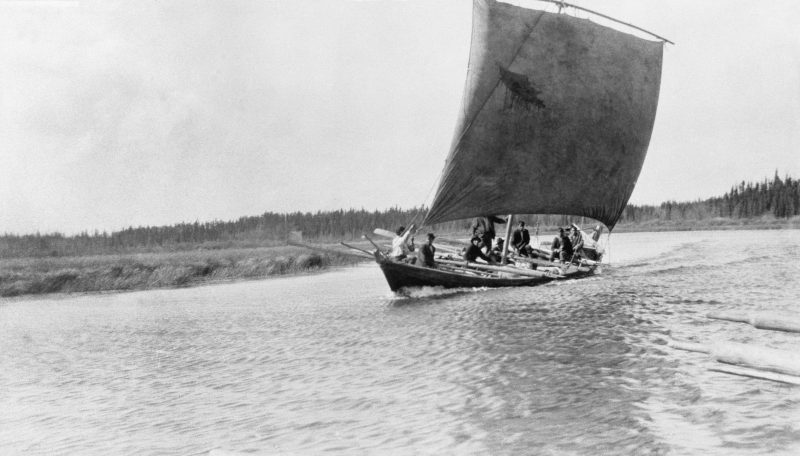
This powerful image of a York Boat under sail is used with the permission of the Glenbow Archives. Its number is na-1847-5. The HBC men sailed these boats anytime the wind was blowing in right direction, both going downriver, and coming upriver.
Crossing Lake Winnipeg was almost always challenging, as the lake was shallow and the wind and waves not generally gentle. Nevertheless, it was suddenly time for Augustus Richard Peers to leave Norway House, and cross the lake with the Portage la Loche Brigades, on his way to the Mackenzie’s River district. The year was 1843. By the fall of that year he would be at Fort Simpson, the HBC headquarters on the Mackenzie River. His journal tells the story of his wait for the York Boats–and for his brother, who would come up in the Montreal canoes.
Unfortunately for Augustus Peers, the Portage la Loche boats arrived before the Montreal canoes did, and he would not see his brother, Henry Newsham Peers, who travelled on to the west side of the Rocky Mountains. “I was kept in a constant fever of suspense lest the Mackenzie’s River brigade should arrive before them [the Montreal canoes] and thus separate us for many years more,” Augustus said. “But I looked in vain…” The men and boats of the Portage la Loche brigade arrived at Norway House, and in a day or so Augustus Peers sailed west with them, crossing Lake Winnipeg in the York Boats. “On the following morning,” he said,
After breakfast the shrill whistle of the guide was heard as he collected his men, and in ten minutes the green was strewed with boxes, bales, cases, etc. [Alexis] L’Esperance, with the other steersmen now proceeded to divide the lot into six equal parts. This being satisfactorily done, the middlemen, with tar brushes, marked their respective cargoes with some particular hieroglyphic such as an O or X,”
The symbol was to avoid mixing up the packs and boxes when they unloaded the boats for a portage. “In about an hour the boats were all ready,” Peers said, “and bidding adieu to my friends I stepped on board the guide’s boat. As we left the shore the united crews burst forth in the strain of Rose Blanche, and in ten minutes Norway House was lost to view as we doubled the point of woods above it.” His story continues:
Half-castes and young Orkney lads, just from their native land, composed the crews of our boats. I was much amused to see the particular mode adopted by the former in rowing. When going at an easy stroke they sit still as every one else would, but when they wish to pull a more vigorous stroke they rise on their feet, stretching back the oar with one hand generally, and as it touches the water with a splash the other hand is applied and the oar is bent under the force of their bodies as they descend to their seats to rise again for another stroke. Before taking the oar out of the water they give it a peculiar hoist and lift the water with it, making it boil and foam. This they term bouillon and look upon it as the plus-ultra of rowing. It is, however, easy to be seen that their constant up-and-down motion with their bouillon lifting only tends to bury instead of lift the boat at every stroke. They look upon the home method of rowing adopted by the Orkney men as childish, and I well remember how often they would say to a blacksmith who pulled an oar in my boat “Boy you no pull hard!” The blacksmith had served some years on board a whale ship and of course knew how to pull; but his tawny boat mates looked upon his long, easy, regular strokes as childish because he made no bouillon.
So, now you know what “bouillon” is. Augustus Peers is not a kind man, and he looked down on everyone who was not an Englishman. I won’t point it out but you will recognize the racism when you see it–and you will see it, sadly. His manuscript was written for the London market, and perhaps he thought he would find people who thought the same way as he did when it was published. Fortunately for us, his story makes up for his prejudice. And he really is a good writer…
Having rowed for an hour-and-a-half against current, the guide put the boats ashore to allow the men to “Pipe it” for five minutes, the better to prepare them for another pull. There I nearly witnessed a game of fisticuffs between a huge half-breed and a no less gigantic Orkney-man. We had put ashore at some steep rocks along which the current flowed fast and deep. The half-caste wishing to go ashore put his foot on the gunwale, and in taking a spring he managed very cleverly to stick his other foot in the folds of said Orkney-man’s kit which stood against the side of the boat, so that instead of ashore, head over heels he went and plunged with a lumbering splash into the river, nothing marking his whereabouts but his hat which floated up. The unfortunate wight soon appeared, spitting and cursing amid the uproarious laughter of the whole brigade. This only exasperated him the more and forthwith he commenced “jawing” the unfortunate owner of the kit who, not liking the look of the half-breed, said nothing, and I was thus deprived of seeing a half-breed fight, which I have been told was something after the approved fashion of Billingsgate–tooth and nail.
Billingsgate is the fish market in London, or perhaps it is the town that the fish market is found in. But it was a rough part of London, obviously. Peers’s story continues:
Towards evening we entered Lake Winnipeg, and the wind, which was ahead, although not blowing very hard, nevertheless caused such a swell as rendered our progress not only laborious but useless, and the distance gained would not have been tantamount to the fatigue of the men. L’Esperance, then after muttering some not over complementary epithets on the wind, made for a long low point, the nearest land to us. After a considerable pull of half an hour the boats grounded on the sedgy shore, and by the united efforts of the crews they were hauled up on the land sufficiently far to prevent the waves from breaking over them.
Every gentleman in these boats had a servant to look after them. Peers’s servant was a Saulteaux man, who had been brought up at Red River and who spoke English well. “Selecting a dry spot under the lee of a clump of willows I had my tent pitched before which a fire soon blazed. Four or five fires were also soon lighted along the shore, round which the crew of each boat might be seen laughing and joking and not at all sorry for the delay. Huge tin kettles soon graced the fire and the cooks were soon also busy stirring the several messes of robbibo, which consists of a portion of pemmican chopped fine in water and as it boils flour is sprinkled in and boiled to the consistency of pea soup.” Peers had scarcely finished his own supper of robbibo, when…
Three boats came scudding down with the wind and seeing our fires they made for the land. They proved to be the boats from Rainy Lake, under the charge of Mr. Sinclair, who was thus making the best of his way to Norway House and thence to York Factory with the returns of his post. There is no ceremony of formal introductions in this country; people are too glad to see strange faces to wait for such, consequently Mr. Sinclair and I were soon on as good terms as though we had been acquainted all our lives….
As the night was dark, Mr. Sinclair resolved to come to an anchor where he was. This I was glad of, as I had no other companion with whom I could converse freely. My visitor had not yet had supper, and although I had already finished mine I was compelled malgré moi to join him in his. The cloth was spread in the stern of his boat and notwithstanding my protestation and asservation [sic] that I could not eat a mouthful more, Mr. Sinclair was inexorable, and piled mimic pyramids of ham and chicken and whether it was the deliciousness of the repast or the animation of our conversation I know not, certain, however, it is I managed to clear my plate and I did as much justice to Mr. Sinclair’s hospitality as he did himself.
They talked until they went to bed, and the voyageurs all slept beside their campfires. In the morning, Peers woke up to see Sinclair’s sails in the distance “far away on the horizon of the lake. Our own boats were still in statu quo thereby proving that the wind was still too strong to allow us to move. Having had ocular demonstration of all this I closed the door [of his tent], fell back on my pillow with a grunt and slept soundly till my tawny cook put his head in at the door and apprised me that breakfast was preparing.” On getting up, Peers found the wind was dying, and after breakfast the party set off once again.
After an hour’s rowing the wind suddenly chopped round and blew a fair breeze. This piece of good fortune was hailed by the crew as a boon and in a few minutes we in our turn were scudding along with “a wet sheet and a flowing sea.” We were not, however, destined to enjoy our good fortune long. L’Esperance, with a practiced eye, predicted that we should soon have too much of it, and as the wind increased the sheet was double-reefed; five minutes more and the waves ran so high that they broke over us at every dive, covering us with spray.
“A terre! A terre!” shouts the guide. “A terre! A terre!” was responded by the several boat’s crews and away we dashed before the whistling gale. Fortunately the wind was dead aft, otherwise it might have gone worse with us–as these craft, from the shallowness of their build, are ill-adapted for a side-wind in a heavy sea. We made for land and as we neared the shore the sails were hauled down and half the crews jumped into the water to keep the boats from being stove in on the stones. While the men in the boats held them off the shore with poles, the rest busied themselves in unloading, which necessary operation being performed the boats were hauled up high and dry on the beach and the cargoes piled together and covered with oil cloths, etc….
As the spot we were encamped upon was a long low point projecting out into the lake and but very scantily supplied with trees, we were fully exposed to the storm, and it was with the greatest difficulty I at last got my tent anchored to the ground by means of large stones….My cook profited by the delay to boil a ham. The half-breeds, to pass the time, sat in little knots and gambled away the time playing cards, of which amusement they are particularly fond. They play for heavy stakes and many were minus a good deal of their clothes at the end of the game.
On this vile point we lay two whole days and nights. At length the wind fell and allowed us to go on, but as if to add still further to our discomfort, it began to rain and, although we ran the risk of wetting the goods, L’Esperance was afraid to risk a delay and we set off with the oil cloth spread out. Rain is a disagreeable thing at any time, but particularly in an open boat. True, you may managed to keep yourself dry by submitting to be smothered under the oil cloth, but you soon find this even worse than the rain, and so it was with me. As there was no alternative, I chose the lesser evil of the two and submitted to the pelting of the pitiless storm. Ere long the rain came down tout bon as the half-breeds express it, and from the thick and murky state of the sky it was evident we were in for a soaking unless we sought the friendly shelter of the land which but an hour or two before we were so glad to leave.
L’Esperance brought the boats ashore again, on a wooded island where there was some shelter from the rain. Peers took an axe and managed to reach the top of the bank which was covered with wood, and choosing a level spot he cleared the land so he could set up his camp. His Saulteaux servant brought up tent and provisions and soon they were set up for the night.
My tawny brethern round about the different fires laughed and joked in their own peculiar style, while the more sober minded and less playful Orkney-men conversed in little knots in their own quiet way. A half-breed cannot keep anything long, particularly anything in the eating line. They had but just left Red River and some of them were wealthy, having some flour, tea and sugar among them, and although this stock of luxuries was small and the voyage long, still they thought only of the moment, and on the present occasion the hissing of frying pans might be heard above the general din, as the happy fellows busied themself in frying pancakes of flour and water which as they browned on one side would by a sudden jerk of the pan be pitched up and received again raw side down….
Not so the provident Orkney-man. Observe that fellow behind that log of wood–how carefully he measures out his tea and sugar with a spoon or maybe with the bowl of a new pipe; and see again how anxiously he overhauls the bag after tying it up to see if he can discover any diminution in its bulk. As I have elsewhere remarked, the Orkney-men are particularly provident while the half-castes are prodigality itself.
Next morning, as the rain had ceased and the wind continued fresh and favorable, the hoarse voice of the guide echoed through the forest as he called sleepers to their duty with a stentorian “Lève! Lève! Lève! [Get up! Get up! Get up!]” In a few minutes my tent was down and myself with half-closed eyes making my way down the bank as well as I could. After the late heavy rain the morning felt damp and chilly and after we had got the sail up, and the boat once more on her course, the silent crews one by one gathered their blankets round them and lay down on the cargo where ever they could find a convenient hole, and soon I found myself, with the exception of the steersman, the only one with open eyes. As it was several hours to breakfast time I made my bed in the stern and finished my nap.
About eight o’clock a.m. we put ashore to breakfast, but as the wind was fair very little time was spent in preparing it. We had the wind in our favor for most of the day and made a good distance. I did not observe anything hitherto particularly picturesque in the scenery of Lake Winnipeg. Its shores are generally flat and uninteresting. Towards evening we passed close to a small, low, sandy island over and around which gulls, large and small and of every color, were flying in circles and screaming at our approach. No sooner had we got within sounding distance of the island than a batch of half-breeds from each boat jumped overboard, some up to their middle in the water. A headlong race was commenced for the booty, which I soon found to consist of caps full of eggs in every state of incubation. I scarcely thought the men would eat them but I had evident proof of it at supper time…
They would pour the contents of the eggs down their throats, half-formed chicks and all! These men were masterful foragers! If it was edible, they ate it.
Towards sundown the wind fell almost to a calm and the oars were once more in requisition, and we pulled till camping time when we put ashore for the night on an island. During the night the wind again veered ahead but it did not prevent us from continuing our route long before sunrise next morning, which proved delightfully fine. About seven a.m. a number of white specks appeared far away on the horizon of the lake ahead of us, the mirage causing them to appear as jumping up and down. I concluded them to be a colony of gulls hovering over their nests, but the more practised eye of the guide pronounced them to be sails…They were the Saskatchewan boats bound for Norway House. As they neared us they made for land and we followed their example. The Cumberland Boats being in company they mustered a pretty strong flotilla of about sixteen boats. Mr. [John Edward] Harriott, who was in charge, informed me that they had been detained some time in Rapid River by ice…
So this is the outgoing Saskatchewan brigades, which also included the men of the York Factory Express. I don’t know who led out the Express in 1843, but I can probably find out. Dugald Mactavish, possibly?
But I learned here that in 1843, Norway House had a schooner, and that she would sail to the Grand Rapids and pick up all the goods that these boats had left in cache at that place! This is the first time I heard that this happened. I wonder how new it was, that these outgoing Expresses cached some of their goods at the Grand Rapids to be picked up by the Norway House schooner? (Of course, it is also possible that Augustus Peers completely misunderstood what he heard.) His journal continues:
After breakfast we parted company and pursued our respective courses. Towards evening we fell in with several large masses of ice floating on the surface of the lake. The half-breeds regarded them with wonder and no doubt thought them stupendous, never having been accustomed to see larger. Towards sunset we entered a beautifully picturesque bay which formed the outlet of the Rapid River. We were now in the vicinity of the of the Grand Rapids and as we presently felt the strength of the current we put ashore on the left bank to prepare to surmount the rapid.
He is speaking here of the horse-shoe shaped bay at the mouth of the Saskatchewan River. The Rapid River that Augustus Peers also speaks of was the rapid-filled and shallow part of the Saskatchewan River east of the bottom of the Grand Rapids–about three miles long, I believe. The last thing here is Augustus Peers talking about the tracking lines that the men use to pull their boats upriver to the bottom of the Grand Rapids. “The sun being up,” Peers said,
the guide determined on getting over a portion of the work forthwith, but as this rapid is several miles in extent, and the water too turbulent to allow of the boats passing up under full cargo, half of the goods of each boat were landed and covered up and a person left to guard them while the several crews prepared to mount their respective boats with the other half of the cargoes to the carrying ground. The mode of procedure was now changed. The oars, being of no service here, were placed fore and aft within board, and a tracking line fastened to the bow–the other end of which was furnished with leather straps to which the men attached themself to drag the craft upstream….
I will leave the rest of the journey for the next post, which will bring Augustus Peers and the Portage la Loche boats, in which he is travelling, upriver to and past the Grand Rapids.
When the next section of his journal is posted, I will put it here: https://nancymargueriteanderson.com/rapid-river-cedar-lake/
To return to the beginning of Augustus Peers’s journey, go here: https://nancymargueriteanderson.com/augustus-peers-journal/
This book, titled: “No Ordinary Risks: Epic Historic Explorations from Hudson Bay to the Arctic Sea,” will be published in January 2027.
Copyright, Nancy Marguerite Anderson, 2026. All rights reserved.