
Simpson to Fort Garry
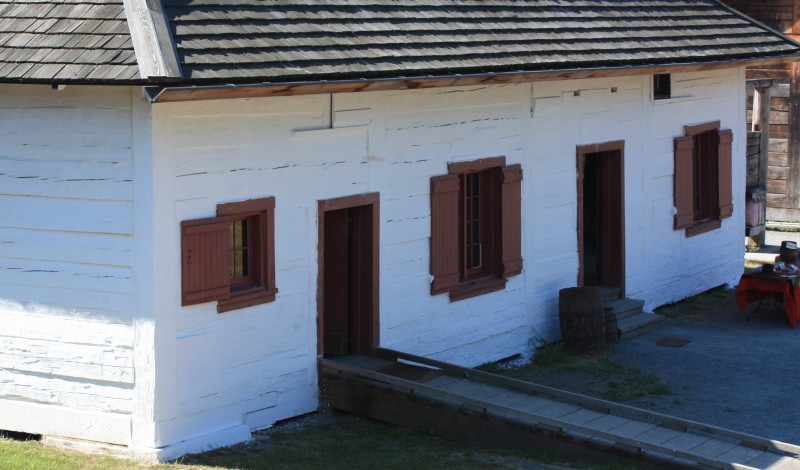
Fur trade warehouse at Fort Langley, the same as found in any fur trade fort
In the last post, we left Governor Simpson heading south and east to Fort Garry. The year is 1825. At the moment, he and his small party of men are near the modern-day boundary line between Saskatchewan and Manitoba, close to the Fort Pelly National Historic Site on the banks of the Swan River, a river that swoops in from the north. These prairie rivers seem to meander through the prairies rather than flow in a straight line, so it makes it difficult, at times, to figure out where Simpson and his party is, and where they are headed. Without a map, I would be entirely lost. Even with a map, I am sometimes guessing.
So we finished the last post with Simpson’s journal entry of May 18th, 1825, as they rode across country to the banks of the Assiniboine River, which flows south into the Whitesand River at the east end of its big jog southward. His journal says that after a long day travelling through waist deep mud, they reached “the head of the Assiniboine River within a Mile of the old Establishment of Fort Alexandria or Hibernia, at Dusk; Fort Pelly cannot be above 15 or 20 Miles distant from this place, but none of our people know the exact spot, and as it might occupy more time to find it out than we can at present afford I have determined on proceeding direct for Q’Appelle.” And Fort Pelly appears now to be on the north bank of the Assiniboine River, where I said in the last post that it was on the south bank.
I told you about Qu’Appelle in the last post, but Simpson’s party is actually only approaching Qu’Appelle, as you will see below. So, let us continue with Simpson’s journal entry for Thursday, May 19th.
Severe Weather, a little Snow on the ground & freezing hard with strong N.W. Wind. Left our Encampment on the South bank of the Assiniboine River at Dawn, and struck out towards the plains in a Southerly direction; there being no track had much difficulty in getting through the Swamp and Underwood. Breakfasted at the Riviere Blanche [Whitesand River] and continued along its banks (which are very beautiful & favorite Summer Encampments of the Assiniboines & Crees) until 6 pm when we crossed it with some trouble owing to its muddy bottom; then Struck out to the edge of the great plain and Encamped after Dusk. We are getting much fagged with continual Walking & Want of Sleep, it being necessary to keep constantly on the Watch as we are now treading dangerous ground; we are not moreover too much pampered in the Eating way, indeed on a very short allowance since the loss of our Hunters.
On Friday, they continued their journey south and east, and were able to kill a Red Deer [Elk]. “Encamped near Midnight having searched for Water upwards of 4 hours but could only find a salt Marsh, indeed throughout the Journey we have rarely been so fortunate as to fall in with good Water at resting time as nearly all the Swamps & many of the Lakes in those plains are impregnated with Salt or Sulphur.” On Saturday, May 21, Simpson noted that “Ourselves & Horses were really in a state of great distress throughout the Day by the unceasing persecution of the Muschetoes [Mosquitoes] bleeding us at every accessible pore & keeping us in a constant fever; they are of a different kind to those found in the Thick Wood & Swamps countries, lead-coloured & Smaller, but much more vigorous & their Sting occasioning inflammation & swelling. At 10 am fell on the Broken Arm River, continued along its banks to the Eastward until 6 pm when we got to the Forks of the Q’Appelle & Broken Arm Rivers & struck into the plains to Encamp.” I know exactly where they are! The Qu’Appelle River is not labeled by its name on this roadmap, but Fort Esperance National Historic Site is just west of where they are, and this post stood on the Qu’Appelle River! The Broken Arm River is the present day Cutarm River. They are still in Saskatchewan (but just barely), and this is another place that Simpson will visit more than once in these journals.
Sunday, May 22nd. The last 24 hours I think have been the most uncomfortable I ever passed; throughout the night we had an awful Thunder Storm and were drenched with Torrents of Rain and in the Morning we could scarcely force our way through the Muschetoes; at 10 a.m. got to the Forks of Q’Appelle & Assiniboine Rivers where we fell in with a couple of Plain Crees; I pressed those indolent rascals to Guide us to Brandon House and offered them the value of 100 Skins for that Service, but they declined it with a variety of excuses….& so they left us with the most hearty curses from every one of our party.
One of the reasons why the Crees had not helped Simpson was because they might lose their horses in the high waters of the rivers. A good reason, I think: Simpson and his party had some difficulty crossing the same rivers as the water was too deep to wade and there was no wood to make rafts, etc. etc. “I, however, being more at home in the Water than any of my fellow travellers, and anxious to save the lives of the poor animals, stripped & Swam across with a few things. Three others followed my example and by making several crossings in this way we got the whole of our little Baggage over. The horses were driven across, those people who could not Swim holding on by their Tails, and with the assistance of Cords we hauled the poor Animals out of the Mud; in like manner we got across the Assiniboine River, having been occupied 5 hours in effecting our passage over these two Rivers, nearly the whole of which time myself and those with me being naked in the Mud & Water, exposed to the blood thirsty assaults of Myriads of Muschetoes, in short I believe there never was an unfortunate Governor in such a Woeful plight as that of the Northern Department of Ruperts Land this Day.” In the evening a Grizzly bear cantered toward them, and they concealed themselves in the woods until he spotted them and ran away. “He was the largest I ever saw,” Simpson said of the bear. “Put up at Dusk much fatigued.”
So they are now travelling along the south bank of the Assiniboine River, which will take them directly to the Red River settlement. On Monday they got under way at 3 am and continued their journey to the east. On Tuesday the journey continued, with the Track generally good except where intersected by streams that gave them a great deal of trouble because of the Mud. On Wednesday they found themselves close to the location of old Brandon House, and were alarmed because there were horses grazing alongside the post, which they assumed belonged to First Nations people. “We therefore took possession of a small clump of pines for the Night where we could defend ourselves against all the Indians of the Plains, if necessary. All hands on guard tonight.” Brandon House, built by the HBC in 1794, stood on the north side of the Assiniboine River, more or less across from the mouth of the Souris River: I presume Simpson looked across the river at the post.
On Thursday, they started before day break, continuing to follow the Assiniboine River south and east. “Incessant Rain throughout the Day, and so foggy we could not keep our Land Marks; lost ourselves among the “Sandy Knowls” for about 3 hours, and having separated in various directions in search of the track had some difficulty in collecting our small party. Put up at the old Pine Fort.” The long-abandoned Pine Fort stood on the north bank of the Assiniboine River near the entrance of Pine Creek. “The Settlement is still three long Days March distant. Considering our Worn out condition and finding that we could not all get that length without assistance, I dispatched the two best Men of our party, Bourassa, & Cadotte, with a Note to Cuthbert Grant at the White Horse Plain, begging he would immediately send us relief in provisions and Horses.” Cuthbert Grant was the leader of the Métis people who lived at White Horse Plain, on the north bank of the Assiniboine River.
They reached Portage la Prairie, at the very bottom end of Lake Manitoba, at sunset the next day. On the next day, “Seeing this Morning that our people and Horses could scarcely crawl and our Provisions being entirely out Yesterday morning, I proposed to Mr. [James] McMillan that he and I should push on ahead on foot in hopes of reaching the White Horse plain, but we had not gone far when we found the low Grounds near Long Lake inundated..” They pushed on through mud and swamp and got to White Horse Plain at Dusk, but Grant was not at home. Simpson wrote a note to the man in charge of Fort Garry, and sent it south with a First Nations man who delivered it. The man in charge of the post — Chief Factor Donald Mackenzie — and Robert Parker Pelly, the Governor of the colony, were astonished to get his message, and instantly
dispatched Men, Horses, Eatables, drinkables and dry clothes for our relief, but I was so anxious to get once more among my much valued Red River Friends that without looking at the contents of their Saddle Bags (altho’ furnished with an excellent appetite) I got across my old charger, “Jonathan,” gave him the Rein with a smart cut across the haunches, and commenced a furious attack on the Gates of Fort Garry at 12 pm [am?], which was immediately answered by a most hearty welcome from Mr. McKenzie and every person at the Garrison, and here I purpose taking a rest of Eight Days after having performed one of the most dangerous and harassing Journeys ever undertaken in the Country, through which, thank God, I have got with no injury or inconvenience worthy of Notice.
Astonishing! Did he and McMillan gallop off with all the food for the entire party or not? They certainly did gallop off with all the food packed in the saddlebags of the two Horses they rode. There is no indication at all that any horses were sent back to Portage la Prairie to feed the men who Simpson had left behind. In fact, he doesn’t seem to think about these men again. He doesn’t tell us whether or not these men made their way to Fort Garry. He doesn’t mention them again.
Simpson had business in the Red River Colony, that he apparently considered was more important than rushing off to Norway House. It is important to know that the Colony and the HBC were separate entities: that Governor Simpson could not interfere in Colony business. Nor could the Governor of the Colony interfere in any way with Company business. So why was Governor Simpson travelling to the Colony?
One of the letters Simpson had received once he reached Jasper’s House must have been from Governor Robert Parker Pelly, governor of the Red River Colony, who said he planned to leave the Colony and return to England because his wife was sick. On June 7, Simpson said that “since my arrival at this place [on May 28] I have been constantly occupied with Governor Pelly on various matters connected with Colony affairs.” Yet, as far as I know, Simpson could have nothing to do with the Colony, as it was a separate entity to the company. “As I anticipated, Governor Pelly could not give me the meeting I requested at Norway House owing to Mrs. Pelly’s delicate state of Health, and had determined on returning to England with his Family by the Fall Ship…his Mind was unalterably made up, Dr. [Richard] Hamlyn having intimated that if Mrs Pelly did not go to England this Season for the benefit of Medical advice, her Life was in danger…” And so, much as Simpson admired Governor Pelly, he could not convince him to stay.
Interestingly, the next man that Simpson suggested to be the Governor of the Colony was Chief Factor Donald McKenzie, who was in charge of Fort Garry. And look at this: McKenzie took on the Governorship of the Colony as well as doing his own job as Chief Factor of Fort Garry. (We must remember that James Douglas was both Governor of Vancouver’s Island Colony, and Chief Factor in charge of Fort Victoria for a few years, so that was not against the rules, although it might cause problems among the Colonists.) The two organizations were not as unconnected as the Colony of Vancouver’s Island was from Fort Victoria! In fact, what the London committee said when they made Richard Blanshard Governor of the Vancouver’s Island Colony, was that “because it was not improbable that those persons, who may settle on the Island may not be content that a Gentleman, having so deep an interest in the Fur trade, should hold the situation of Governor of a Colony, which is to be free and independent.”
But, of course, McKenzie’s appointment to the Governorship of the Red River Colony was only temporary. This was what Governor Simpson said of McKenzie’s appointment as acting-Governor of the Colony:
The next point to be considered was who would be the fittest person to take charge of the Settlement during our absence; this did not require a Moments hesitation, our Eyes being simultaneously directed to Chief Factor McKenzie, and we have but one opinion on the subject which is that no Man in Rupert’s Land is so fit for it; his judgement is sound, his coolness and determination proverbial, the whole of the population is under his influence and he is both feared and respected by Indians as well as by Settlers, in short I consider our choice as a most happy one; Mr. McKenzie is much averse to being placed in such a prominent situation but knowing the importance and necessity of both Governor Pelly & myself going home, he saw there was no alternative and accordingly undertook the troublesome & laborious duties of superintending the Colony for the Current Year in addition to those of the honorable Company, and I do congratulate all interested, in seeing it in such able and competent hands.
And so the Chief Factor in charge of Fort Garry would, for the next year only, act as Governor of the Red River Colony as well as doing his own job for the Company. A new man would be sent in to take over the position of Governor of the Colony, as soon as the London Committee and the Secretary of State for the Colonies could appoint a man to replace Governor Pelly.
I said there were rules that a Colony had to follow. I have this information somewhere, and when I find it I will include it here. But what I remember is this: The Company did not interfere in the business of the Colony; the Colony did not interfere in the business of the company. As we know, Governor Richard Blanshard, Governor of the Colony of Vancouver’s Island, interfered in company’s business. The Company paid none of the expenses of the Colony. The Colony could sell land; they could not give it away, nor “grant ownership” to anyone. Ten percent of the money from the sales of land went to the Company. The Colony paid rent to Great Britain: for the Vancouver’s Island Colony there was an annual rent of 7 shillings, which is a pittance! And, most interestingly, where a Colony existed, the company no longer had a monopoly on the fur trade.
For those of you who want to know, I updated the Frog Portage part of his outgoing route with correct information, here: https://nancymargueriteanderson.com/frog-portage/ This had been keeping me awake at night (funny how that happens), and so I checked it out and corrected it.
So next, Governor Simpson will rush off to Norway House. When that post is written, it will appear here: https://nancymargueriteanderson.com/simpson-to-norway-house/
To return to the beginning of Simpson’s journey south and east from Carlton House, go here: https://nancymargueriteanderson.com/simpson-at-carlton-house/
Copyright, Nancy Marguerite Anderson, 2026. All rights reserved.