
Simpson to Norway House
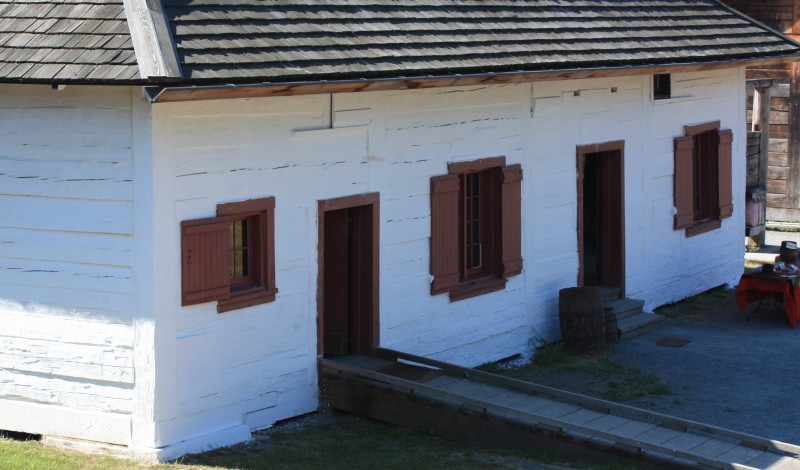
Fur trade warehouse at Fort Langley, the same as found in any fur trade fort
It is time now to bring Governor George Simpson to Norway House and so to close down this journal. At the moment, the Governor is at Fort Garry, which place is actually on the Red River south of Lake Winnipeg. This is what Ernest Voorhis, author of Historic Forts and Trading Posts of the French Regime and of the British Fur Trading Companies, has to say about the place. Or perhaps I should say, these two forts called Fort Garry.
Fort Garry. The chief Hudson’s Bay Co fort at Winnipeg, was built on site of N.W.C. Fort Gibraltar in 1822 after the union of both Companies in 1821. It was a rough affair with wooden palisades, known at first as the Company’s Fort, or Fort Gibraltar. It was named Fort Garry by Governor Simpson in 1823 after a Hudson’s Bay Company councillor. The fort consisted of the buildings erected by the North West Co. after the destruction of Fort Gibraltar and some additions and palisades. This fort was known as the first Fort Garry. [It] was situated near the banks of the Assiniboine and Red Rivers. Much of the land was washed into the Assiniboine River, especially by the flood of 1826, and in 1852 what was left of the fort was pulled down.
The second Fort Garry was begun in 1835, a little removed from the site of the first Fort Garry. It was known as Upper Fort Garry, [and was] built by Governor Alexander Christie. It was substantially built, covered a space 240 x 230 feet enclosed by a solid stone wall and four large round bastions of solid masonry at the corners. It was sold to the city of Winnipeg in 1882. Only the north gate now remains as an historical site.
In 1832, when A.C. Anderson travelled north and east from Lachine in the Lachine brigades, he saw the second fort still under construction. I wrote in The Pathfinder (his biography), “At that time, the original Fort Garry, which had been flooded out so many times the wooden buildings were rotten, was in the process of being replaced by a stone fort closer to Lake Winnipeg. The new fort was only half finished, but the brigaders stopped here to pick up the Red River fur returns, which they were to carry north to York Factory.” If I remember correctly, Anderson was introduced to John Stuart (who was previously in charge of New Caledonia) at Fort Garry that year.
So, at Fort Garry in June 1825, Governor Simpson travelled from the old Fort Gibraltar (not the famous Stone Fort!!) north to Norway House. “It was my intention to have started tomorrow for Bas de la Riviere [the mouth of the Winnipeg River] to meet the Montreal Express Canoe, but I was agreeably surprised by the arrival of Mr. Joseph McGillivray with the Packet about 11 p.m. of the 5th; he reached Bas de la Riviere on the 3rd and hearing of my being at this place continued his route immediately.”
Joseph McGillivray was the son of the famous William McGillivray of the North West Company, and he was a chief trader assigned to the Severn River district. Simpson’s journal continues:
Having finished my arrangements with Governor [Robert Parker] Pelly and being anxious to get to Norway House as early as possible, I took leave of the Settlement this afternoon, accompanied by Messrs [Donald] McKenzie, [William] McGillivray & [James] McMillan; the first goes to Norway House for the purpose of receiving official official instructions in regard to his temporary charge of the Colony and in order to give his opinion on the projected arrangements connected with the business of the West side of the Mountain, being more conversant on that subject from his knowledge of and experience in the country than any of the Gentlemen with whom I am likely to meet at Norway House…
And, indeed, Donald McKenzie had worked west of the Rocky Mountains, first as a member of W.P. Hunt’s Overland Expedition of 1810-12, and later as a North West Company gentleman at Fort George [Astoria], Fort Nez Perces, and on the Boise River. I know exactly who he is. He was in charge of the Boise camp when my g.g. grandfather James Birnie arrived in the district having joined the NWC fur trade. Also at the Boise camp was my g.g.g.grandfather Joseph Beaulieu, one of the many independent or free-trappers employed there, along with his friend Jaco Finlay! Both of these men were David Thompson’s ex-employees. HBC Clerk William Kittson was also there, being McDonald’s clerk at that camp. What a pleasant surprise to connect the one historic man with the other! Simpson’s journal continues:
Monday, June 13th. Norway House. Our passage across the Lake was most boisterous and occupied us until this afternoon; we parted with the Montreal Express Canoe and two of the Company Boats in a Storm on the Morning of the 11th, saw them in distress and making for a Harbour which I trust they gained while we kept driving under close reefed Sail, shipping sufficient Water to keep two Men constantly baling. At length it became necessary to give up the contest and we put ashore under the Lee of Rabbit Point, from whence we started yesterday afternoon, kept at our Oars all Night, had the benefit of a fair breeze in the course of the Day and got here at Sunset, where I found Messrs. [John] Stewart [Stuart], McIntosh, [Miles] McDonell, [John] Rowand & [Joseph Felix] Larocque with their respective Brigades. Here I receive the Honourable [London] Committee’s despatches per the ship last Fall, my private Letters from England by the same conveyance, and communications from all parts of the country, which are highly satisfactory.
Is that not typical of Simpson: Keeping his men at work during a storm that drove everyone else off the surface of the lake until he, too, finally had to give in?
Tuesday, June 14th. The Canoe and Boats with which we parted on the 11th made their appearance today, likewise Messrs [James] Leith [of Cumberland House] & [Alexander] Kennedy with the Columbia Brigade. Those Gentlemen met Captain [John] Franklin and Dr. Richardson on the 12th instant windbound in Cedar Lake; they expected to have fallen in with me coming down the Saskatchewan and appeared disappointed that we had taken different routes. They had, however, nothing particular to communicate and appeared much pleased and gratified by the arrangements which had been made for them all along the route; they expect to reach Fort Chipewyan in sufficient time to send back their Canoes to Montreal this season, which can be done with perfect ease; Mr. [George] Back in charge of two half laden Canoes was coming on behind.
The Mr. George Back mentioned above was the same Lieutenant George Back whose route James Anderson followed as he made his way down and up the Great Fish River in summer 1855, in my book (working title) “Three Journeys North to the Arctic Sea,” which will be published in January 2027. Simpson’s journal continues:
It was my intention to have assembled a Council at this place for the purpose of getting through the principal arrangements of the Season, so as to be enabled to proceed to England via Canada in hopes of getting there about the latter end of August, before the departure of the Columbia Ship, and thereby have an opportunity of communicating fully with the Honourable [London] Committee so as to enter upon the extension of Trade on the West side of the Rocky Mountains without delay, if such met their Honors approbation…but on looking over the correspondence of Mr. Secretary [William] Smith with Messrs. McGillivray, Thain & Co., of Montreal, I find by that Gentleman’s letter of 8th December that the Columbia Ship of this Season was intended to have Sailed early in the Summer; in which case no benefit but serious inconvenience to the Service generally would result from my absence, as it would have been impossible to have got to London before the end of August.
Messrs. McGillivray, Thain & Co. of Montreal was the company formed on November 30, 1822, to wind up the affairs of the North West Company and to act as agents of the HBC in Canada. Simpson’s journal continues:
I have therefore altered my plan, deferring it until the Fall, when I shall proceed agreeably to their Honors instructions, but in order to give them the earliest intimation of our proceedings, I purpose dispatching a Light Canoe for Canada with dispatches for England as soon as a sufficient number of Gentlemen assemble to form a regular Council.
My Columbia voyage being now considered as terminated, I shall conclude this Journal, which any person who may glance at it will perceive was never intended to have gone out of my own possession, but as there is not a thought, word, or action connected with my duty which I can have any object in concealing from the Honorable Committee, it is my intention to hand it to the Deputy Governor in Confidence, knowing that he will make the proper use of whatever it contains worthy of remark, and be so indulgent as to excuse any blunders that may have crept into it, and this I am satisfied he will readily do when he knows that many parts of it were scrawled off on the Voyage under circumstances not favorable to study, and that my time does not now enable me to re-peruse, far less to revise or correct it.
And that is the end of his journal. He must have shipped it out in the canoe to Montreal with the other dispatches for London that he mentions above. He left Norway House and travelled down the Hayes River to York Factory. I think he must have held the Annual meeting there when the appropriate gentlemen came downriver from Norway House.
One more thing happened at Norway House, that he does not speak of in this journal. Do you remember that on May 15 he lost his two hunters, Tom Taylor and George Bird? He waited for them to return from their hunting adventure, and then proceeded south, knowing that they could make their way back to Carlton House in safety. But they didn’t do that. According to James Raffan, in his book Emperor of the North: Sir George Simpson and the Remarkable Story of the Hudson’s Bay Company, Simpson found these two men safe at Norway House on his arrival there. “He was reunited with Tom Taylor, though he thought not to mention it in his journal of the day. It was only in a subsequent volume, detailing travels of 1842-43, that he thought to tell the real story… ” Here is what Simpson said, according to James Raffan:
After abandoning all hope of falling upon the track of our party, they [Taylor and Bird] set themselves seriously to work in order to find their way to some encampment of the savages or to one of the Company’s posts. After a day or two, their ammunition was expended, and their flints became useless, while their feet were lacerated by the thorns, timber, stones, and prickly grass. The had no other clothing than their trousers and shirts, having parted from us in the heat of the day; so that they were now exposed to the chills of the night, without even the comfort of a fire– a privation which placed them as it were, at the mercy of the wolves. From day to day, they lived on whatever the chances of the wilderness afforded them, such as roots and bark, and eggs in every stage of progress.
At length, after fourteen days of intense suffering, despair began to take possession of their minds, and they were strongly tempted to lie down and die. Next morning, however, the instinctive love of life prevailed, and they slowly and painfully crept forward, when suddenly the sight of our track revived their energies and their hopes. Almost intoxicated with joy, they followed the clue of safety; till at length, after growing more and more indistinct for a time, it entirely disappeared from their eyes. At this awful moment of disappointment, and despondency, Tom Taylor, as if led by a merciful Providence to the spot, slowly recognized the scenes of his infant rambles, though he had never seem them since his childhood.
Life was now in the one scale almost a certainty as death was in the other; and under the influence of this definite motive of exertion, the two famished and lacerated wanderers reached before night the Company’s establishment on Swan River. Being well acquainted with Mr. [Miles] MacDonnell, the gentleman in charge, they crawled rather than walked to his private room, standing before him with their torn and emaciated limbs, while their haggard cheeks and glaring eyes gave them the appearance of maniacs. After a minute inspection of his visitors, Mr. MacDonnell, with the aid of sundry expletives, ascertained by degrees that one of his friends was “The Governor’s Tom;” and having thus penetrated to the bottom of the mystery, he nursed them back into condition, with the kindness of a father and the skill of a doctor, and then carried them to Norway House.
And so Governor Simpson found his two lost hunters safe at Norway House when he reached the place in June 1825. At first blush it appears that Tom Taylor’s father worked at Swan River in the early 1800s, when I thought him a sloop master. And yes, it seems I am correct about him being a sloop-master. George Taylor was a sea man aboard the Prince Rupert in 1787, a sloop-master to Churchill in the late 1700s, and in 1818 a pilot at York Factory. So how did Tom Taylor know the country around Swan River in the days of his youth, when his father was no where near the region? The HBCA Biographical Sheets tell me that Thomas Taylor Senior (Servant of Governor George Simpson from 1822 to 1830) apprenticed first at Qu’Appelle River in 1815-1816, and at Fort Hibernia, Swan River District, in 1816-1820. And so, now we know.
I think this is the end of this particular series. If you want to start from the beginning, as he sets out from York Factory to “Frog Portage” and the Churchill River, go here: https://nancymargueriteanderson.com/nelson-river/
As well, I have a new Simpson journey to investigate, and when I write the first post in that series, you will find it here: https://nancymargueriteanderson.com/whatever-i-call-it/. This one is really interesting and answers a lot of questions I had about his difficulty with his so-called “Frog Portage” in 1824.
Copyright, Nancy Marguerite Anderson, 2026. All rights reserved.
Hi Nancy, are all of these blogs available in your book?
I so want to be able to just sit, hold it and read about this incredible history!
Thanks!!
In the book I am writing now, not the one that is being published in January 2027. So you have to wait a little longer.
And of course Thomas Taylor was the brother of Marguerite who would become Governor Simpson’s country wife.