
Simpson at Carlton House
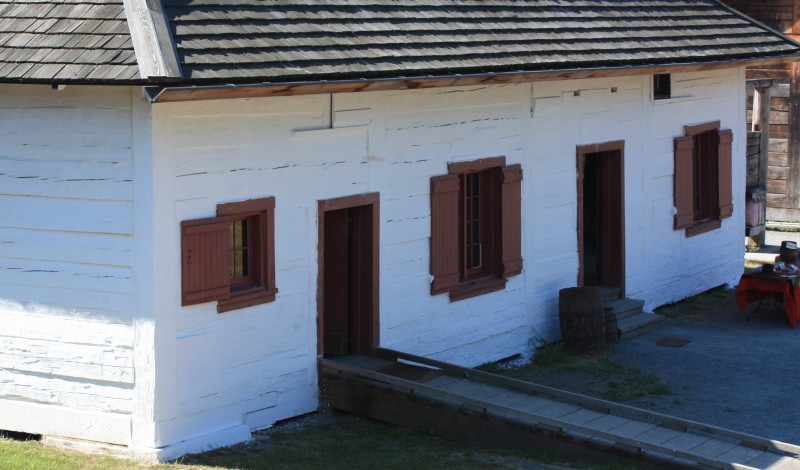
Fur trade warehouse at Fort Langley, the same as found in any fur trade fort
Two hundred years (and a few months) ago, in 1825, Governor George Simpson made his way from the newly constructed Fort Vancouver to Carlton House, on the North Saskatchewan River. The date he reached Carlton House was Thursday, May 12, 1825, and John Stuart was the man in charge of the post at the time. We who come from the west side of the Rocky Mountains know that John Stuart served under Simon Fraser in New Caledonia; he travelled with Fraser down the Fraser River to its mouth. After Fraser left New Caledonia, Stuart brought out the first brigades to Fort George, at the mouth of the Columbia River. He was the creator of the first brigade trails that ran through this massive territory, from Fort St. James to Spokane House and Fort George, at the mouth of the Columbia River.
So continuing along from the last post in this series: Simpson left Edmonton House on May 5, ten or twelve days before the outgoing Saskatchewan brigades planned to leave for York Factory (the York Factory Express did not yet exist.) And when he left Edmonton House, Simpson hurried downriver, planning to reach Norway House, which had been destroyed by fire with the complete loss of all its goods and furs. As Simpson wrote while he was at Edmonton House: “I have every inclination to indulge my poor crew with a few Days rest at this place…but my anxiety occasioned by the deranged state of our affairs owing to the Norway House Fire, scarcity of provisions, failure of the Indian Corn Crops in Red River, together with the assistance required of us by Captain [John] Franklin’s Expedition, quite unhinges me so that every hour will appear an Age until I get into the scene of action…” He had “therefore determined on being off immediately.” And off he went, without regard for the safety of his men and himself as he travelled downriver through Blackfoot Territory.
But he made it to Carlton House in safety. According to the Carlton House post journals, on May 12, “About 7 am. Laplante and Esperance arrived & delivered me a letter from Governor Simpson, dated the 10th instant. He was then encamped at Battle River and the purport of his letters was to desire me to have a dozen or fourteen Horses with the necessary Saddles and Saddlebags in readiness, it being his intention to proceed direct across land to Red River, within an hour of his arrival here.”
While it had been Simpson’s intention to go straight to Norway House, that intention changed as he came downriver. It was a river journey that he described as “tedious owing to the lowness of the Waters and continual head Winds occupying 8 Days in which nothing of interest occurred. We were not molested by Indians,” which was good. As he said:
When I left Edmonton, it was my intention to have proceeded direct to Norway House (either by Ice or across Land from Cumberland [House] on foot as the Navigation would not be entirely open so early), for the purpose of making various arrangements previous to the passing of the different Brigades…
He also listed another three or four things that he thought were as important to deal with as the Norway House fire was: such as dealing with Governor Pelly who was leaving his post because of his sick wife; purchasing a sufficient amount of grain to serve as provisions for the Company, and more.
These different objects appeared to me of too much moment and importance to be entrusted to a Written communication per Express, I therefore formed a plan, the boldness of which induced the people to believe my senses had taken leave of me, no other than that of starting forthwith personally across Land to Red River Settlement, a distance according to our route computed at 800 Miles through plains infested by the Most Warlike and hostile Tribes in North American, which would occupy Twenty Days constant travelling.
The distance from Carlton to Red River is only about 500 miles, so the distance of his journey was exaggerated. Whether the First Nations along this route were the most hostile in the territory is also doubtful, as I think the Blackfoot would have been a more dangerous tribe to meet than any other, and I don’t think they normally came this far east. Nevertheless, the recipients of this letter–that is, the members of the London Committee–would not know that!
However, it seems that at Carlton House, John Stuart had some difficulty with complying with Governor Simpson’s request, which included more than just a request for horses. Stuart’s journal entry recorded that
The necessary Saddles and Saddle Bags were soon prepared and having but five Horses, Mr. [James] Bird’s brother-in-law, who late last night in company with Mr. Pruden’s Son, arrived, was sent down to Carp Creek with a message to a Cree Indian stiled [?], the governor desiring him to come here to act as guide for Mr. Simpson and to bring all the Horses that can be mustered there, for though I did not imagine Mr. Simpson would wait for them, I imagined it proper to send, and let [illegible]
I am presuming, perhaps incorrectly, that this man is the brother-in-law of the James Bird, who was in charge of Edmonton House in the early 1800s. If not, it was referring to George Bird, son of James Bird, who was an active, steady man. (John Rowand, however disagreed with that description, calling him useless, and George Bird retired to Red River in 1824.) There were other Bird sons, but both father and sons were wed to Indigenous women, and so one way or another this Bird brother-in-law would probably be Cree. On the other hand, Chief Factor John Peter Pruden had been in charge of Carlton House from 1821 to 1824 and at this time was on furlough in England. His wife was mixed-blood, and so this son was also Métis. It does not, however, seem that it was he who was sent to fetch the First Nations horses. The Carlton House journal continues, when on Thursday, May 12:
Governor Simpson, Chief Factor Kennedy, and Chief Trader McMillan arrived, and from the little conversation I have had with these Gentlemen, I find that much improvement has been made in the Columbia. The Establishment of Fort George at the Sea Coast has been abandoned and another formed at the Beveres [Belle Vue] point of Vancouver. That place Fort George I purchased from the Americans in 1813 but by the Treaty of Ghent the British Government again gave it up to the Americans as if no purchase had taken place, and not only gave it up but stranger to relate sent a British ship of war to convey the American Commissioners to whom the establishment was to be delivered, and be a witness that the American Flag was substituted in lieu of that of Britain… Mr. McMillan had in course of winter coasted all along to the entrance of Fraser’s River, which from its source I had explored in 1808, and it is now intended to form an establishment at its mouth, from which in my opinion, and it is not a new idea, much more benefit will be derived by the Company than ever could result from the Columbia. It is the most central place hitherto discovered on the North west side of the mountains, and from it W[estern] Caledonia and the Columbia can be supplied with equal facility —
So back to Governor Simpson: On his arrival at Carlton House, Simpson wrote in his journal:
On my arrival at Carlton at 11 o’clock am this Day I made known my intentions to Chief Factors [Alexander] Kennedy and Stewart [John Stuart], and to my Staunch & Manly Friend and Fellow Traveller, Chief Trader [James] McMillan. They saw the importance of the object and the two former were lavish in their commendations, but they would not venture the offer to accompany me (altho’ they might have done it with safety as I should not have accepted it, knowing their inability to meet the fatigues of the Journey.) McMillan, however, altho’ Worn down to a shadow, began to pack up instantly. To my Crew I intimated my intention but would require none of them to undertake this laborious and dangerous trip as they were all nearly exhausted. Four of them, however, would not be denied, and entreated permission to follow me, say my own Servant Tom [Taylor], Lesperance, Hogg & Sherkie, the other Six would not venture, being dead beat.
I am sure they also did not venture being dead, either! But do you know who Tom Taylor is? He is the brother of Margaret Taylor, who became Governor Simpson’s mistress and mother of one of his children–George Simpson Jr., who worked on the west side of the Rocky Mountains. He is mentioned in my book, The HBC Brigades, as he clerked for A.C. Anderson in 1848, on the incoming HBC brigade from Fort Langley to Kamloops. Esperance, or Lesperance, is believed to be Alexis Bonamie dit L’Esperance, but no one knows for sure. Hogg is Amable Hogue, who also accompanied Simpson on his second journey to the west side of the Rockies in 1828 (as did Tom Taylor), and who later married Margaret Taylor. Sherkie is mentioned a couple of times in Simpson’s journals (with various spellings), and I haven’t yet figured out who he is. If you know, please let me know.
So Simpson selected four Métis men from Carlton House, he wrote his final letters of instruction to various gentlemen on the river, got everything in readiness, and he and nine men, including James McMillan, set off across land to Red River.
We were furnished with 12 Horses, the best at the Fort but scarcely able to Walk light far less to carry; for Provisions we had to depend on our Guns. Our guide was not at home in the route, having only passed twice, the last time Eleven Years ago, in short, never did a party undertake a dangerous Voyage so ill prepared, and never was such a Voyage, considering all the circumstances thereof, undertaken in the Indian Country. Just as we were on the eve of starting, information was brought to the Fort that a War Party Camp of Fall Indians was in ambush about a Mile distant In the Woods.
The footnotes here are interesting: they say “Fall Indians are a detached branch of the Arapaho family of no great importance historically.” Allow me a laugh! The Fall Indians were often mentioned in the York Factory Express journals, and in 1835 James Douglas reported that there were 250 tents of them on the prairies. They were also called Gros Ventres (now Atsina), or Big Bellies, and he said they were friendly and well disposed. Under pressure from the Cree and Assiniboine the Fall Indians retreated into American territory in the late 1800s. But were they not the people who attacked and burned down Manchester House in 1793? Yes, they were. They captured the post, and stripped the employees of trade goods and personal possessions, and the HBC abandoned Manchester House and the post was burned to the ground a year later, and was ever after called Fort Brule! The story is in The York Factory Express, in fact. So, while the Fall Indians might have been considered friendly in 1835, in 1825 they were not!
So according to the Carlton House post journals, Dubois and Yartin were sent to the South branch River (the South Saskatchewan) with a canoe, and in the afternoon [of May 12, 1825]
Governor Simpson, Chief Trader McMillan, seven men and Bourassin, acting in the double capacity of guide and Hunter, took their departure for Red River, and after their departure some horses having been seen on the opposite side of the River, Mr. [John Edward] Harriott and three men crossed to ascertain what Horses it might be, and it proved to be three or four horses stolen from Lavalle on the 23rd ulto…In the evening after dark I in company with Mr. Rocque went to bring these three horses to Mr. Simpson’s camp and we proceeded on to the other end of Duck Lake and there found Dubois and Yartin, the two men sent to the South branch River with the canoe, from whom we obtained information that Mr. Simpson was still behind, and of course that unperceived, we must have passed his encampment, we then at daylight….
May 13, Friday, returned back and an hour afterwards met Mr. Simpson and party with whom we continued to the South branch River where we parted with them and returned here in the afternoon. In travelling along I got much valuable information regarding the west side of the mountains from Mr. Simpson, and am not a little proud to find that the Ideas entertained of the whole of that quarter altogether coincides with what I myself entertained since its first establishment, and if his views are now carried into execution, the H.B. Coy may still be remunerated for the vast expenses incurred by the late NWCoy in exploring and establishing that quarter. It is certainly a field from which much emolument might be derived.
So what did Governor Simpson say of this time period? You will remember that Simpson selected four Metis men from Carlton House, and started on the journey south, in spite of the fact that Fall Indians were reported to be camping in their path.
When Messrs. Stewart [Stuart] & Kennedy and al the other good folks of the Garrison prayed that we would not venture from the House until the “Coast was clear,” but on examining the informants they could give us nothing but vague conjectures sufficiently alarming, it does not however do for a Governor to appear shy. I therefore wished our Friends good bye and pushed off and at Dusk, encamped on the borders of a small Lake about Ten Miles from the House. To guard against surprise we have determined to keep constant guard, myself and two of the people took the first Watch.
Let’s tell you how the HBC men kept watch. The Canadians kept watch out for the First Nations who might attack them, and the gentleman watched the Canadians (or other employees), ensuring they remained awake and alert.
Friday, May 13th. Started at 1/2 past 2, found Mr. Stewart [Stuart] in the track, he had ascertained that the Fall Indian reports were false and followed us last night, in order to communicate on some points connected with the Summer arrangements of his post, but could not fall on our Encampment; he accompanied us to the South branch of the Saskatchewan, or Bow River, where we breakfasted, crossed and stuck through a beautiful country consisting of small plains, hillocks, clumps of poplar, and ponds or Lakes. Encamped at the Cross Lake, having crossed the Birch Hills.
So Governor Simpson, James McMillan, L’Esperance, Hogue, and Sherkie (whoever he is), began their journey south and east toward the Red River Colony and Fort Garry, passing through Duck Lake, crossing the South Saskatchewan, passing over the Birch Hills and encamping at the Cross Lake. When I continue this story, it will appear here: https://nancymargueriteanderson.com/whatever-i-call-it/
When I started this thread, I said that I believed Governor Simpson never travelled the same route twice. Of course I was wrong. He came over Athabasca Pass twice, for example, but he also travelled this route (more or less, as his party kept getting lost) three different times. And, In 1835, James Douglas travelled over this route from Carlton House to Red River, and in 1831 so did George Traill Allan!
If you want to go back to the beginning of this journey from Fort Vancouver, go here: https://nancymargueriteanderson.com/simpson-at-fort-vancouver-1825/
If you want to read James Douglas’s journal that takes him over the same route in 1835, go here: https://nancymargueriteanderson.com/carlton-to-red-river/
And if you want to read George Traill Allan’s journey from Carlton House to Fort Pelly (which is only half way) see here: https://nancymargueriteanderson.com/carlton-to-fort-pelly/
Of course, it will take one more post to get Allan from Fort Pelly to Red River, and when I have it written, I will add it here: https://nancymargueriteanderson.com/simpson-to-quappelle/
You can order my books, The HBC Brigades, and The York Factory Express, through Amazon if you wish, at https://amazon.com/author/nancymargueriteanderson
Canadians can also order my books here: https://ronsdalepress.com/products/hbc-brigades-the
My new book, Working Title: Three Journeys North to the Arctic Sea, will be published in January 2027.
Copyright, Nancy Marguerite Anderson, 2025. All rights reserved.
Really enjoy your stories and insights! Thank you
Glad you do. I enjoy them too, frankly. Doing these journeys in little tiny increments allows me to investigate each micro-story for things that might change the entire story! And its fun, too.
Another connection on this trip! James McMillan’s granddaughter Philomene would marry Amable Hogue and Marguerite Taylor’s son Thomas Hogue Sr. They are my paternal greatgrandparents.
Connections all over the place! You have quite a family history. Nice to hear from you, Jackie. Should I be calling Margaret Marguerite?
She was called Marguerite once she married Amable who was from Quebec (not Metis). Both her scrip record and gravestone say Marguerite.
Thanks. That makes sense.