
York Factory
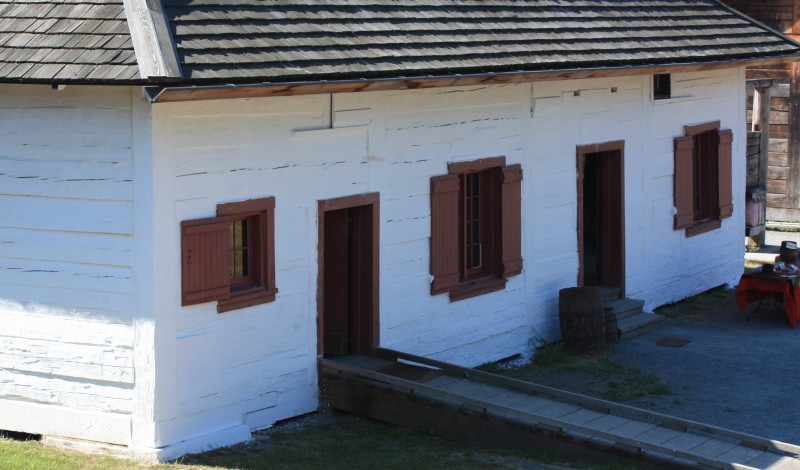
Fur trade warehouse at Fort Langley, the same as found in any fur trade fort
In 1842, the young Augustus Peers arrived by the London ship at York Factory, and spent his first winter in the HBC fur trade there. Ten years later he wrote a manuscript that he intended to have published in England. It told the stories of his time at the Hudson’s Bay headquarters of York Factory, and of his journeys into the interior — all the way north to the northernmost post in the Mackenzie River district. I found this manuscript in the BC Archives because I recognized his last name: he is the older brother of Henry Newsham Peers, who is a character in my book, The HBC Brigades: Culture, Conflict, & Perilous Journeys.
Augustus Peers work is not a journal: it is a manuscript, often addressed to the “Dear Reader.” There is information in his manuscript that can be applied to life at any fur trade post, and especially those in the north. So, let’s see what I can tell you from his jumbled manuscript, written in the years between 1842 and 1852. In this paragraph, below, Dr. John Birkbeck Nevins and Augustus Richard Peers have just off-loaded from the London ship, and they are introducing themselves to the gentlemen at York Factory.
The ceremony of introduction being over, Mr. [Robert] Wilson, the Post Master — considerate man — judged that the afternoon’s trip up the river had given us an appetite, conducted us to the mess room, where the rest of the gentlemen having already supped, we sat down to supper. Having been, for the last months, living on ship brisket, it may be supposed that Dr. N and I did ample justice to the new baked bread and butter and other good things set before us.
Dr. Nevins wrote the book, Narrative of Two Voyages to Hudson’s Bay, which can be found on the Canadiana site (just google the title of the manuscript). Nevins and Peers sailed in the same ship to Hudson Bay, but Nevins was the ship’s doctor and not an HBC employee, and so he sailed away again. Peers’s manuscript tells us that they arrived at York Factory on August 10th. (Nevins’ journal disagrees on the date.)
Supper over, I proceeded sans ceremonie to make myself at home. After catching a glimpse of Mr. Wilson’s coat tails as he doubled a corner, I followed him, and soon found myself at the door of the clerk’s house, or as they termed it Bachelor’s Hall. Opening the door, I had the full view of the interior of this abode. The room was a capacious one, furnished by two deal [wood] tables and a few chairs manufactured from the wood of the neighbouring forest. In the centre of the room stood a large iron stove, before the door of which, with his feet on the stove, sat the Doctor of the Fort, with a long clay pipe in his mouth from which ever and anon he sent forth a copious stream of tobacco smoke.
This was Dr. William Todd, who served west of the Rocky Mountains for a few years. In fact he is mentioned in one of Governor Simpson’s journals as travelling out with him by the Athabasca Pass route. Todd’s biography makes it clear that it must have been 1829.
William Todd: Born in Ireland, ca. 1784. Death, Red River Settlement, December 22, 1851. I happen to know that he died of the York Factory Complaint, which I wrote about in The York Factory Express — see here: https://nancymargueriteanderson.com/york-factory-complaint/
My book, Working Title: Three Journeys North to the Arctic Sea, will be published in January 2027.
Dr. Todd joined the HBC as a surgeon in 1816, and until 1827 was employed at a variety of posts east of the Rockies. He came into the Columbia district in 1827, in what must have been Edward Ermatinger’s returning York Factory Express. After a brief stint in the Columbia District, Todd returned to the Red River district, becoming Chief Trader in 1831. Two of his children [Robert and William] later served in the Columbia district, and I think both were connected to the Kamloops post. But, onward with Augustus Peers’s story.
At the farther end of the room, with folded arms, and likewise smoking, walked Mr. Hamilton, who had the year before, and at this season, made his first appearance in Bachelor’s Hall in the capacity of Junior clerk. Mr. [William] McTavish, the Accountant, Mr. Wilson, the post master — the other occupants of the room — were engaged in conversation respecting certain boxes and parcels brought out by the ship. Diverging from the Hall were the respective bed rooms of these gentlemen, the doors of which were wide open to admit the heat supplied to one and all alike from the aforementioned stove.
As I was forthwith to become an inmate of Bachelor’s Hall for an indefinite period, a spare room was appropriated to my use. Having observed all this and having answered a multitude of such questions as the gentlemen chose to ask, respecting the Old Country, I took a candle and entered my future dormitory. As it was a corner room it proved of ample dimensions, though the scantiness of the furniture made it appear larger than it really was. In one corner stood a four post bedstead, without curtains, the bedding of which consisted of two or three buffalo robes spread out in place of a feather bed, the whole covered with three blankets. Under the window which, bye-the-bye, could not boast of a curtain either, stood a square deal table… In another corner stood a wash-hand-stand containing a basin of water, while beside it stood an eight-gallon keg also full of the same liquid for ablutionary purposes, and also to quench the thirst. Having thus minutely examined the premises, I prepared to turn in for the night, but in turning down the bed I was rather surprised that there were no sheets. However, believing that the stupid chamber man had forgotten to supply them, I extinguished the candle and vanished beneath the blankets. As I had always hitherto been accustomed to sleep between the sheets the tickling sensations caused by the woolly nature of the covering kept my fingers continually on the move, making me feel as though I had been placed in a bag with a swarm of starving fleas. This, with the continual racket kicked up in the hall, opening boxes, the peculiar and not over-agreeable smell of the buffalo robes, and withal the novelty of my situation, kept me in a continual fever till at last I entertained serious thoughts of trying to stand on my head in the water barrel to cool myself. I really now forget if I got any sleep that night or not.
Chamber man at York Factory? Peers had a lot to learn about the differences between residing in a comfortable home in rural England, with servants to look after you, and living in an HBC post in the wilderness. Things were different here. Peers’s’ story continues:
Next morning, not at the fashionable hour of eight, but at the healthy hour of five — the inmates of Bachelor’s Hall were astir, and this being a particularly busy season, they betook themselves to the office, there to scribble till eight at night or even later. At eight o’clock the bell tolled for breakfast and a precipitate rush was made from all quarters — from office, from shop, and fur store, the centre of attraction being the mess room. This room, which was about forty feet long by about twenty-five wide, containing four long deal tables and numerous benches, and warmed by two capacious stoves, served the inhabitants the three-fold purpose of summer men’s room, church, and ball room, for all which purposes it was well adapted.
As you can see, I learned a lot about how the voyageurs who came in with the York Factory Express and the Portage La Loche Brigades lived at York Factory — they were the summer men, and they slept either on the floor of the fort’s dining room, or in the summer men’s quarters, mentioned later. But let us continue with Peers’s story.
We took seats at the board, which was amply provided with dishes of whitefish steaks, bread and butter, with huge bowls, literally slop basins, of smoking hot tea. I had formed a full intention to enjoy those luscious fish cutlets, but had scarcely taken a mouthful and sweetened my ocean of tea, when to my surprise the guests arose, the empty state of their huge cups and plates convincing me of the fact that they were already done. Not wishing to be laughed at I, of course, rose too, promising my disappointed vitals to be up to trap another time. No sooner was the repast over than the press of business again called the gentlemen to their respective duties, while I in company with my former friend and shipmate, Dr. Nevins, strolled about the neighbourhood to view the wonders of my future home in the wilderness.
But sooner or later, Augustus Peers had to begin his work at York Factory. “Having made myself master of all the ins and outs about the place, I was proceeding to the office to do a little for the Company when just at the door I met Mr. [James] Hargrave, the Superintendent at the Depot, who I guessed had been on his rounds, expecting perhaps to catch some of his youngsters larking. Shutting the office door, he availed himself of such an appropriate time and place, and forthwith proceeded to lecture me as to my future career as a quill driver, and having glanced at the routine of one day’s work, as an example of those to follow, finished his discourse by recommending early and late hours, strict attention and no mistakes, and then continued on his walk; while I entered the office to place myself at the tender mercies of the accountant. I need scarcely say I was speedily furnished with pen, ink, and paper, and stepping noiseless across the room I mounted a long leg stool for the first time.” His story continues:
I no longer had a will of my own, and I set manfully to work, fully resolved to do or die, and in short time I became accustomed to the daily task of quill driving.
In the course of a few days, a brigade of boats arrived from the interior ladened with fur packs and bringing passengers for England. At length, the ship having been restowed with a cargo of furs and other produce of the country, she was reported ready for sea. As is customary, the gentlemen of the factory went down to take a farewell of the captain and the passengers, and we spent a merry afternoon. It was with regret that I parted with my friend, Dr. Nevins…. As the Prince Rupert got under weigh, we dropped into the yawl and put off for land, not forgetting to give three hearty cheers for old England. By the time we reached the shore the sails of the Rupert were scarcely visible on the distant horizon.
Peers describes the incoming brigades and the Métis men, who he calls “half-castes.” Then, after the last boats departed for the distant posts in the interior, “the noise of the trucks as they rolled, driven by the aforesaid half breeds, with no tender arms over the wooden platforms, had ceased, and the place wore a quiet and tranquil appearance, each one congratulating the other that the job was over once more. As our fingers were pretty well tired of scribbling, it may readily be believed that the joyous announcement that we were to have the next three weeks to ourselves was hailed with unfeigned delight by one and all. Nor were we long in fixing on a pastime. Although most of the wild fowl had passed south, there were nevertheless plenty to be found, and it was agreed that we should proceed to a certain well-known spot, and there spend our holiday in indiscriminate slaughter amongst the feathered tribe.”
He doesn’t say which spot he retired to, but it was either the North, or the South Goose Hunt. “The swampy nature of the country invites vast flights of wild fowl to linger for a while in their annual migrations, and they are eagerly sought after as a means of subsistence, great numbers being salted for the use of the establishment.” So these were provisioning hunts, to which “a boat is dispatched spring and fall, containing a number of the best shots among the Indians, with an ample supply of powder and shot. The cooper of the factory, with a number of casks, accompanies the party, who remain at the goose hunt till all of the casks have been filled with salted goods. The quills and prime feathers of the birds are also preserved, the former are sent to England for sale, while the latter are converted into feather beds, pillows, etc.”
When the hunting season ended, the men were called back to work. “The summer office was not adapted as a winer counting house. We therefore withdrew our books and stools and set up business in the spare room of the hall, and which, like the bedrooms, was warmed by the stove in the common room. Here then we were to scratch the livelong winter through, however, we had the advantage of two days in the week, besides Sunday, to ourselves, which was a great consideration. In the winter, though there was plenty of work to be done in the writing way, the business was not pressing as in the summer. The daily routine of business therefore was to arise any time before nine, when we breakfasted; wrote till one, when we dined, and again wrote till six when we had supper and shut up the books at eight o’clock, spending the rest of the evening as suited our several temperaments best — some reading, some doing odds and ends, and others taking a moonlight stroll visiting the fox traps.”
The HBC men then had to prepare for winter, and winter at York Factory was cold:
Winter had set in in good earnest, and it was absolutely necessary to provide against its severity. For this purpose we put off our lighter clothing, substituting a suit of dressed moose deer skin instead. Strips of buffalo robe were nailed around the doors, double glass filled in the windows and everything necessary was done to keep out the cold and retain the heat emitted from the capacious iron stove, which we kept well fed from a box of dry wood. I have often seen the stove in parts red hot.
It is time to let Augustus Peers tell us more about York Factory:
Like most other forts in the country it is built on three sides of a square, the whole surrounded by high pickets except in front where low ornamental palisades are substituted. The buildings are all of wood, the damp nature of the ground rendering it necessary to raise them on logs as a means of keeping them out of the wet, and most of them are covered with tin on the roof to prevent accidents from fire.
In the centre of the square stands the principal, or as it is called the General Store, wherein are deposited the goods for the Indian trade throughout the north. On its right and left are the summer mess room and a range of low buildings which are appropriated as summer residences for visitors. The private dwelling house of the gentlemen in charge of the depot, the clerk’s dwelling house and those of the numerous artizens [sic] and labourers, with the sale shop, fur store, and Indian trading shop, etc., form the plan of the fort. The interior of the square is intersected by wooden platforms, and in front of the General Store are two lots of ground enclosed by low pickets dignified by the flowery name of Gardens pro firma, but in which I could discover nothing but a good collection of rank weeds and a few turnips which made a feeble struggle for existence in a moist, ungenerous soil.
Dandelions are apparently a plant that is imported, and I suppose that these gardens contained those plants, which today are considered weeds, but are quite healthful and full of vitamins.
The actual residents of the establishment are a commissioned officer, an accountant, a surgeon, and three or four clerks with a post master. Among the servants are a blacksmith, tinsmith, cooper, sailmaker, house and boat carpenters, and a store-keeper, besides a sufficient number of labourers to do the necessary outdoor work. All tinware, such as kettles, teapots, camp plates, and pots; also all ironworks, axes, ice and earth chisels required for the trade are manufactured here. As there is no coal found in the neighbourhood, an annual supply is brought from England by the ship for the use of the forge.
They had several head of cattle at York Factory, and oxen were employed in wintertime to haul home the wood for the stoves from a distance of several miles. At some seasons, “The neighbouring swamps supply, in good seasons, any quantity of delicious cranberries and during summer several other kinds of berry grow in the neighbourhood, amongst which are the eyeberry, swamp berry, a small species of gooseberry, and red and black currents.” From these berries, the cooks at York Factory made berry pies that were two feet long. “A daily supply of fresh white fish are caught in the river during the summer in small nets set along the shore in the eddies, where the fish delight to feed, but as the fall and cold season approaches, fisheries are established at several distant lakes inland, and the produce preserved for winter use. They are brought to the fort by means of dog sledges in winter.” There is more! Provisioning was an important job: the men not only fed themselves, but their numerous dogs! And those dogs were also interesting.
The dog is an animal in great requisition throughout the north, and without them we should be badly off indeed. They are broken in to run in harness tandem-wise. A great number are kept at York [Factory], of the Esquimaux species. This breed is the best fitted for the country, as they are strong; and by the woolly nature of their hair they are enabled to stand a great degree of cold with very little inconvenience and — what is of still greater moment — they can subsist on very little and keep their flesh well.
Whenever these dogs arrived at the factory from the distant fishing stations inland, the noise and racket they would kick up exceeded the yelping of a pack of hounds in full cry. The tolling of the fort bell for work, etc., was a signal for them to set up their cry, and they would gather round the ringer and literally drown the noises of the bell as with noses upturned they ran in circles round him, howling in every key from shrill to bass.
The same thing happened at Fort Victoria, and it probably happened at most fur trade forts.
I had occasion to notice the sagacity of these animals. About the middle of the winter they arrived as usual at the factory, and no sooner would they be liberated from the harness than one of them, who had been petted by gentlemen on former occasions, came bounding across the fort to the door of the Hall. Mr. McTavish admitted him, and the poor creature seemed really delighted to see his old admirers once more. This fact is the more remarkable as he had not visited the fort for nearly two years, still he had not forgotten the spot where he was wont to get a “feed,” and as it happened to be one of the shooting days, “Buffalo Robe,” as he was called from the shaggy nature of his coat, soon put half a dozen partridges under his robe.
There is lots of interesting information in Augustus Peers’s manuscript. For example: winter entertainment might include skating, snowshoeing https://nancymargueriteanderson.com/snow-shoes/ or shooting, see below:
About a quarter of a mile below the present establishment is a clearing on the edge of the bank where the fort stood in days of yore. It is now used as a graveyard to receive the remains of those who may die in the neighbourhood. Here there is a deep natural cut in the bank which serves as an admirable dock for the schooners in winter. Before the river sets fast in the autumn, they are run in here, and as the cold advances they become embedded in a solid mass of ice, and as the disruption of the ice approaches in spring, the labourers set to work with ice chisels to cut a deep trench around them, and being propped up are left till the rising of the water floats them out.
Below this place, the land gradually descends for about five miles in a long low point called “the Point of Marsh,” a dreary and extensive waste where nothing relieves the eye but a high ship beacon constructed of wood, surmounted by a ball which is drilled through and through, having served the numerous visitors who may have wended their way hither in search of game, as a target whereat to prove the excellency of their guns.
At long last the winter began to recede at the end of March, 1843, and Augustus Peers had to leave York Factory for the Mackenzie River district. “The district of McKenzie’s River was looked upon as a sort of Botany Bay and I inwardly hoped that although I should be sent somewhere, it might not be to that particular station, where winter reigned unmolested for eight long months, and where provisions were more remarkable for quantity than quality. Judge then my discomfort when Mr. H. informed me that I was ordered off at the shortest notice on a tramp of about two thousand miles to McKenzie’s River.
His journey from York Factory to Norway House begins here: https://nancymargueriteanderson.com/dogsled-1/
To return to the beginning of this thread, go here: https://nancymargueriteanderson.com/augustus-peers-journal/
Copyright, Nancy Marguerite Anderson, 2026. All rights reserved.
Having visited York Factory in August 2023, which trip was absolutely amazing, and in large part inspired by your writings on the York Factory Express. It was a continuing adventure to read this post, further animating life at York Factory! The dogs, the smells, the relentless cold, the imported coal for the forge, the frying pan…. Once, a two plus century hub and crossroads of trans/intercontinental commerce! Now, a place all but forgotten and ironically remote, even by modern accessibility.
I think we are aiming sometime during the last two weeks of July for a return to York Factory trip. We’ll firm up those dates in the next month as per group member scheduling preferences. You previously mentioned Nancy you might be willing to join us? Happy to send you a tentative itinerary if you’re game.
Great read, thank you Nancy!
Thank you Nancy for your continued effort in enlightening life in the old HBC settings. Very interesting!