
Simpson at Rock Depot, 1820
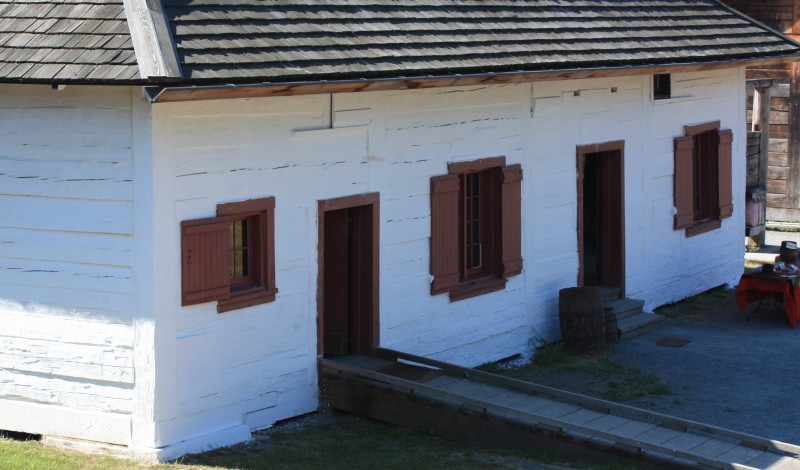
Fur trade warehouse at Fort Langley, the same as found in any fur trade fort
I have a new journal for you. This is a journal that I did not intend to look at, but I am very happy I did. I have always been curious as to what happened in Governor Simpson’s first year as Governor locum tenans. I wanted to know how he dealt with the North West Company in the Athabasca district, and learned, to my surprise, that most of his problems in that district came from other Hudson’s Bay Company men. I wanted to know how Simpson so intimidated Samuel Black over that Athabasca winter–and now I know the stories. Of course you know what journal I am speaking of: it is the Journal of Occurrences in the Athabasca Department by George Simpson, 1820 and 1821. This journal, written by Simpson himself, tells us a lot about what kind of man he was. It tells you why he made the decisions he made in later years, when he re-organized district after district. It also tells you why he had to re-organize the company, from top to bottom. It is really interesting to realize that without Simpson, the Company might not have survived the next few years.
So lets go: In 1818, Colin Robertson was the HBC man in charge of the Athabasca District, and had his residence at Fort Wedderburn. This post was built by Robertson in 1818, on an island about a mile from the NWC post of Fort Chipewyan, on Athabasca Lake. At this time the HBC and the NWC were at war, and instead of taking a passive role in the war, the HBC men were fighting back at last!
In the same year Robertson built Fort Wedderburn, he was arrested by the NWC men when he was outside the fort without protection, performing a funeral service for a man who had died. The NWC men Samuel Black and Simon McGillivray Jr. arrested him on a bench warrant from Quebec, and carried him off to Fort Chipewyan, where they imprisoned him. When spring came they took him out by the Saskatchewan River to be tried in Canada, but he escaped them and found his way to Cumberland House. He spent the next winter on the Peace River, which was a part of the Athabasca district.
If you are wondering why the NWC men at Fort Chipewyan arrested any HBC men at all, this is just what was happening at that time in the Athabasca District and elsewhere. This is how the HBC men, and the NWC men, fought their wars. Both companies obtained bench warrants in Quebec, and arrested each other’s gentlemen in the interior, often ambushing each other’s brigades as they passed through the Grand Rapids on the way to wherever they were delivering their furs (the HBC to York Factory, the NWC to Rainy Lake.) And in fact, on June 29, 1820, Robertson was recaptured at the Grand Rapids, and taken down to Montreal. He escaped them once again: and made his way to New York where he sailed for London. Obviously the gentlemen of the HBC’s London Committee were unimpressed with Colin Robertson’s carelessness.
But long before Colin Robertson was arrested for the second time, the London Committee sent out one George Simpson to act as Governor locum tenans [a person who temporarily fills a position], in case either Robertson, or Governor-in-chief William Williams himself, were captured by the NWC. Simpson was to communicate with Governor Williams and then return to England by the next London ship. But, as we know, it didn’t quite work out that way.
Governor William Williams had been employed by the HBC as Governor-in-chief in 1818, mostly because the London Committee thought him an amiable, conciliatory, and enterprising leader. Williams made his home not at York Factory, but at Cumberland House. Moreover, he did not seem to be as conciliatory as the London Committee believed him to be. When in January 1819, he heard of Colin Robertson’s so-called “inhumane” treatment at Fort Chipewyan while imprisoned there, Williams declared that the abuses practiced by the NWC must stop, and that passive measures were no longer working. It was time to retaliate, and from Montreal he obtained bench warrants for the arrests of the worst of the NWC gentlemen. Collecting 30 or so HBC men together, he headed off to the Grand Rapids to capture the Nor’Westers as they came downriver. On June 21, 1819, Williams’s party met the NWC’s brigades and arrested five NWC men on Canadian warrants, and six more on his own warrants as Governor.
At the about same time as this happened, the London Committee learned that Governor Williams had been indicted in Canada, and an attempt would be made to capture him. They were also very concerned about Williams’s arrests of the NWC gentlemen, and condemned them as neither legal nor wise. On February 26, 1820, the assignment to travel to Montreal and beyond was given to George Simpson, clerk at the mercantile house of Grahame, Simpson, and Wedderburn. (The Simpson in that company was George Simpson’s uncle, Geddes McKenzie Simpson.) George Simpson sailed from Liverpool on March , 1820 (as you see even before Colin Robertson was captured for the second time.) He arrived in New York on April 6, and in Montreal on April 28. On May 28 he attempted to deliver a message from the Secretary of the Colonial Office to the gentlemen of the NWC at Fort William, on Lake Superior, but learned that a force of men had already been sent north to the Grand Rapids to arrest Robertson and Williams. On June 29, 1820, they captured Colin Robertson, but missed Governor Williams because Williams had passed the Grand Rapids the day before the NWC men reached it.
After his visit to Fort William, Simpson travelled west and north to Norway House, and arrived at the Rock Depot, where he met Williams and hear the news of Robertson’s arrest at the Grand Rapids. The arrest of Robertson and the threat to Governor Williams changed everything. Instead of returning home to London, Simpson was sent to the Athabasca District to take over the charge of the territory until Robertson returned from London.
The first entry in George Simpson’s “Journal of Occurrences in the Athabasca District” read:
Governor Williams, having been pleased to invest me with the charge of the Athabasca Department in the absence of Mr. Robertson, I have abandoned my intention of returning to England this season, in the hope that my presence in the interior may be of some advantage to the Company’s affairs in that quarter, and I intend that the following Journal shall give an accurate and unbiased report of the principal Occurrences that may take place within my observation.
Mr. [Robert Seaborn] Miles has hitherto been occupied in arranging the different Outfits and finishing the accounts of last year, and for some days past my time has been employed in re-engaging the people, assisted by Mr. [John] Clarke; to this Gentleman I am particularly indebted for his polite attentions, he has given me much useful information, and his influence over the Canadiens has been exerted with great success, as notwithstanding the exorbitant Wages they have now exacted, I am confident that they are lower by one-fourth than any other Gentleman in the service could have engaged them at. I am of opinion that in future the contracts of both Officers and men should be renewed Inland in the course of the Winter instead of delaying it until their arrival here, as when they find that we absolutely require their services, they take advantage of their market, and hold out for most extravagant terms which has been dearly exemplified this season.
This establishment [the Rock Depot] is still in its infancy and therefore the business is not yet conducted on such a regular system as could be desirable, but under Governor Williams’s active and discerning management I am satisfied that little room will be left for improvement in the course of another season.
According to Voorhis’s Historic Forts and Trading Posts, Rock Fort was built “on the Hayes River below the falls and rapids, about 30 miles below Swampy Lake. Established before 1812, at which time it was in charge of John McLeod, chief trader.” Was the the same John McLeod Sr., who was in charge of the Kamloops post, and who led out the first York Factory Express? Apparently not! The John McLeod Sr., of Ross (who is the John McLeod of Kamloops), entered the HBC as a writer (clerk) in April 1811, and was in the Winnipeg district, 1813-14; Turtle River post and also at Fort Douglas, 1818-16; in charge of Ile-a-la-Crosse in 1816-1817, where he was twice made a prisoner by the NWC; Columbia district in 1822.
Robert Seaborn Miles, mentioned above, is sometimes said to have appeared on the west side of the Rockies for a short time [according to great-uncle James Robert Anderson], but it actually appears to have been his son, John Miles. Robert Seaborn Miles was born in Oxfordshire, and entered the HBC as an accountant in 1818. He kept the “Journal of the Proceedings at Fort Wedderburn” during the winter of 1818-19 under Colin Robertson, and was employed as accountant at Fort Wedderburn when Simpson was there in 1820-1821.
John Clarke, also mentioned above, joined the NWC in 1804, but switched to the Pacific Fur Company in 1810. (Well, I wasn’t expecting that!) He led the second expedition to Fort Astoria in 1811, and established Spokane House in 1812 in opposition to James McMillan of the NWC. When the two companies merged he declined to enter the NWC, but in 1814, on Colin Robertson’s insistence, joined the HBC. He led an expedition to the Athabasca in 1815, and established Fort Wedderburn over the winter of 1815-16. The NWC arrested him on October 7, 1816, on a warrant issued by Archibald Norman McLeod, a NWC partner then in charge of Fort Chipewyan. He was released a few days later, but had been forced to sign a document of some sort, promising future good behaviour. However, Clarke’s behaviour after his release was unchanged, and on April 15, 1817, the NWC again arrested him. He was detained at Fort Chipewyan until June, and spent time imprisoned at Great Slave Lake and Ile-a-la-Crosse before he was released on December 12, 1817. By 1820, Governor Williams, James Bird, Colin Robertson, and Thomas Douglas, Earl of Selkirk, agreed that Clarke was vain, extravagant, and lacked foresight. When he also had the opportunity to see how Clarke behaved, Simpson would agree with them. But for now, Simpson’s journal continues.
Embarked at four o’clock p.m. with Mr. Miles in a light Canoe, accompanied by Messrs. Clarke & [Louis Leon] Pennsonnant in another. Encamped at 8 o’clock.
31st Monday [July]: Heavy rain during the night and the morning cold and raw. Left our encampment at day break. Passed Lamallice’s Brigade in the Rapids. Arrived at Swampy Lake Depot at seven o’clock p.m. Lamallice came up with us about nine o’clock.
Lamallice appears often in these journals, and there are many in northern BC who will recognize immediately who he is. Paul Bouche dit La Malice was a Canadien Metis who entered the HBC service in 1810 in the capacity of guide at Fort Wedderburn, where he remained until 1821.
August 1820, 1st, Tuesday: Embarked about two o’clock a.m., overtook Messrs. [Neil] McDonald & [Jonas] Oxley at six; Met the Montreal Canoe that had gone by Red River in Knee Lake; sent it to Swampy Lake for six pieces goods belonging to the Northern Discovery Expedition…Encamped at eight pm. in Knee Lake.
The Northern Discovery Expedition was an expedition of exploration under Lieutenant John Franklin (later Sir John Franklin) that attempted to explore the Arctic Coast. Both the HBC and the NWC had agreed to provide these English explorers with provisions, and George Back would in future prove to be a constant irritation to Simpson while he was at Fort Wedderburn. Yes, that George Back–the same one who explored the Great Fish River in 1834, in the upcoming “Three Journeys North” book.
2nd, Wednesday: Detained in our Encampment by heavy rain until 6 a.m. Arrived at Oxford House about one p.m., where we halted for the day in order to make some arrangements…
3rd, Thursday: Left Oxford House at two o’clock a.m. Encamped at the upper end of White fall Portage….
5th Saturday: Left our encampment at 3 o’clock a.m. Came up with [Jean-Baptiste] Brunnelle’s Canoe, who was unable to keep Company with Magnion’s Brigade in consequence of his wife being taken in labour on the march two days ago; both she and the child are doing well, and she already assists in paddling in order to make up for lost time. Arrived at Norway House at six o’clock p.m. Learnt that Mr. [Duncan] Finlayson took his departure from thence for Peace River, accompanied by two Canoes intended for New Caledonia on the 2nd Inst., but I fear the latter cannot reach their destination this season; it was arranged that they should meet Mr. [Ignace] Giasson at the Rocky Mountain Portage [Peace River] on the 20th prox., but that is almost impracticable.
The HBC was planning an expedition across the Rocky Mountains so they could set up posts in the New Caledonia district, and Ignace Giasson was the man in charge of that expedition. I am told that anyone who carried the name, Ignace, is Iroquois, but in this case that does not seem to hold true. Giasson was a very old name in Montreal, according to Bruce Watson’s Lives Lived.
And Norway House? The Norway House that Simpson arrived at in 1820 was the first Norway House, built on Mossy Point about 1800. This is the same post that was consumed by fire November 19, 1824, the burning of which upset Governor Simpson when, in 1825, he learned of its destruction.
6th, Sunday. [Jean Baptiste] Magnion, the Peace River Guide, arranging his Canoes. Monsr. Demoulie, the Priest from Red River, performed Divine Service; this Gentleman’s exhortations seem to have little effect on the Canadiens, I understand, however that he lays them all under contribution, and will make a profitable trip of it.
The priest from Red River is Reverend Joseph Nicholas Severe Dumoulin, who accompanied Bishop Provencher to the Red River Settlement in 1818, and who returned to Lower Canada in 1823.
7th, Monday: The Canoes are in a very crazy state and Magnion going on with the repairs…
8th, Tuesday: Engaged a few men. Their terms are most extravagant. Occupied writing my Letters for England the greater part of the day. Gave the people a dance in the Evening.
9th, Wednesday: No work done today, the Guides and men in a state of inebriety. They purchase spirits of the English Servants, but I have requested Mr. [James] Sutherland to put a stop to this disgraceful Traffic, as it is productive of serious inconvenience to the service; he has given intimation that a repetition of the offence will be severely punished.
All of you can read this journal and know what changes Simpson makes when he comes into power. Right?
10th, Thursday: Lamallice employed in repairing his Canoes; he complains of the quality of the Bark and scarcity of Gum. Arranging our men for the different posts. Mr. Clarke has got nearly all the best hands for Ile-a-la-Crosse. I expostulated with him on the impropriety of selecting the most useful men for any particular District, without avail. He does not seem to take a general view of the Company’s Interests, but confines his attention to the District which he individually superintends; if the Governor [Williams] would take the trouble of appropriating the men, and determining the quantity of goods for each Department, it would prevent much altercation between the Officers.
Simpson is viewing everything that is wrong with the HBC under Governor William Williams, and it doesn’t end here! All this would change when Simpson became Governor.
11th, Friday. Messrs Oxley and [George Peter] Andries took their departure for Athabasca Lake. Magnion’s Cargoes delivered to him, and ready to start from the [Mossy] Point tomorrow Morning. I am under the necessity of leaving upwards of a Hundred pieces of goods here in consequence of the scarcity of men, so that I fear it will not be possible to establish any new posts this season.
12th, Saturday: Magnion detained at the point by contrary wind. Lamallice still occupied in repairing his Canoes, some of them are in such a bad state that I suspect they cannot reach their destinations; the Cargoes, I fear, will sustain much damage.
13th, Sunday. Many of the Canadians have actually bartered their shirts & blankets for Rum with the English servants. Magnion’s Brigade is unable to proceed, and all work at a stand, every man in the camp being more or less intoxicated. I caught an Iroquois in the act of selling a fathom of cloth for half a pint of spirits. Mr. Sutherland has got the names of two of his men who were also detected today, and I hope they will be made an example of; the most effectual way of stopping this illicit Trade is by forwarding the allowance of the English Servants inland as Cargo and serving it out to them at their Wintering grounds. Our Provisions getting short, and if the Brigade are detained another day, I fear the allowance will be insufficient for the Journey to Cumberland [House]. Magnion has applied for an additional supply, but we have none to give him, he had one and a half bags of Pemican for each canoe on the 11th, a great proportion of which is already consumed.
14th, Monday: Magnion’s Brigade at the Point wind-bound. Lamalice’s canoes arranged, gone to the Point with their Cargoes, and ready to take their departure, passengers Messrs [Joseph] Greill, [Jacques] Chastellain, & [Neil] McDonald, also two Esquimaux for the Northern Discovery Expedition; [William St. George] O’Doherty and [Patrick] Cochran [Corcoran] sent by Mr. Clarke’s [York] Boats as we could not give them a passage in the canoes without leaving about ten pieces of goods, which we cannot afford in the present limited state of our supplies. Much inconvenience is experienced by having so many passengers in the Brigade, and I shall endeavour to remedy this evil next year by taking none out except those who are determined to retire from the service. The room which our passengers occupy this season would have enabled us to bring upwards of sixty pieces more goods than we now have. Mr. Clarke has nearly as many goods for the District of Ile-a-la-Crosse as we have for the whole department of Athabasca. I sincerely trust he may bring them to a good Market; those who know his character as a Trader have their doubts on that head. Previous to my departure from the [Rock] Depot, Governor Williams gave me an order on Mr. [John Lee] Lewes for one of the Lesser Slave Lake canoes, in the event of its being absolutely required for the use of the Athabasca Department; on looking particularly into the state of our affairs, I found that an additional canoe would be of very essential importance, and therefor was under the necessity of presenting the order, altho’ I know Mr. Lewes had not an overstock of goods; I am, however, glad to find that he will not suffer more than a little personal inconvenience by the arrangement, as instead of travelling to his Post in a gay Light Canoe manned by eight or nine smart Canadians, which is too much the fashion in this service; he very prudently laid empty show aside, converted his travelling Equipage into a vehicle of burden, and with the assistance of a boy undertook the Voyage in a small Indian Canoe, thereby securing for the use of his post every piece that was originally intended for it. Mr. Lewes deserves much credit for this convincing proof of his zeal; it is perhaps the only instance of a District Master in the Canadian establishment having so far laid aside self-importance for the interest of his Employers.
So, in spite of this being an Athabasca Journal, we have quite a few men who later appear on the West side of the Rocky Mountains here–among them John Lee Lewes who is now in charge of Lesser Slave Lake. I do not remember if Lewes is as well regarded by Simpson at the end of this journal, but those of you who are descendants of him (and there are a few who follow me) can follow along and find out. You will also find James Murray Yale here, and Donald Manson, Paul Fraser, Duncan Finlayson, and I don’t remember who else. Archibald McDonald is at Ile-a-la-Crosse but he won’t show up in these journals (I think) as he is not in Simpson’s boats.
And, so, the brigades are ready to leave Norway House on their way west. When the next post in this series is published, it will appear here: https://nancymargueriteanderson.com/whatever-i-call-it/
Copyright, Nancy Marguerite Anderson, 2026. All rights reserved.