
Fort Pelly to Fort Garry
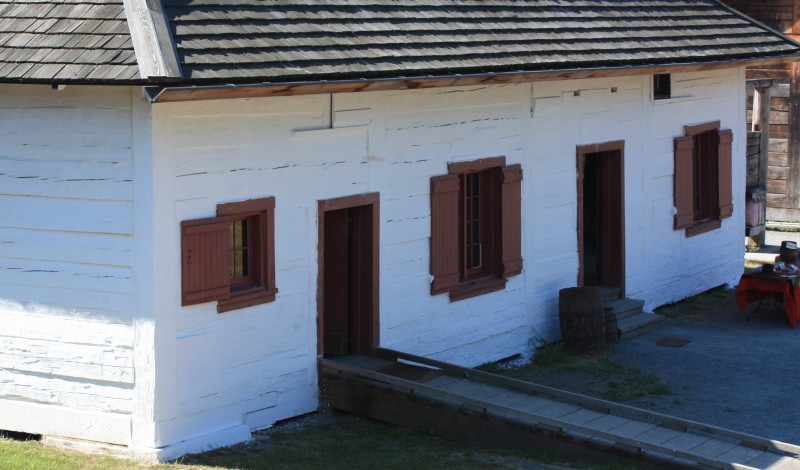
Fur trade warehouse at Fort Langley, the same as found in any fur trade fort
This is a continuation of George Traill Allan’s journey from Carlton House to Fort Garry, via Fort Pelly, in summer 1841. Six years earlier, in 1835, James Douglas had taken the same route through the prairies to Fort Garry. In 1825, Governor George Simpson travelled this route from Carlton House to Fort Garry, and bragged about it — and in 1841, Sir George Simpson would travel from Red River to Edmonton House and beyond by this same dangerous route. As you see by all these men’s comments, the route is considered dangerous and the HBC men were always careful to avoid the First Nations peoples in this region.
You can order my books, The HBC Brigades, and The York Factory Exxpress, through Amazon if you wish, at https://amazon.com/author/nancymargueriteanderson
Canadians can also order my books here: https://ronsdalepress.com/products/hbc-brigades-the
My new book, Working Title: Three Journeys North to the Arctic Sea, will be publshed in January 2027.
Please remember this, as you read this post, THE YEAR IS 1841.
So, in the first post in this short series, we left George Traill Allan at Fort Pelly, which is, seemingly, built on the first location of Carlton House, “on the upper waters of Assiniboine River…
near confluence of Whitesands River, west of the headwaters of Swan River. Built 1790 and was the first Hudson’s Bay Company fort on the Assiniboine. Known as Carlton House and sometimes Fort Assiniboine…. A North West Company fort called Marlboro House was in the immediate neighbourhood….The old fort had stood on lower land about 500 yards distant where a low sandy ridge rises 6 feet above the general level of the valley bottom. Fort Pelly was situated on rising sandy ground on the east side of the river. It was a large well-built fort protected by a high fence or wall of sawn planks. Over the heavy gate in front was a stout bastion from the top of which a magnificent view of the surrounding country was seen. It was a compact, well-ordered post, on route from Fort Garry to Fort Carlton on the [North] Saskatchewan. Sheltered on the north by woods, with the Assiniboine River in front, for many years after 1806, Fort Pelly was one of the main trading posts of the Hudson’s Bay Co. Boats from 3 to 4 tons burden annually descended the Swan River carrying furs to York Factory, the proximity of which enabled the Company to trade goods among the Indians a month earlier than the North West Co., whose goods were transported from Montreal to Fort William and thence distributed. A short portage led from Fort Pelly to the Swan River. This fort was operated by the Hudson’s Bay Co. for over 100 years, until about 1900.
So, in spite of Allan’s arrogance when he arrived at Fort Pelly, this was an important post for the HBC.
So, lets continue George Traill Allan’s story, as he prepares to leave Fort Pelly.
Wednesday 2nd [June 1841]. Bidding adeu to Mr. Peter Sinclair and his importance, we soon fell upon a narrow muddy River, in endeavouring to cross which some of our horses nearly stuck fast & what would have been a still greater misfortune, the Cassette containing the papers narrowly escaped getting wet.
Thursday 3rd. Starting this morning as early as usual we arrived upon a River — both deep and rapid, which gave us some trouble to cross. We soon, however, fell upon the plan of rafting the Provisions, &c, by means of the bed oil-cloths, which we converted into a Raft, drove in the Horses and swam after them.
4th, 5th, & 6th. Our route during these three days lay through a low, swampy country studded with woods and small lakes.
Monday 7th. We arrived this morning upon another very rapid River, over which we swam the Horses and crossed ourselves & luggage in a sort of wooden canoe lined with two of the oil-cloths. We had no sooner landed and had just begun upon the opposite bank to arrange every thing for a fresh start when one of us happening to look ahead discovered upon a rising ground descending towards us a band of eight Indians, tall fierce-looking fellows who we soon perceived to be armed from the glancing of the guns in the sun as they descended the hill. As our guns were all scattered about we immediately each secured his own & remained waiting the approach of the Indians, who we imagined might be Assiniboines, but fortunately they turned out to be Saulteaux, or it is not unlikely the recourse to our guns had not been in vain. I was not, I need not say, displeased to find they were Saulteaux as I felt very anxious respecting the fate of the dispatches, besides we did not feel particularly anxious to fight, they being more numerous than our party and, as Buttler has it “He that fights and runs away, lives to fight another day.”
So much for the Saulteaux and our encounter with them, who having received their pittance of Tobacco “took their road and so did we.” Towards evening we fell in with a Hut of Indians and procured a large supply of Eggs, viz: Goose, Duck, and Water Hen or Coot, which enabled us to make a comfortable supper.
You realize they didn’t fry or scramble those eggs, right? They were fertile eggs, and they cracked the egg and ate the chick and whatever else was inside. To continue:
Wednesday 9th. This morning having got underway very early we pushed the Horses to a trot, determined if possible to reach the settlement next day; we had now trotted on to about 9 o’clock a.m. where we began to think of breakfasting at a small River, now at no great distance, when we suddenly perceived a band of Horses and Cattle, and upon a nearer approach discovered people and a great number of Carts and other paraphernalia, evidently the accompaniment of a party about to start upon a very long journey, who we immediately supposed to be some of the Red River settlers bound upon a pilgrimage to that land of promise — the Columbia — and upon our coming up our conjectures proved to be correct.
This is James Sinclair and his Red River settlers, just beginning the journey from Red River to the mountains. Of course: it’s 1841. I had totally forgotten about them. George Traill Allan’s story of his journey to Red River continues:
Having received the news of Red River, we in our turn dealt out those of the Columbia to willing ears. The Doctor [William Fraser Tolmie] and myself were upon the point of setting down to breakfast when an invitation arrived from one of the principal settlers for us to partake with him of that meal, and certainly nothing could have happened more apropos, as though our waiting-man had possessed in perfection all the attributes of the never to be forgotten Caleb Balderstone, he could not have garnished our table with more than Pemican, of which we had now become thoroughly tired. On proceeding to the Tent of Mr. Alex McKay, for to him we stood indebted for the invitation to dejeuner, we found that his wife, a nice tidy little woman, had laid out the table in great style, consisting of Bread and Butter, Buffalo tongues and Roast Veal flanked by a fine Pork Ham of stately dimensions. I need scarcely remark that we did ample justice to Mr. McKay’s hospitable board, which seemed like a table spread in the wilderness for us. Breakfast being dispatched, we bade adieu to our kind entertainers, wishing the a pleasant trip to the Columbia, and continued our route over beautiful and extensive plains.
Thursday 10th. I have hitherto refrained from stating the annoyance which we daily received from those mischievous dabblers in human blood, the Moschetto [mosquito] & the Bull Dog or Gad-Fly, as it is a plague to which travellers in this country are always more or less subject; today, however, we felt rather indebted to than annoyed by that respectable insect, the Gad-fly, as when our Horses began to flag he invariably attacked them and spurred them on, or I question much whether or not we would have reached the Fort in the time we had anticipated. Soon after breakfast we reached the first house in the Settlement belonging to Mr. Balcour [Father Georges Antoine Belcourt], a Catholic priest, who received us with great kindness, to whom I stated the miserably fatigued state of our horses, and as we were still about thirty miles from the Fort solicited his assistance in providing us fresh ones, and we did not solicit in vain — his reverence soon procured us what we required and it was high time, as upon coming out of the house we found our own poor Horses lying down, saddles and all, just as we had dismounted. We again resumed our journey with many thanks to the Revd. Mr. Belcourt and in about an hour and a half reached the hospitable mansion of Mr. Cuthbert Grant, who would not let us depart without dinner — at which we had an opportunity of proving the quality of the Red River beef in the shape of an excellent steak. Having dined we proposed starting for the Fort when Mr. Grant kindly tendered me the loan of his Gig by way of change, and his fine American horse to drive to the Fort; of course this was too agreeable a proffer to be rejected, we having by this time (our sixteenth day on horseback) had quantum sufficit of that sort of exercise; and having, as we thought, during that time proved our equestrianship beyond a doubt, had no wish whatever to show off before the good lieges of Red River. The Doctor and I had no sooner taken our places in the Gig and I had taken possession of the reins & Whip, and which I am sure no John in the Strand could have done more knowingly, we set out and having got safely round the angle of a fence (against which by the bye, in spite of my dexterity in managing the reins, we had nearly run foul) we found ourselves in the high road to Fort Garry. Mr. Grant’s American [horse] is of first rate metal, a single shake of the reins being sufficient to put him to a hard trot, at which rate we continued until we reached our destination. During the drive we passed through beautiful green plains, alive with herds of Cattle, Horses and Sheep, and, upon each side of the road, neat whitewashed cottages, with gardens and fences, laid out with great taste. Upon our arrival at Fort Garry we were kindly received by Chief Factor [Duncan] Finlayson (the same gentleman whom I accompanied formerly to the Columbia) and the rest of the gentlemen. By Mr. Finlayson we were introduced to Sir George Simpson, Governor in chief, who had arrived from England on that morning, & Sir George introduced us to Lords Mullgrave and Caledon and a Russian gentleman who had accompanied His Excellency to Red River — their Lordships in order to enjoy a Buffalo Hunt and the Russian to accompany Sir George to the Columbia, and from thence to Russia. Having delivered the dispatches to the Governor we retired to have a view of the Fort, which was found to be extremely neat in all its arrangements, the Houses and Stores laid out with great regularity, the whole surrounded by a well built Stone Wall ten or twelve feet in height, & a Bastion of stone at each angle; in fact from whatever side the approach is made the effect is striking and leads one to believe that there will be comfort within the walls, which a day’s trial at Mr. Finlayson’s table will not fail to realize even to a more fastidious appetite than mine. On Sunday, I accompanied the other gentlemen to church where we had a good Sermon from the Reverend Mr. Cockrane, whose congregation looked very respectable.
So George Traill Allan arrived at Fort Garry later in the same day that Governor Simpson, now Sir George Simpson, had arrived. Travelling with Allan in this group of riders was Dr. William Fraser Tolmie, who was returning to England to take more medical training. He would rejoin the Company and return to the Columbia a few years later. The two Lords are, of course, the Earl of Caledon, and the Earl of Mulgrave — two young adventurers who came west with Governor Simpson to hunt the Bison. The above-mentioned Russian was a Russian American Company employee named Nicolas von Freymann, who Simpson had agreed to deliver to Sitka, in the Russian-owned section of the northwest coast. John Rowand of Edmonton House was also at Fort Garry: you will remember that when George Traill Allan reached Fort Pelly, he received a note left by John Rowand, who was travelling over the trail a few days before Allan did. Now we know for sure that Rowand came overland to Fort Garry from Edmonton House to meet his son, who was returning from his training as a doctor in England.
So we know what Sir George Simpson did: he left Fort Garry and travelled across the plains to Edmonton House and then on to the Columbia district. That story begins here: https://nancymargueriteanderson.com/rough-notes/
What did George Traill Allan do? On June 24 he set out for Norway House and York Factory.
In company with Mr. Chief Trader [George] Gladman & Dr. Tolmie I started in a bark Canoe for York Factory, a voyage of ten days during which, when not wind bound in Lake Winnipeg, we travelled at the rate of seventeen hours per day — and on one occasion we started at half past 7 pm the following evening. I mention this to give some idea of light Canoe travelling, which of all kinds, is by far the most severe upon the men. On the 30th [June] we reached Norway House, the place where I had passed my first winter in the Indian Country: and here I found Mrs. Ross, who looks upon me as one of the family. On the same evening Mr. [Donald] Ross arrived from Red River, accompanied by the Rev. Mr. Evans and his daughter. I soon discovered that an absence of ten years had made great changes at my old quarters; instead of living all the year round upon white fish, as in days of old, Mr. Ross produced a dinner, a better than which I have seldom seen beyond the Rocky Mountains….
July 4th. We arrived at York Factory where I had the pleasure of drinking tea with Mrs. [James] Hargrave, a Lady just come out from Scotland last year; and when seated at table could not help thinking myself once more across the Atlantic, enjoying that beverage with some of my own dear friends.
Wednesday 14th July. Having arranged and brought all the accounts connected with the Columbia to a close, I embarked with Chief Traders Messrs [John Edward] Harriott & [Donald] Manson, & a young gentleman, a Mr. Pelly, Clerk, upon my return to the Columbia.
And now we also know that Donald Manson, who traveled to Montreal from London with Sir George Simpson, did NOT travel west with Simpson and his party to Red River. From Montreal, he took the Brigade canoes to Norway House and York Factory, and then returned to the Columbia with the incoming York Factory Express. And the young Mr. Pelly? I don’t know which one he was, but he might not have gone all the way to the Columbia district.
So there has been a ittle surprise for all of us in this post. I am quite amused by the discovery of this journal fitting in so well with Sir George Simpson’s journal. In a way, its a good thing that I did not remember to finish this thread when I wrote the first post, as I would certainly have forgotten about George Traill Allan having met James Sinclair, and then Sir George Simpson, at Red River!
To return to the beginning of this very short series, go here: https://nancymargueriteanderson.com/carlton-to-fort-pelly/
Copyright, Nancy Marguerite Anderson, 2025. All rights reserved.